The @ adventure

@ fatigue yet? Never!

MoMA has collected the @ sign, as you have probably heard by now. We consider the “acquisition” of @, an exquisite symbol of communication between people and machines, not only a celebratory step towards the Talk to Me show but also an important step towards setting all curators free to roam about and tag away, bringing the world into their collections and their collections into the world, no matter the physical constraints. I was however taken aback–pleasantly–by the public’s reaction to the announcement. Not all feedback was good, mind you. Lots of snarky comments and funny parodies but it struck a nerve! and that is much more than we could hope for. One more hit towards a wider, deeper understanding of design.

On March 22, early in the morning, I posted a piece on the main MoMA blog to spread the news. No press release, we decided to test the strength of the blog and draw traffic to it. I then sent 43 emails to nodal friends and colleagues and boarded a 5-hour flight. Upon landing, all heaven and hell broke loose. For a few days, a whirlwind of interviews, posts, and articles. Not to mention a flurry of comments to the blog post, to the point that we had to follow up with a second to explain criteria for inclusion in the collection.

Here is a selection of the most interesting/gratifying/hurtful/funny articles:

The International Herald Tribune
The Independent
PC Magazine
Hyperallergic
The Daily Heller
Fast Company
NPR
Digital Artist

Posted in Updates | Tagged | Comments closed

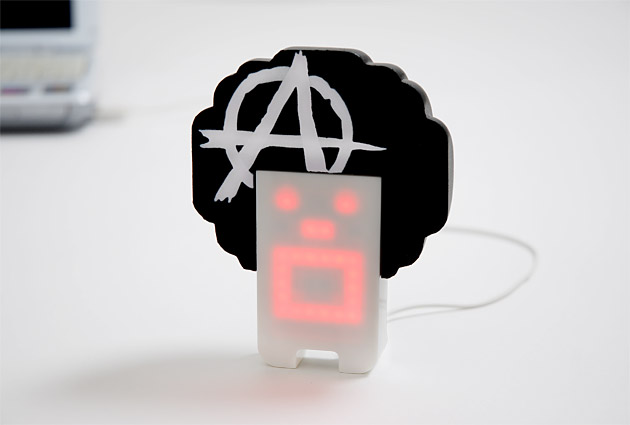
Tengu

Tengu © Crispin Jones

Expressive and reactive, designer Crispin Jones’s Tengu is a desktop companion that reacts to sounds from your computer. The face, with eyes, a nose and a mouth, begins to sing, contort and respond to noise.  The simple yet effective interface of Tengu is a platform for the user’s imagination. The Tengu jumped to immediate popularity when launched in 2009. Users responded by treating it as an interactive “Mr. Potato Head”, attaching elaborate costumes to the interface.
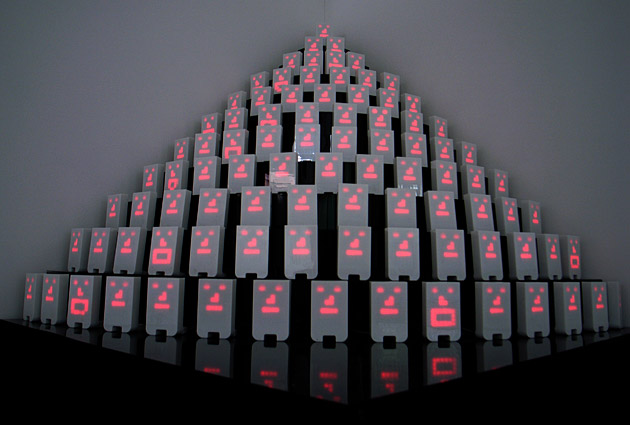
Tengu Choir © Crispin Jones

We love the Tengu’s flexibility and open “face”, which sparks the user’s creativity. The object launched a series of animations ranging from stylized, experimental to the absurd, where users have envisioned their own Tengu worlds with the simplest of movie-making techniques.  Here is one such video here:

http://www.youtube.com/watch?v=TSm2hRqu9ok&feature=related[/youtube]

http://www.youtube.com/watch?v=TSm2hRqu9ok&feature=related[/youtube]
Posted in Checked | Tagged | Comments closed

Phones that Grow, Gain Weight and Breathe

We were intrigued by these devices that are in development—they were sent to us by Bastian Koch. They are prototypes for mobile phones that were developed by Fabian Hemmert at TU Berlin that are designed to give us the feedback we would expect in the real world from a physical object.  For example, the shape-shifting phone moves depending upon the information that it contains. If you download Moby Dick for reading on your phone, it would actually expand and become larger—telling you that your phone now holds more information.  Another example he has developed is the weight-shifting phone.  If you’re looking at a map, the weight will shift inside the phone, guiding you to the left or the right—so you don’t have to be looking at your phone to know where to go.  Finally he also developed a “living” phone that would have a heart beat and breathe, and as it is stimulated by missed calls or unread emails, it gets agitated and demands attention.  I thought that these projects are relevant to the thesis of Talk to Me, since they are using intuitive human senses to transmit information.  Check out Fabian Hemmert’s TED talk:

http://www.youtube.com/watch?v=QCmsvXgxdDY&feature=player_embedded[/youtube]

Posted in Checked | Tagged , | Comments closed

Siftables

David Merrill and Jeevan Kalanithi have capitalized on the dexterity of the human hand through interactive siftables–new ways to effortlessly sift and sort.

Siftables are independent, compact devices with sensing, graphical display, and wireless communication capabilities. They can be physically manipulated as a group to interact with digital information and media. With this flexible technology, one day Siftables could be used to implement any number of gestural interaction languages and human-computer interaction applications.

We like this project as it touches upon higher level goals, rather than just the objects themselves.   Siftables has the potential to go well beyond their immediate use or appearance. They are not only talking to us, but also initiating our imaginations.

Posted in Checked | Tagged | Comments closed

South by Southwest Digest

It’s been about a week now since I’ve been back from SxSW interactive, and I’ve been constantly thinking about what I saw, who I met and what I learned—so much of it pertains to Talk to Me and what the show is about it is all-consuming project to track down all the leads. I thought, since due to my techie-novice status, I was nowhere near the ability to blog live from the conference, I would “slow journal” once I was back—which means I am transcribing my low-tech pen and paper notes from selected panels I attended, editing them as I go, and annotating what I liked for Talk to Me.  I will separate them out by title of the panel, so you know which ones I attended (you can also see my schedule here—and since SxSW was so big and there were many interesting things going on at once, I’m hoping that they will soon post the panels I missed via podcast and you tube—and I will link to them.

Day One: History of the Button

I chose to attend this panel because I recognized the presenter’s name, Bill DeRouchey, from the Interaction Design Conference (IxDA) that Paola attended in February.  He had given us some great info while we were researching the acquisition of the @ sign and  since it was based in history, I thought it would be a good first panel to attend, to ease my way into the contemporary (or even future) design world that is SxSW. He has generously shred his slideshow with us hereRead More »

Posted in Events | Tagged , , , | Comments closed