Not on view
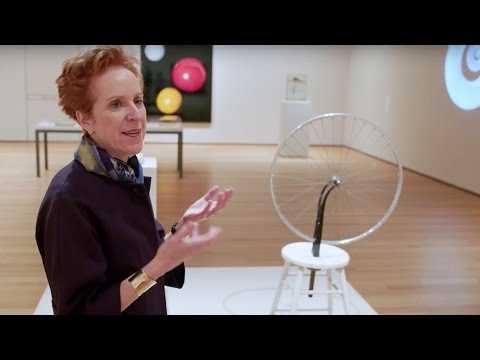
Duchamp produced the original version of Bicycle Wheel in Paris in 1913, two years before he first employed the term “readymade” for works that were selected, rather than crafted, by the artist. He described Bicycle Wheel simply as something he enjoyed having in the studio: “I liked it, like when one has a fire in the fireplace, something moving while you stare.” The original did not survive; Duchamp produced this replica at the request of Sidney Janis, who included it in an exhibition at his gallery in New York in 1951. Janis’s son, Carroll, recollected that the wheel for the replica was sent from Europe, and the kitchen stool was bought by his father in Brooklyn.
Marcel Duchamp, April 12–August 22, 2026
Publication excerpt from MoMA Highlights: 375 Works from The Museum of Modern Art, New York (New York: The Museum of Modern Art, 2019)
Though Bicycle Wheel predates Marcel Duchamp’s use of the word “readymade”—a term he coined after moving from Paris to New York in 1915—it is the earliest example of this class of groundbreaking artworks. Like most of Duchamp’s existing readymades, MoMA’s Bicycle Wheel is a later version of an earlier creation, made for a 1951 exhibition at the Sidney Janis Gallery in New York. As was his penchant at that point in his career, Duchamp found others to do much of the work for him: Sidney Janis, the gallery’s owner, selected the bicycle wheel while in Paris and found the stool in Brooklyn, and Duchamp put the two together. What mattered to Duchamp was the transmission of a readymade’s concept, not its exact physical appearance.
Bicycle Wheel distinguishes itself from all of the artist’s subsequent readymades by virtue of its central object’s implicit movement, a quality Duchamp appreciated for its calming effects. “To see that wheel turning,” he once remarked, “was very soothing, very comforting, a sort of opening of avenues on other things than material life of every day. I liked the idea of having a bicycle wheel in my studio. I enjoyed looking at it, just as I enjoyed looking at the flames dancing in a fireplace. It was like having a fireplace in my studio.”
MoMA Highlights: 375 Works from The Museum of Modern Art, New York (New York: The Museum of Modern Art, 2019)
Explore more
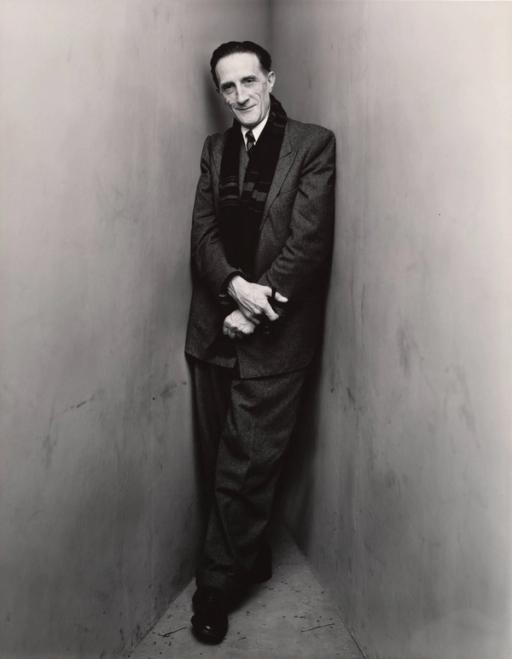
Marcel Duchamp
American, born France. 1887–1968 192 works onlineWhen Marcel Duchamp created his most famous work—the industrially produced urinal Fountain —it was largely ignored. Fountain was the high point of Duchamp’s campaign to dismantle and expand the boundaries of what constitutes a work of art; it had begun four years earlier, when he asked, “Can one make works that are not ‘of art’?
Learn more →

Avant-garde
French for “advanced guard,” originally used to denote the vanguard of an army and first applied to art in France in the early 19th century.
Learn more →

Dada
An artistic and literary movement formed in response to the disasters of World War I (1914–18) and to an emerging modern media and machine culture.
Learn more →
Found object
An object—often utilitarian, manufactured, or naturally occurring—that was not originally designed for an artistic purpose, but has been repurposed in an artistic context.
Learn more →
Mass production
The production of large amounts of standardized products through the use of machine-assembly production methods and equipment.
Learn more →


Modern art
Art made from the 1880s to the 1970s—a time marked by the growth of cities, the rise of industry, a surge in technologies, and the development of mass media.
Learn more →

Readymade
A term coined by Marcel Duchamp in 1916 to describe prefabricated, often mass-produced objects isolated from their intended use and elevated to the status of art by the artist choosing and designating them as such.
Learn more →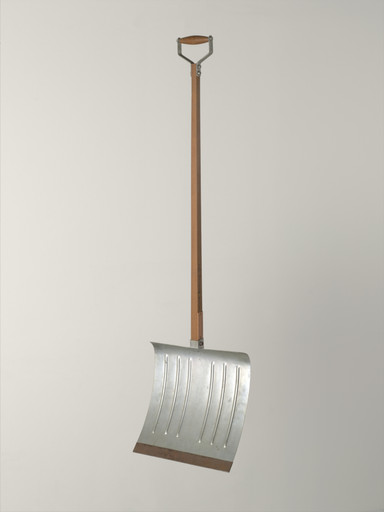

Audio
Audio from the playlist Collection 1880s–1940s
Audio from the playlist Kids
Audio from the playlist Verbal Descriptions
Articles and videos
From MoMA Design Store


Installation views
We have identified this work in the following photos from our exhibition history.
Licensing
Artwork or archival images
If you would like to reproduce an image of a work of art in MoMA's collection, or an image of a MoMA publication or archival material (including installation views, checklists, and press releases), please contact Art Resource (publication in North America) or Scala Archives (publication in all other geographic locations).
Audio and film clips
MoMA licenses archival audio and select out of copyright film clips from our film collection. At this time, MoMA produced video cannot be licensed by MoMA/Scala. All requests to license archival audio or out of copyright film clips should be addressed to Scala Archives at [email protected]. Motion picture film stills cannot be licensed by MoMA/Scala. For access to motion picture film stills for research purposes, please contact the Film Study Center at [email protected]. For more information about film loans and our Circulating Film and Video Library, please visit Circulating Film and Video Library.
Text from a publication or the archives
If you would like to reproduce text from a MoMA publication, please email [email protected]. If you would like to publish text from MoMA's archival materials, please fill out this permission form and send to [email protected].
Feedback
This record is a work in progress. If you have additional information or spotted an error, please fill out this feedback form.