


GERMAN EXPRESSIONISM MAPS
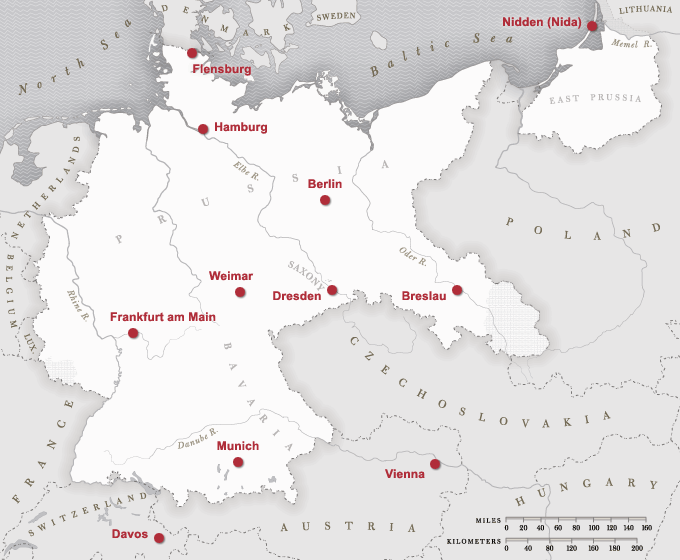
German Empire
Weimar Republic
Weimar Republic
1919–1933
Established following the defeat of the German Empire in World War I.
Several territories were ceded to neighboring countries.
Berlin
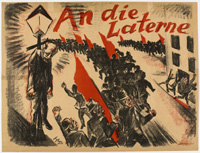
Max Pechstein
1919
Advertising a short-lived journal published by the socialist government, this poster warns of the mayhem that would sweep over Germany if the Communists were victorious.
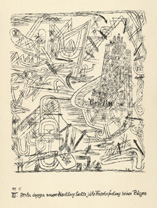
Paul Klee
1919
In his illustrations for Curt Corrinth's novella, which imagines a utopian transformation of Berlin, Klee presents the city as a towering, fantastic, and disorienting place.
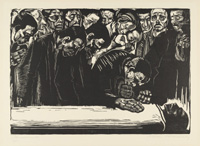
Käthe Kollwitz
(1920)
Kollwitz depicts workers mourning Karl Liebknecht, the socialist leader who was brutally murdered by reactionary soldiers in Berlin in January 1919. She based this woodcut on sketches she made of Liebknecht's corpse in the mortuary.
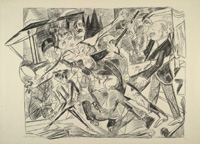
Max Beckmann
(1919)
In contrast to Kollwitz, Beckmann depicts political murder in action, here showing Liebknecht's comrade-in-arms Rosa Luxemburg being carried to her death.
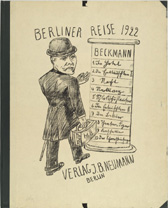
Max Beckmann
1922
Beckmann depicts himself as a traveler arriving in Berlin, looking to an advertising column for guidance to the city's amusements, which he experiences as a detached observer rather than an active participant.
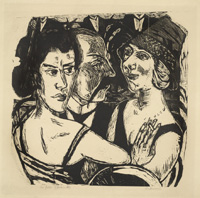
Max Beckmann
(1923)
In this portrait of Berlin society at the Eden Bar, Beckmann captures the alienation and boredom that permeated even the city's elegant locales.
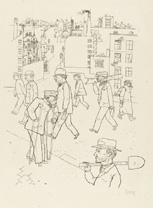
George Grosz
(1920/21, published 1921)
By contrast, Grosz shows the lives of those who go without: the laborers and veterans who filled the streets of the working-class neighborhoods.
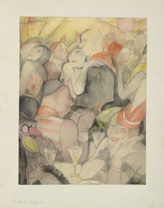
Jeanne Mammen
(c. 1930)
Mammen depicted the lives of Berlin's modern young working women. Here, she shows costumed figures enjoying the momentary pleasures of a nightclub.
- Alfred Flechtheim
- Altershilfe des Deutschen Volkes
- Euphorion
- Fritz Gurlitt
- Internationale Arbeiterhilfe
- J.B. Neumann
- Karl Nierendorf
- Malik-Verlag
- Paul Cassirer
- Propyläen-Verlag
- Verlag Der Sturm
- Verlag des graphischen Werkes von Käthe Kollwitz (Alexander von der Becke)
- Werbedienst der deutschen Republik
Breslau
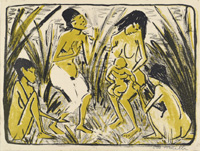
Otto Mueller
(c. 1920)
After taking a professorship in Breslau in 1919, Mueller continued to explore his favorite theme: nudes set in nature. His lithographs were printed in the Breslau academy's workshops.
Dresden
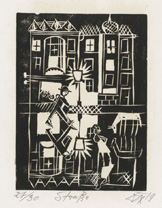
Otto Dix
1919 (published 1922)
After World War I, Dix returned to Dresden to resume his studies. This woodcut, one of his earliest prints, captures the ceaseless energy and clatter of the city street.
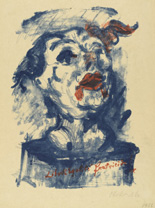
Oskar Kokoschka
(1918, published 1919)
On this print, created in the wake of Germany's November Revolution, Kokoschka parodies the slogan of the French Revolution, changing "Liberty, Equality, Fraternity" to "Liberty, Equality, Fratricide." He executed it in Dresden, his home from 1917 to 1923.
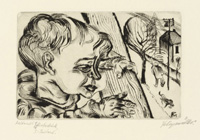
Conrad Felixmüller
(1921)
Felixmüller was born in Dresden, where he lived until 1934. Here he presents a lovely depiction of his son Titus, who watches the quiet suburban street from the balcony.
Frankfurt
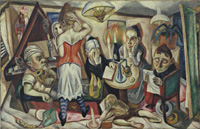
Max Beckmann
Frankfurt 1920
After World War I, Beckmann remained in Frankfurt while his family lived in Berlin. Here, he created an imaginary scene featuring people who remain bored and lonely despite their physical proximity.
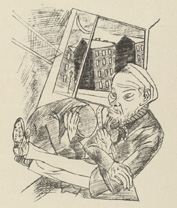
Max Beckmann
1921
In this book, Beckmann illustrated six poems chronicling the author's nightly peregrinations through Frankfurt. Here, two workers spend a cold, uncomfortable night in cramped quarters.
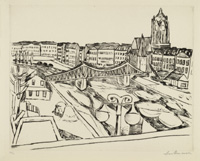
Max Beckmann
(1923, published 1924)
This view of a footbridge—the Eiserner Steg—is typical of Beckmann's many images of Frankfurt as a quiet, peaceful city, in contrast to the tumultuous energy of the Berlin metropolis.
Nidden
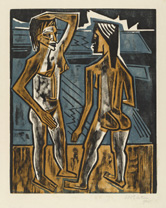
Max Pechstein
1920
Pechstein returned to his favored prewar haunt, Nidden, in 1919 and found it unchanged by the intervening upheavals. Dialogue blends the rough, raw landscape with nudes inspired by African and Oceanic art.
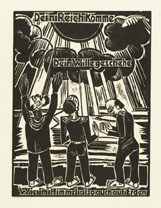
Max Pechstein
1921
Pechstein set his illustrations of the Lord's Prayer in Nidden and populated them with the remote town's rustic fishermen. He made these prints after his fifth summer there in 1920.
Davos
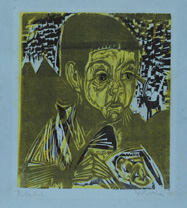
Ernst Ludwig Kirchner
(1919)
Kirchner emphasized the rustic and rough-hewn qualities of Alpine life in this woodcut of the son of a local peasant in Frauenkirch, the district in Davos where Kirchner settled after World War I.
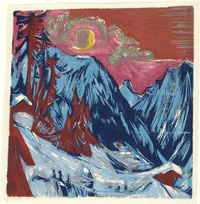
Ernst Ludwig Kirchner
(1919)
Kirchner extolled the grandeur of his new home in the Alps, where "the moon set spectacularly, the mountains all blue, the sky reddish violet with little pink clouds, and the crescent moon yellow. It was simply, fantastically beautiful, but terribly cold."
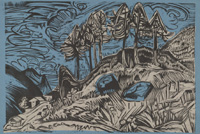
Ernst Ludwig Kirchner
(1920)
Still psychologically and physically fragile from his wartime experiences, Kirchner found solace and revelation in the natural beauty around Davos.
Vienna
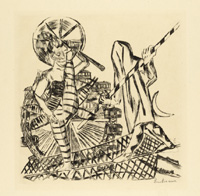
Max Beckmann
(1921, published 1922)
Vienna's famous Ferris wheel at the Prater amusement park is visible behind the tightrope walkers. Beckmann was in Austria, visiting his wife, Minna, in Graz, when he made this print.
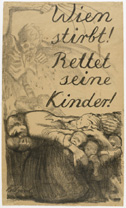
Käthe Kollwitz
1920
After the war, Vienna suffered severe food shortages. Kollwitz made this poster to support humanitarian relief efforts.
Weimar
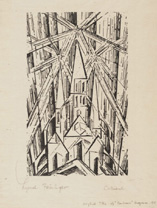
Lyonel Feininger
1919
Feininger's soaring Gothic cathedral served as a symbol for the strivings of the Bauhaus, founded in Weimar in 1919. The woodcut appeared on the cover of Walter Gropius's manifesto outlining the school's aim of revolutionizing modern art.
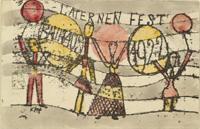
Paul Klee
1922
Klee made this fanciful postcard for the annual lantern party at the Bauhaus in 1922. He had moved to Weimar and joined the school's faculty one year earlier.
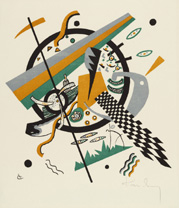
Vasily Kandinsky
(1922)
Kandinsky also taught at the Bauhaus. While there, he made the portfolio Small Worlds, in which he explored the expressive qualities of different printmaking techniques.
Munich
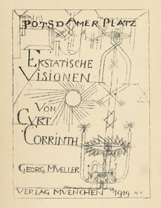
Paul Klee
1919
Klee was living in Munich when he received the commission to illustrate Curt Corrinth's novel about Berlin. At the time, Klee was contemplating a move to the capital, where his pictures sold better than in Munich.
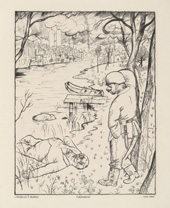
George Grosz
(1919, published 1920)
The dead body of a worker washing ashore on Munich's Isar River does not disturb this soldier's cigarette break. The title plays on the role of the German soldier: to serve, not to think.
Hamburg
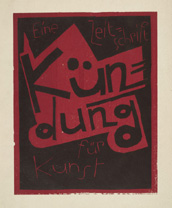
Karl Schmidt-Rottluff
1921 (executed 1920)
This periodical, with its innovative use of typography and mix of art, literature, and poetry, was published in Hamburg and represented the city's most important contribution to Expressionism after World War I.
Flensburg
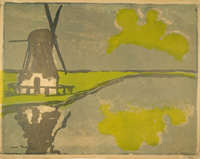
Emil Nolde
(1926)
At the Westphalen lithography workshop in Flensburg, Nolde printed six variants of Mill by the Water, showing the marshy landscape around his homeland, where Danish drainage projects threatened the traditional way of life.
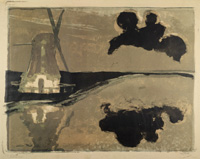
Emil Nolde
(1926)
This variant, printed in dusky grays with an ominous black cloud, evokes a cold, silvery moonlit night.
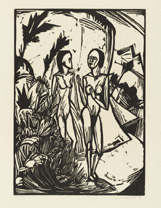
Erich Heckel
1919 (published 1921)
After World War I, Heckel addressed the theme of the nude in nature as a regenerative force. Here, he depicts two figures on the elemental and dynamic coast around Flensburg.
If you are interested in reproducing images from The Museum of Modern Art web site, please visit the Image Permissions page (www.moma.org/permissions). For additional information about using content from MoMA.org, please visit About this Site (www.moma.org/site).
© Copyright 2016 The Museum of Modern Art
Welcome to MoMA.org. To take full advantage of all the site’s features, including the option to save works in the collection, please upgrade your browser to Firefox, Google Chrome, Safari, or Internet Explorer 9.
To take full advantage of all of the features on MoMA.org, please upgrade your browser to Firefox, Google Chrome, Safari, or Internet Explorer 9.