
In previous posts we’ve showcased exhibition and wayfinding graphic developments and looked at interesting ephemera created by the Graphic Design department throughout MoMA’s past. This post is about a much more humble, but extremely important, type of design: the warning sign. These signs are created for a wide range of purposes—to prevent overcrowding in the galleries, to prevent damage to the artwork or Museum spaces, to alert people about potentially controversial artworks in the galleries, etc.—and they represent a collaboration between Graphic Design and the Curatorial, Legal, Visitor Services, and/or Education departments. Some signs, such as room-capacity notices, are required by law; others, such as the “warning” notices at the entrance to the Marina Abramović exhibition, are more of a courtesy. They all have one thing in common: they’re designed to make sure each guest has a safe and fun time at MoMA. The slide show above includes just a few of the signs we’ve made over the years. Enjoy… at your own risk!
Posts in ‘Behind the Scenes’
Protect Me from What I Want
In previous posts we’ve showcased exhibition and wayfinding graphic developments and looked at interesting ephemera created by the Graphic Design department throughout MoMA’s past. This post is about a much more humble, but extremely important, type of design: the warning sign. These signs are created for a wide range of purposes—to prevent overcrowding in the galleries, to prevent damage to the artwork or Museum spaces, to alert people about potentially controversial artworks in the galleries, etc.—and they represent a collaboration between Graphic Design and the Curatorial, Legal, Visitor Services, and/or Education departments. Some signs, such as room-capacity notices, are required by law; others, such as the “warning” notices at the entrance to the Marina Abramović exhibition, are more of a courtesy. They all have one thing in common: they’re designed to make sure each guest has a safe and fun time at MoMA. The slide show above includes just a few of the signs we’ve made over the years. Enjoy… at your own risk!
MoMA Offsite: European Stay-cation?
Much of the dust—er, ash—has settled in Europe, and those marooned there by Iceland’s Eyjafjallajökull volcano are trickling back home. Nonetheless, when airspace was finally cleared mid–last week, there were reports of half-empty planes returning from some of the most afflicted cities, such as Zurich and London. I know a handful of people whose airlines will not honor tickets at their original prices until April 29 or later, so perhaps this in part explains the sparsely populated jets. But one must also consider the Europeans who may have canceled trips and vacations to the States completely. How many of those people will therefore miss a planned trip to MoMA, I wonder?!? It is with this concern in mind that I drafted this MoMA Offsite entry. Perhaps it’s too rash to predict for Europe the trend of the “stay-cation” (which swept our nation last year due to factors altogether different, of course), but nonetheless I’d like our members, friends, and supporters there to know that many MoMA works are on view in Europe at this time.
Art/Work: MoMA’s Creative Minds: Claire Corey

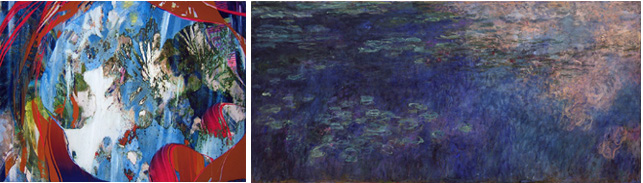
Left: Claire Ellen Corey. Cove. 2009. Archival inkjet on canvas. © Claire Ellen Corey. Right: Claude Monet. Water Lilies. 1914-26. Oil on canvas, three panels, each 6′ 6 3/4″ x 13′ 11 1/4″ (200 x 424.8 cm), overall 6′ 6 3/4″ x 41′ 10 3/8″ (200 x 1276 cm). The Museum of Modern Art. Mrs. Simon Guggenheim Fund
Many of MoMA’s employees aren’t just guardians of the Museum’s collection: they are artists in their own right, and have found inspiration for their own work through their engagement with artwork shown at MoMA. Our jobs do sometimes force us to hurry by breathtaking works, with no time to let their power wash over us. But at other moments—whether retouching a paint job, placing a wall label, or installing a work of art—we find ourselves alone, in empty galleries, confronted with some of the greatest works of art made in the last century. This new series of blog posts will focus on a few of MoMA’s many employee/artists, and will address the ways in which they have incorporated their daily work experiences into their own artistic processes.
As Production Manager in the Museum’s department of graphic design, Claire Ellen Corey produces various components of many of MoMA’s exhibitions, installations, and marketing campaigns. Outside of her duties at MoMA, she’s also a painter, a practice that has been informed time and again by all she has learned within the Museum. In fact, Corey combines techniques of painting and the tools of graphic design to create her multilayered paintings, ultimately producing her final image on an ink-jet printer.
Burton Farewell: Installing the Exhibition
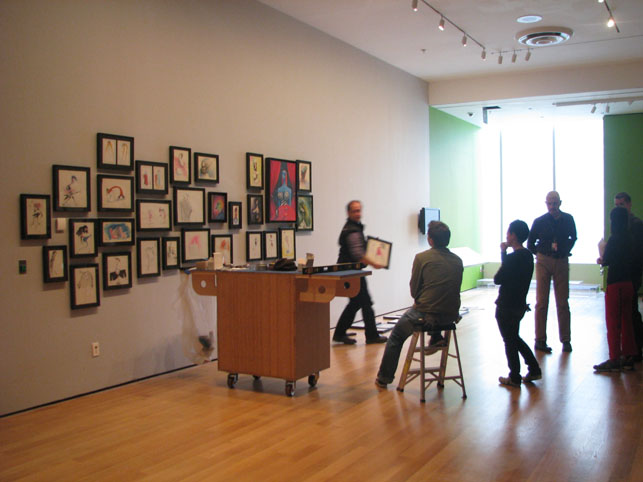
The installation of the Tim Burton show took thirteen days, beginning on October 28, 2009, and ending (save some inevitable last-minute tweaking) on Friday, November 13. As the first institution given the opportunity to exhibit Burton’s unseen work, the urge to present a comprehensive selection was hard to resist. With 716 pieces of framed art, objects, and media to put in place, the pressure was on—especially since we knew that a series of special openings had been scheduled before the general public arrived: Tim’s private opening on November 16 for his friends and collaborators, a Department of Film benefit honoring Tim on November 17, and the opening reception on November 18. The realization that we would soon be hosting Johnny Depp, Danny Elfman, Helena Bonham Carter, Catherine O’Hara, Bo Welch, Glenn Shadix, Diane Wiest, Colleen Atwood, Danny DeVito, Jeffrey Jones, Crispin Glover, and others—not to mention Tim himself—added to the sense of excitement shared by everyone on the MoMA installation team.
Getting Green: MoMA QNS’s Solar-Paneled Roof
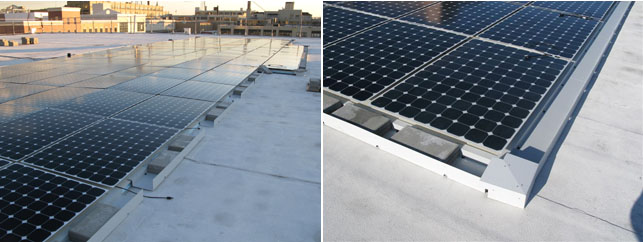
Today is the fortieth annual Earth Day, and MoMA is committed to its green efforts. In December MoMA’s Operations Team completed the installation of solar panels on the roof at MoMA QNS, the permanent home for storage of MoMA’s collection and a facility for conservation, study, and research. The project included the installation of 161 solar panels tied to the main Con Edison electrical feed to the building, which is located in the building’s basement. The panels are photovoltaic, meaning that they convert the energy of the sun into electricity. The solar roof at MoMA QNS will generate solar energy for the facility, which will further decrease the Museum’s carbon footprint and subsequently lower energy costs—as such, it represents a major step in making MoMA a more environmentally responsible institution.
MoMA Offsite: Where Did It Go?
In this column I have often discussed the efforts made by the Department of Painting and Sculpture to circulate works in our collection galleries as frequently as we can manage, thereby showing the broadest possible range of our extensive holdings. All of our works are historically significant in their own way; still, we do recognize that there are dedicated audiences for certain landmark acquisitions made by the Museum, and so there are a few works that remain on view indefinitely. Les Demoiselles D’Avignon (1907) by Pablo Picasso, The Starry Night (1889) by Vincent van Gogh, and Salvador Dalí’s The Persistence of Memory (1931) certainly all fall into this category.
The Ad Reinhardt You Never Knew

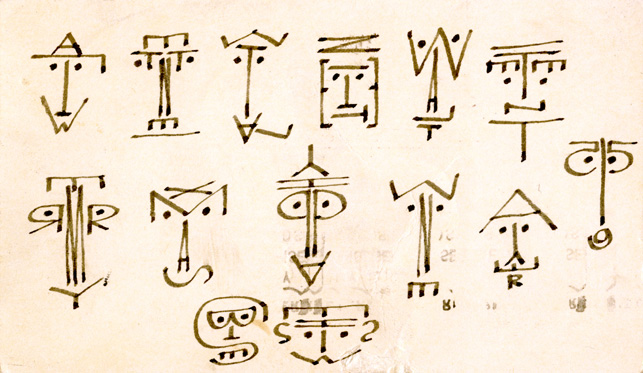
Ad Reinhardt. Walt Nettie Walt Nettie Walt Nettie Merry Xmas Happy New Year 55! Best Wishes. Postcard, 1954. Courtesy Anna Reinhardt.
At the MoMA Library we recently unearthed an intriguing box of ephemera by artist Ad Reinhardt (1913-1967). The material was gifted to the Library by Walter and Nettie Wittman, who were friends of the artist. The letters, photographs, tear sheets, and some original commercial illustrations form a vignette of the artist’s professional and personal life, glimpsed from the perspective of Mr. Wittman, a lawyer residing in New Jersey.
Reinhardt and Walter Wittman met as students at Columbia University. We get a taste of their initial friendship with a 1931 notebook page documenting Reinhardt’s translation efforts in freshman German class (“In paradise what have I to do win?”)
MoMA Offsite: From Matisse to Matisse

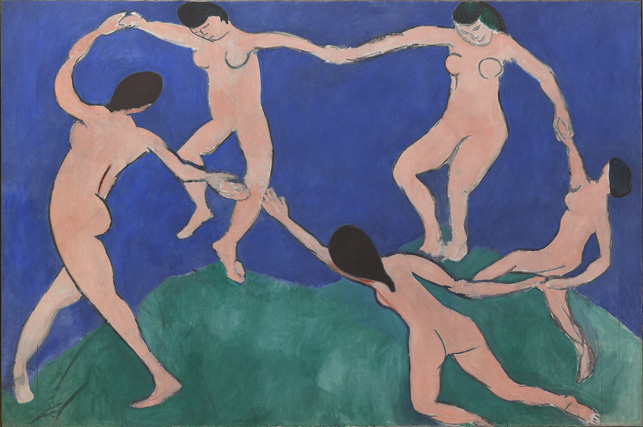
Henri Matisse. Dance (I). 1909. Oil on canvas, 8' 6 1/2" x 12' 9 1/2" (259.7 x 390.1 cm). Gift of Nelson A. Rockefeller in honor of Alfred H. Barr, Jr. The Museum of Modern Art, New York
I distinctly remember my first visit to the new MoMA building. I was nineteen and had just celebrated my first New York City anniversary (so I am of the generation that cannot clearly recall MoMA in its pre-2004 guise). Of the many snapshots in my mind from that day, none is as vivid as the vision of Henri Matisse’s 1909 painting Dance (I). As some may remember, it was hanging in an interior stairwell that joined the fourth- and fifth-floor galleries. In addition to being viewable from those stairs, it could also be glimpsed through a window that opened up to the Marron Atrium below, and that is how I first saw it. As I rounded a corner and entered the space, cosmic in size, I raised my head and the familiar piece of history slowly unfurled above me, and I let a smile unfurl with it.
Finding Burton

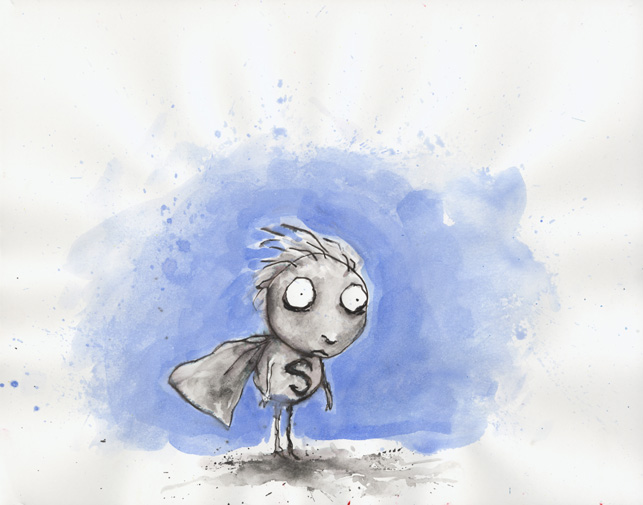
Tim Burton. Untitled (The Melancholy Death of Oyster Boy and Other Stories). 1998. Pen and ink and watercolor on paper, overall: 11 x 14" (27.9 x 35.6 cm). Private collection. © 2009 Tim Burton
We found Tim Burton in London. Just as was the case with the Museum’s Pixar exhibition in 2005, we discovered that he, too, held a body of work that had never before been seen by the public. In Tim’s case, there was childhood ephemera, high school papers, cartoons, early 8mm and 16mm amateur films, sketchbooks, drawings, verse, art for a number of unrealized film and book projects, work related to well-known feature films, and material cut from his 1997 book The Melancholy Death of Oyster Boy. Keeping things new and fresh would not be a major concern, and we recognized that we would be relying less on studio archives than we had originally expected. The obvious issues were what to select from a personal archive that contained close to 10,000 elements, and how to make sense of it all.
Different Strokes: Custom Alphabets Help Us Introduce Audiences to Artists

Left: "A" from alphabet created for Tim Burton exhibition graphics; Right: "A" from alphabet created for Marina Abramović exhibition graphics
What’s so special about a “special” exhibition? For us, MoMA’s graphic designers, they’re special enough to require their own unique graphic identity, and oftentimes a unique identity is all in the letters. For two very different shows now on view at MoMA, Tim Burton and Marina Abramović: The Artist Is Present, we created two very different title typefaces.
If you are interested in reproducing images from The Museum of Modern Art web site, please visit the Image Permissions page (www.moma.org/permissions). For additional information about using content from MoMA.org, please visit About this Site (www.moma.org/site).
© Copyright 2016 The Museum of Modern Art