The artists featured in The Forever Now: Contemporary Painting in an Atemporal World all draw inspiration from a dizzying array of art-historical styles and processes. Two years ago, in conjunction with the exhibition Inventing Abstraction, 1910–1925, MoMA asked contemporary artists to discuss works in the show that they found compelling. We thought it might be fun and enlightening to revisit this approach and invite several artists from The Forever Now into the Museum’s collection galleries to see which works pique their interest.


Posts in ‘Collection & Exhibitions’
January 30, 2015
|
Artists,
Collection & Exhibitions
Bread Tins and Thumbtacks: A Gallery Tour with The Forever Now Artist Michael Williams
January 29, 2015
|
Artists,
Collection & Exhibitions
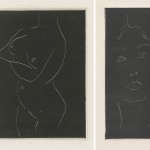
Matisse’s Monotypes: An Unexpected Installation
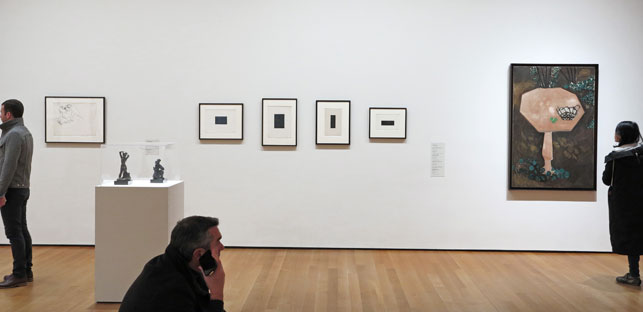
Installation view, Painting and Sculpture Galleries, The Museum of Modern Art. Shown: all works by Henri Matisse. © 2015 Succession H. Matisse, Paris/Artists Rights Society (ARS), New York
As the groundbreaking exhibition Henri Matisse: The Cut-Outs enters its final weeks, visitors can rest assured that there’s more Matisse to discover at MoMA. Head to the fifth-floor Painting and Sculpture Galleries, where you’ll encounter an entire room devoted to Matisse’s early-20th-century work—an especially fertile period for this modern master—with an unexpected twist.
January 28, 2015
|
Collection & Exhibitions,
Videos
Making Music Modern: Sourcing the Stratocaster
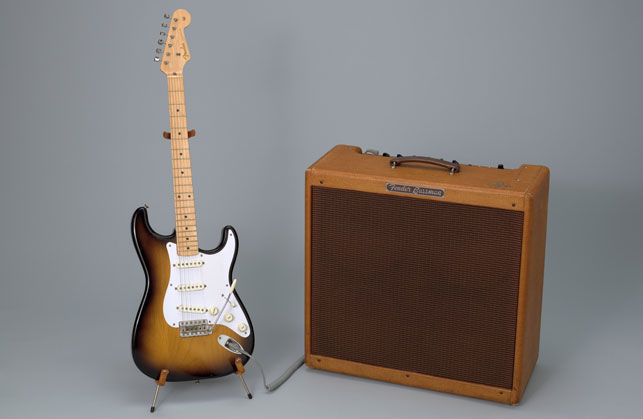
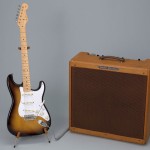
Leo Fender, George Fullerton, Freddie Tavares. Left: Fender Stratocaster Electric Guitar. Designed 1954, this example 1957. Wood, metal, and plastic. Right: Fender Bassman amplifier. 1959. Wood, metal, and plastic. Committee on Architecture and Design Funds
As a curatorial assistant at MoMA, one of the most fun aspects of my job is researching and facilitating new acquisitions for the Museum’s collection. In the Architecture and Design department, we collect a range of materials, from architectural models to video game interfaces. And then there’s the time we acquired a 1957 Fender Stratocaster

January 27, 2015
|
Collection & Exhibitions
One Photograph, Two Contexts: Aleksandr Rodchenko’s Dive
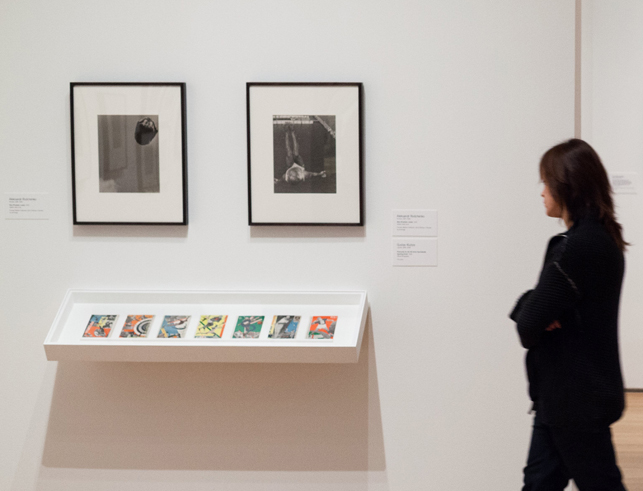
Installation view of Modern Photographs from the Thomas Walther Collection, 1909–1949, The Museum of Modern Art, New York, December 13, 2014–April 19, 2015. Photo: Jonathan Muzikar. © 2015 The Museum of Modern Art
On the Museum’s third floor, Aleksandr Rodchenko’s Dive (1934), a gelatin silver print roughly 12 inches high and 10 inches wide, is on display in the exhibition Modern Photographs from the Thomas Walther Collection, 1909–1949. On the related Object:Photo website, the same photograph is shown reproduced in the July 1935 issue of Sovetskoe foto (Soviet photo), a state-sanctioned, Moscow-based journal founded in 1926 dedicated to photography and photographic techniques.
January 22, 2015
|
Artists,
Collection & Exhibitions
Jean Dubuffet: Memories from Nature
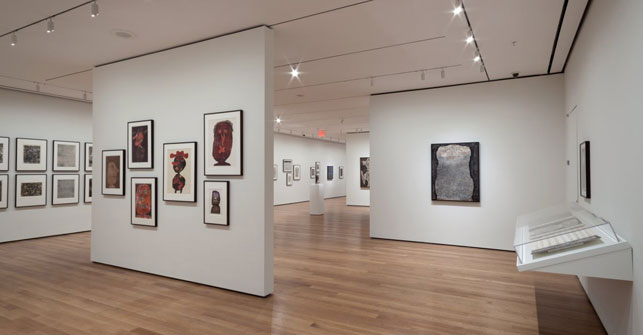
Installation view of Jean Dubuffet: Soul of the Underground, The Museum of Modern Art, October 18, 2014–April 5, 2015. Photograph by John Wronn
In July of 1963 the French artist Jean Dubuffet (1901–1985) declared of his radical lithographs, “Sometimes I took imprints of every chance element that might even suggest something: the ground, walls, stones, old suitcases, any or every sort of object—I even went so far as to do them from the naked skin of a friend’s back—and sometimes I obtained astonishing images…that I had sprinkled with tiny elements such as wires, crumbs, bits of torn paper, and all sorts of debris….”
January 21, 2015
|
Collection & Exhibitions
Contemporary Painting Exhibitions at MoMA: A Brief History
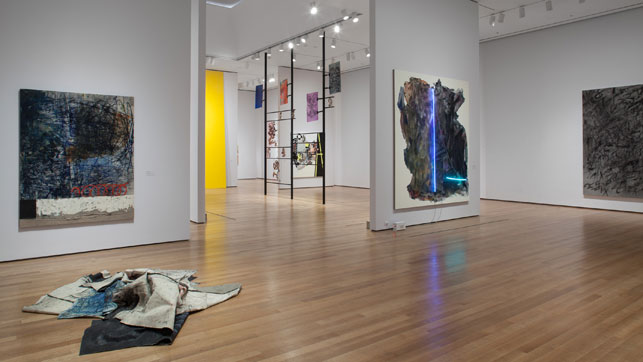
Installation view of The Forever Now: Contemporary Painting in an Atemporal World, The Museum of Modern Art, New York, December 14, 2014–April 5, 2015. Photo by John Wronn. © 2015 The Museum of Modern Art
The Forever Now: Contemporary Painting in an Atemporal World has, as the critics have said, been “a long time coming” and “long anticipated.” The art world has been waiting for MoMA to take a position on contemporary painting now that worry over the “death of painting” in the 1980s and 1990s has been more or less settled by the medium’s persistence in both artists’ studios and the (much-maligned) painting-heavy art market.
January 20, 2015
|
Artists,
Behind the Scenes,
Collection & Exhibitions
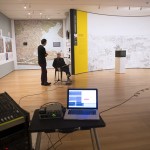
Collecting Alvin Lucier’s I Am Sitting in a Room
In 1969 American composer Alvin Lucier first performed his landmark work I Am Sitting in a Room, conceived for voice and electromagnetic tape. Lucier read a text into a microphone. Attempting to smooth out his stutter, he began with the lines, “I am sitting in a room, the same one you are in now. I am recording the sound of my speaking voice.” As described in the text, his voice was recorded, then played back into the room. This process was repeated, and with each iteration Lucier’s recorded speech grew muddled, sounding distant, and specific sonic frequencies started to dominate the recorded sound.
January 15, 2015
|
Artists,
Collection & Exhibitions
Inbox: Christopher Wool
The artist Christopher Wool is never through with a form just because he’s used it before. Rather, in a perpetual cycle of self-appropriation, he runs the visual elements he creates through numerous incarnations, constantly experimenting with shifts in scale and medium.
January 8, 2015
|
Collection & Exhibitions
Sound and Vision: A Making Music Modern Virtual Tour and Playlist
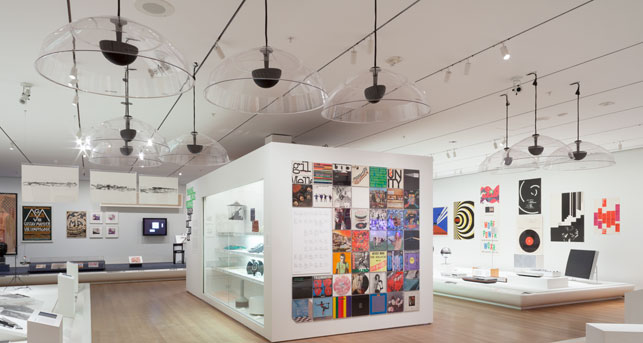
Installation view of Making Music Modern: Design for Ear and Eye, The Museum of Modern Art, November 15, 2014–November 1, 2015. Photo: John Wronn
“Don’t you wonder sometimes/’Bout sound and vision?” sings David Bowie wistfully on a track from the album Low, released in 1977. Recently I’ve spent a lot of time thinking about how music—an essentially invisible and immaterial art form—grounds us in the physical world, influencing the mood and tone of everyday life. Without it we definitely lose our bearings.
January 7, 2015
|
Collection & Exhibitions,
Film
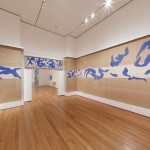
Popcorn Allowed: Matisse Goes to the Movies
It’s a dream job: my role in marketing and communications at MoMA is to get the public excited by telling stories about our exhibitions and programs. It’s also a fast-moving and fluid media environment; we need to constantly experiment with new ways of telling those stories, and test new channels for connecting with an audience that has many options for enjoying art and culture.
If you are interested in reproducing images from The Museum of Modern Art web site, please visit the Image Permissions page (www.moma.org/permissions). For additional information about using content from MoMA.org, please visit About this Site (www.moma.org/site).
© Copyright 2016 The Museum of Modern Art
Welcome to MoMA.org. To take full advantage of all the site’s features, including the option to save works in the collection, please upgrade your browser to Firefox,
Google Chrome, Safari, or Internet Explorer 9.
See our help page for more information.
To take full advantage of all of the features on MoMA.org, please upgrade your browser to Firefox, Google Chrome,
Safari, or Internet Explorer 9.