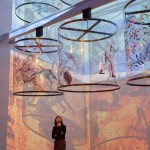
A menagerie of color and the enchanted siren call of classical raga greets visitors entering the carouseling silhouettes of Nalini Malani’s Gamepieces (2003/2009). Installed as part of the exhibition Scenes for a New Heritage: Contemporary Art from the Collection, the artwork was first conceived by Malani in 2003 for the 8th Annual Istanbul Biennial.


Posts in ‘Collection & Exhibitions’
March 13, 2015
|
Behind the Scenes,
Collection & Exhibitions
Gamepieces: An Installation Deconstructed
March 10, 2015
|
Collection & Exhibitions
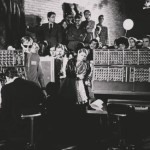
Sounds from Outer Space: The Moog at MoMA
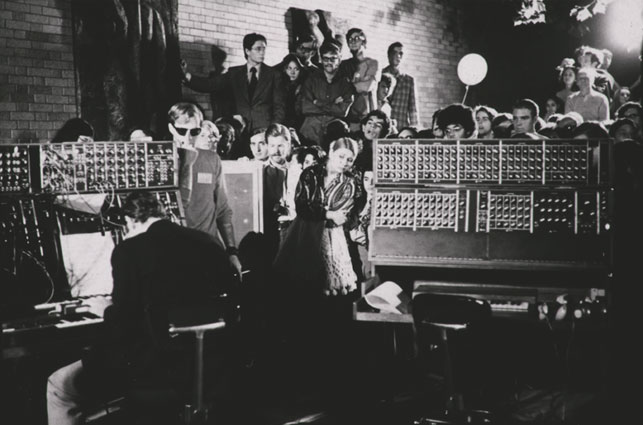
View of the concert performed by Robert Moog and the Moog Synthesizer, part of the Jazz in the Garden series, The Museum of Modern Art, August 28, 1969. Photographer: Peter Moore. Photographic Archive. The Museum of Modern Art Archives, New York
The exhibition Making Music Modern: Design for Ear and Eye explores the ways in which sound technologies have shaped the way we listen to musical culture. Highlighting both technical innovation and design aesthetics, the exhibition includes a number of modern instruments, including a Yamaha Portatone Keyboard and a Fender Stratocaster electric guitar.
March 4, 2015
|
Collection & Exhibitions,
Design
Is This for Everyone? New Design Acquisitions at MoMA
What do Susan Kare’s graphic designs for user interface icons, The Living’s mycelium bricks, and Formafantasma’s speculative Botanica series of vessels have in common? Apart from each being compelling contemporary design experiments in their own right, they’re also part of the newest crop of acquisitions welcomed into The Museum of Modern Art’s collection, and all are now on public display in the recently opened exhibition This Is for Everyone: Design Experiments for the Common Good.
March 3, 2015
|
Collection & Exhibitions,
Learning and Engagement
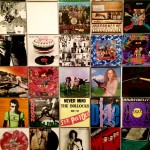
Looking at Music, Mayhem, and Rock-n-Roll
Leading up to her new class After-Hours: Making Music Modern, instructor Marianne Eggler sits down with MoMA’s Susannah Brown to share her excitement for this unique new program.
February 27, 2015
|
Collection & Exhibitions,
Five for Friday
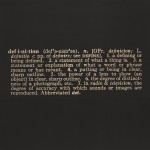
Five for Friday: How Is This Art? or, What I Learned from Conceptual Art
When you visit a modern art museum it can be easy to find yourself looking at a blank white canvas or a pile of bricks and wonder, “How is this art? Shouldn’t art be about something?” The problem of appreciating art is not limited to casual viewers. As an artist and employee at MoMA, I too can find it tough to relate to certain artworks. But the good news is that we can do more than just throw up our hands and ask for our money back. With a bit of imagination, we can make up our own ideas about an artwork and those stories may end up having more meaning to us than any art historical analysis.
February 24, 2015
|
Collection & Exhibitions
The LP Cover: A Counter-Cultural Icon
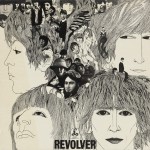
The Beatles’ Revolver, with Klaus Voorman’s haunting illustration and photo-collage work, was the first LP cover added to the design collection in my time at MoMA and I was thrilled to see it arrive. Recently Help!, Rubber Soul, and Sgt Peppers’ Lonely Heart’s Club Band LP covers were acquired and all are currently on view in Making Music Modern: Design for Ear and Eye along with The Beatles, aka the White Album, from MoMA’s drawings and prints collection. Exhibited together, these Beatles album covers offer a design-based narrative of the band’s evolution, and at same time read as a cultural narrative of the times.
February 20, 2015
|
Artists,
Collection & Exhibitions
Trains and Cars: A Gallery Tour with The Forever Now artist Joe Bradley
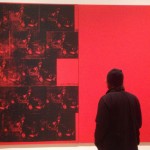
In conjunction with the exhibition The Forever Now: Contemporary Painting in an Atemporal World, we invited several artists from the show to walk us through MoMA’s permanent collection galleries and discuss a few artworks. Revisiting key pieces in the Museum’s collection with these artists has truly given me a fresh perspective on the works themselves and their significance today.
February 5, 2015
|
Collection & Exhibitions
Korean Hangul Typeface Design: A Unique Game of Modular Design
In 2011, MoMA’s Department of Architecture and Design acquired 23 digital fonts, a landmark addition to the Museum’s collection. The fonts were first encountered by MoMA visitors in the exhibition Standard Deviations: Types and Families in Contemporary Design, and went to join other contemporary graphic design acquisitions such as the @ sign and, later on, the Google Maps Pin. As part of a new exhibition series with the Hyundai Card Design Library in Seoul, Korea, MoMA senior curator Paola Antonelli has organized three capsule exhibitions that highlight new frontiers in contemporary design and encourage international dialogue. The first exhibition, Digital Typefaces, opened in Seoul in October 2014 and is on view until February 15, 2015.
February 4, 2015
|
Collection & Exhibitions,
Tech
Object:Photo—Visualizing the Thomas Walther Collection
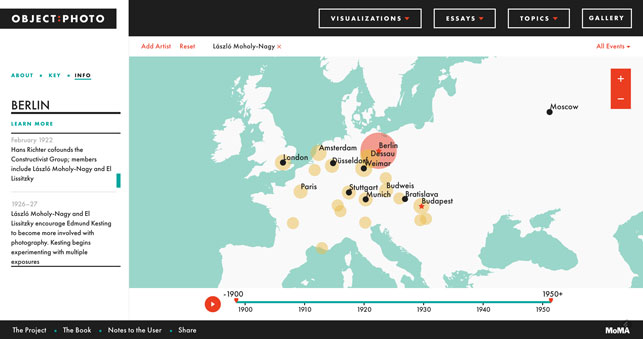
A screen grab of the Object:Photo website showing a map of selected events in László Moholy-Nagy’s life
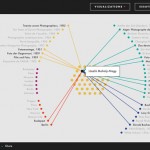
When MoMA’s departments of Photography and Conservation set out to make a website to showcase the 341 photographs in the Thomas Walther Collection, the goal was to create an innovative resource that would take full advantage of the Internet’s interactivity. In December, MoMA launched Object:Photo, a digital research platform featuring four data visualizations that allow visitors to explore the materials, techniques, and art historical context of these 341 modernist photographs.

February 3, 2015
|
Collection & Exhibitions,
Learning and Engagement
Sketching from Life: Drawing Sessions Inspired by The Paris of Toulouse-Lautrec

Sketching from Life drawing sessions at MoMA inspired by The Paris of Toulouse-Lautrec: Prints and Posters. All photos by Manuel Molina Martagon. © 2015 The Museum of Modern Art, New York
In 2014, MoMA’s education, curatorial, graphic design, exhibition design, and marketing departments collaborated to develop an interactive learning space adjacent to the exhibition The Paris of Toulouse-Lautrec: Prints and Posters. This is the third interactive space we’ve developed in relation to an exhibition, following the success of Performing John Cage and the Polke Pop-Up Activity Space. This café-like space offers activities and resources to connect participants with Lautrec’s life and artistic process using both unfacilitated and facilitated approaches.
If you are interested in reproducing images from The Museum of Modern Art web site, please visit the Image Permissions page (www.moma.org/permissions). For additional information about using content from MoMA.org, please visit About this Site (www.moma.org/site).
© Copyright 2016 The Museum of Modern Art
Welcome to MoMA.org. To take full advantage of all the site’s features, including the option to save works in the collection, please upgrade your browser to Firefox,
Google Chrome, Safari, or Internet Explorer 9.
See our help page for more information.
To take full advantage of all of the features on MoMA.org, please upgrade your browser to Firefox, Google Chrome,
Safari, or Internet Explorer 9.