“What floor is the copycat exhibition on?” I recently overheard a museum visitor ask this of a security guard, presumably hoping to locate <a href="http://www.moma.org/visit/calendar/exhibitions/1497" target=_blank>Sturtevant: Double Trouble</a>. At first glance, the exhibition appears to be a group show of 20th-century masterpieces—a Jasper Johns flag painting here, an Andy Warhol Marilyn Monroe there—until you realize that these are all by Sturtevant, an American artist best known for making her own versions of the works of her contemporaries, including Joseph Beuys, Marcel Duchamp, Keith Haring, and many others.


Posts in ‘Collection & Exhibitions’

December 24, 2014
|
Artists,
Collection & Exhibitions
Happy Holidays from MoMA (and Matisse)!
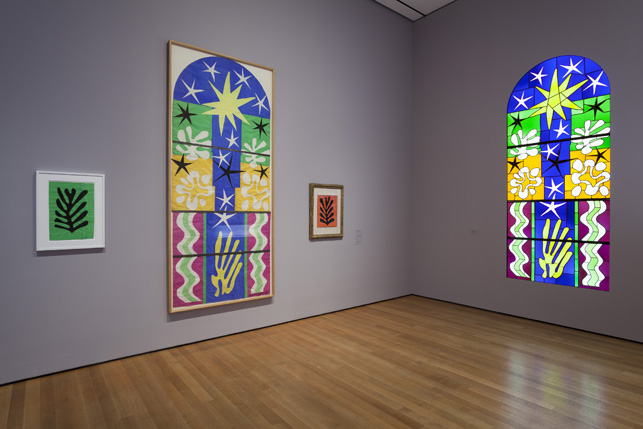
Installation view of Henri Matisse: The Cut-Outs at The Museum of Modern Art, New York (October 12, 2014-February 10, 2015). Photo: Jonathan Muzikar. © 2014 The Museum of Modern Art. Shown (from left): Black Leaf on Green Background. 1952. Gouache on paper, cut and pasted. The Menil Collection, Houston; Nuit de Noël. 1952. Maquette for stained-glass window. Gouache on paper, cut and pasted, mounted on board. The Museum of Modern Art, New York. Gift of Time Inc.; Black Leaf on Red Background. 1952. Gouache on paper, cut and pasted. Private collection; Nuit de Noël. 1952. Stained glass. The Museum of Modern Art, New York. Gift of Time Inc.; All works by Henri Matisse. © 2014 Succession H. Matisse/Artists Rights Society (ARS), New York
In 1952 Henri Matisse was commissioned to make a stained-glass window for the Time Life Company.
The window, titled Nuit de Noël, was exhibited at Rockefeller Center during the holiday season, and on December 4, 1952, Matisse wrote to MoMA’s founding director Alfred H. Barr:
December 18, 2014
|
Collection & Exhibitions
Consider the Rock Concert Poster
I’m one of those people that carries a notebook everywhere so I can be sure to record what mostly turns out to be a lot of useless information, for example rock concert set lists—though not religiously, just when I feel like it. Recently I tried using the notes app on my phone, but it’s just not the same.
December 4, 2014
|
Collection & Exhibitions
Manipulating Cultural Material: Cut to Swipe
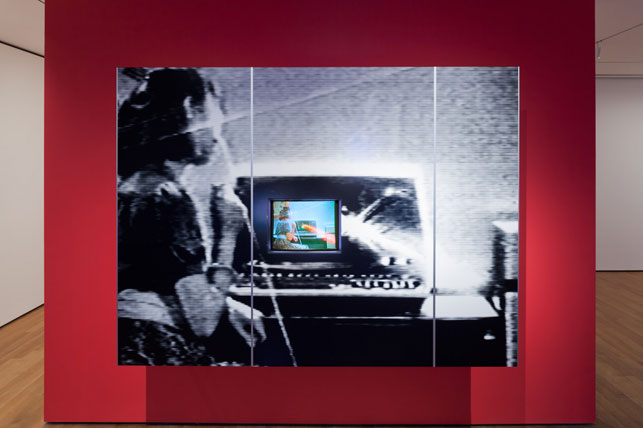
Dara Birnbaum. PM Magazine (detail). 1982. Four-channel video (color, three channels of stereo sound; 6:30 min.), two chromogenic prints, Speed Rail® structural support system, aluminum trim, one wall painted Chroma Key Blue, and one wall painted red, dimensions variable. The Museum of Modern Art, New York. Acquired with support from The Modern Women’s Fund Committee, The Contemporary Arts Council of The Museum of Modern Art, and through the generosity of Ahmet Kocabiyik. © 2014 Dara Birnbaum. Courtesy the artist and Marian Goodman Gallery, New York and Paris. Installation view, Cut to Swipe, The Museum of Modern Art, October 11, 2014–March 22, 2015. Digital image © The Museum of Modern Art, New York. Photo: Jonathan Muzikar
There has been no shortage of commentators noting the effect of the increasing circulation of images on the development of artistic production. From the current “Art vs. Image” issue of Texte zur Kunst to Hito Steyerl’s influential 2009 essay “In Defense of the Poor image,” contemporary art’s concern with mobile images has grown with the proliferation of technologies that facilitate it, both hardware (laptops, smartphones) and software (Tumblr, Final Cut Pro).
November 21, 2014
|
Artists,
Collection & Exhibitions
“Dear Mr. Szarkowski”: Postcards from Nicholas Nixon
Celebrating the publication and exhibition on the 40th anniversary of Nicholas Nixon’s The Brown Sisters, the Department of Photography wanted to share from its collection a selection of “postcards” by Nixon that the photographer sent to the department’s former director, John Szarkowski. On the back of each of these photographs, one finds letters written by Nixon to Szarkowski.
November 20, 2014
|
Collection & Exhibitions
Matisse and Gober: Two Chapels
MoMA has been called a temple of modernism, even a sacred destination for art lovers, but that religious language is usually just figurative. With the exhibitions Henri Matisse: The Cut-Outs and Robert Gober: The Heart is Not a Metaphor open simultaneously, however, visitors can witness the unlikely confluence of two chapels on 53rd Street (not even counting Saint Thomas, next door).

November 11, 2014
|
Collection & Exhibitions
MoMA Celebrates Veterans Day
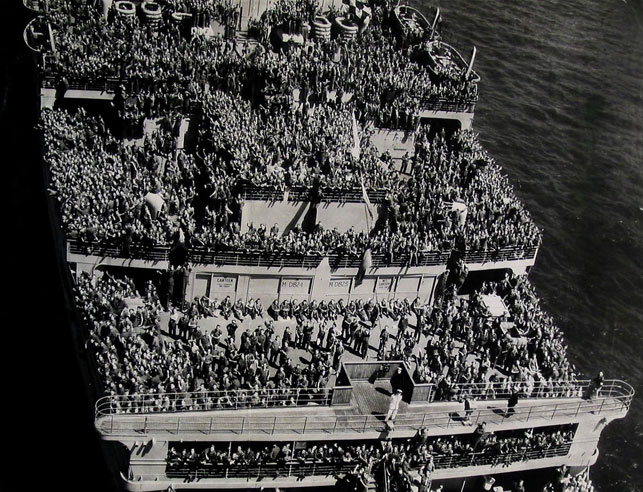
U.S. Coast Guard. It Was a Record Day for Allied Soldiers as 34,355 Arrived Here. July 11, 1945
The Museum of Modern Art salutes the men and women of the U.S. Armed Forces. Thank you for your service, dedication, and courage.
November 11, 2014
|
Artists,
Collection & Exhibitions
Matisse: The Same Thing, Different Means
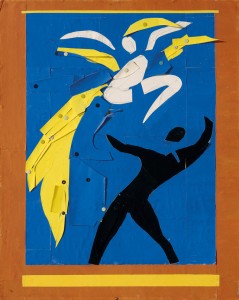
Henri Matisse. Two Dancers (Deux danseurs). 1937–38. Stage curtain design for the ballet Rouge et Noir. Gouache on paper, cut and pasted, notebook papers, pencil, and thumbtacks, 31 9/16 x 25 3/8” (80.2 x 64.5 cm). Musée national d’art moderne/Centre de création industrielle, Centre Georges Pompidou, Paris. Dation, 1991. © 2014 Succession H. Matisse / Artists Rights Society (ARS), New York
Henri Matisse: The Cut-Outs, currently on view in the Museum’s sixth floor temporary exhibition galleries, looks closely at the works Matisse created in the final decade of his career. Adopting painted paper as his primary medium, and scissors as his chief implement, he invented a radically new form that came to be called a cut-out. But while this work was utterly new, its concerns were consistent with those that had driven Matisse throughout his entire career.
November 6, 2014
|
Collection & Exhibitions
What’s on Your Turntable?
My first record player came built into a portable red-and-white leather case with two locking hasps on either side of its red leather handle. It played both 45s and 33s, and had a black plastic 45 adapter that was stored in a recessed slot in one corner. It was a magnificent machine.
October 30, 2014
|
Collection & Exhibitions,
Family & Kids,
Publications
Inside Matisse’s Garden
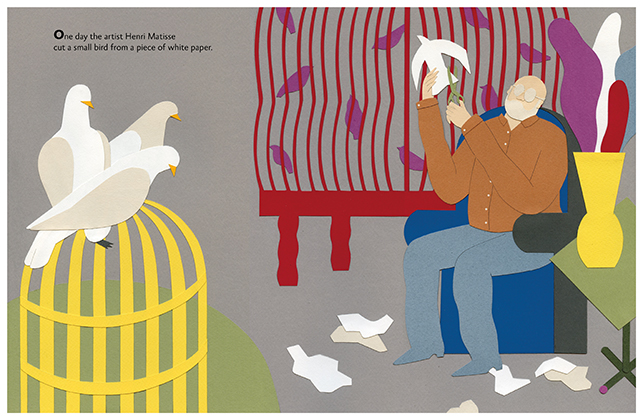
Interior spread from Matisse’s Garden. © The Museum of Modern Art. Illustration by Cristina Amodeo. © Cristina Amodeo
“One day the artist Henri Matisse cut a small bird from a piece of white paper. It was a simple shape but he liked the way it looked and didn’t want to throw it out. So he pinned it on the wall of his apartment to cover up a stain.”
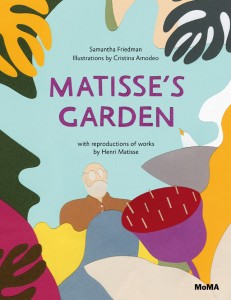
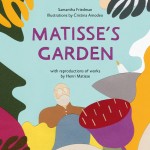
Cover of Matisse’s Garden, published by The Museum of Modern Art
Thus begins Matisse’s Garden, the story of an endlessly curious artist who used scissors and painted paper to make something utterly new. Written by Samantha Friedman, an assistant curator at MoMA and co-organizer of the exhibition Henri Matisse: The Cut-Outs, and featuring colorful cut-paper illustrations by Italian designer Cristina Amodeo, it’s an immersive introduction to Matisse’s vibrant cut-outs.
If you are interested in reproducing images from The Museum of Modern Art web site, please visit the Image Permissions page (www.moma.org/permissions). For additional information about using content from MoMA.org, please visit About this Site (www.moma.org/site).
© Copyright 2016 The Museum of Modern Art
Welcome to MoMA.org. To take full advantage of all the site’s features, including the option to save works in the collection, please upgrade your browser to Firefox,
Google Chrome, Safari, or Internet Explorer 9.
See our help page for more information.
To take full advantage of all of the features on MoMA.org, please upgrade your browser to Firefox, Google Chrome,
Safari, or Internet Explorer 9.