
MoMA
Posts in ‘Collection & Exhibitions’
March 18, 2010  |  Artists, Collection & Exhibitions
On View: Wangechi Mutu’s “One Hundred Lavish Months of Bushwhack”

Wangechi Mutu. One Hundred Lavish Months of Bushwhack. 2004

The Modern Myth: Drawing Mythologies in Modern Times, a new exhibition organized by my colleagues Geaninne Gutiérrez-Guimarães and Luis Pérez-Oramas, opened in the Drawings Galleries last week, bringing together a stunning display of works from MoMA’s collection that draw on the motif of mythology. One eye-catching work in the contemporary section of the exhibition is a large-scale collage by Wangechi Mutu titled One Hundred Lavish Months of Bushwhack. She made this work in 2004 during her artist-in-residency at the Studio Museum in Harlem, and it was acquired by MoMA directly from her soon after our curators saw it on view in the Studio Museum’s exhibition Figuratively.

Though she has also worked in video, sculpture, installation, and, most recently, performance (as part of Performa in 2009), for the past several years Mutu has produced stunning collages of fantastically ornate hybrid women, composed of cut-out images culled from magazines ranging from Vogue to National Geographic, outdated ethnographic surveys, pornography, and botanical illustrations. Mutu is interested in how stereotypes become ingrained into the public conscious, and through her art she investigates gender and racial stereotypes, in particular those pertaining to black women, formulating a distinctly personal position on feminism, postcolonial continental Africa, and globalization.
March 15, 2010  |  Collection & Exhibitions, Tech
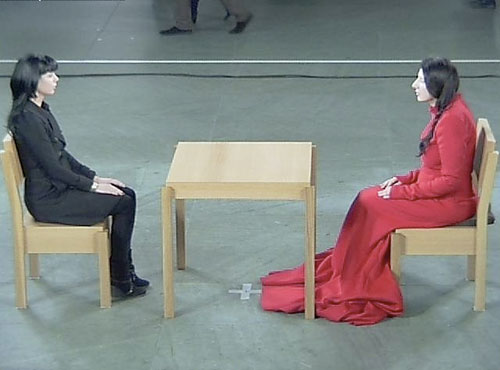
Live-Streaming Marina Abramović: Crazy or Brave?

“We want to live-stream a silent woman, sitting still in a chair all day for three months.”—Paraphrased from a meeting a few weeks ago, followed by the sound of my hand hitting my forehead.

Screenshot from performance by Marina Abramović, MoMA, March 9, 2010

Screenshot from performance by Marina Abramović, MoMA, March 9, 2010

Working in a department that interfaces with the Internet (home of zany fun like Is This Art? and my new favorite site Selleck Waterfall Sandwich), you get used to hearing a lot of unusual ideas getting presented as Things We Need To Be Doing Right Away. I guess I should be used to it by now, since MoMA is a museum that has in its collection an alleged can of poop.

Small Steps Lead to Bigger Changes: MoMA’s Shifting Wall Colors

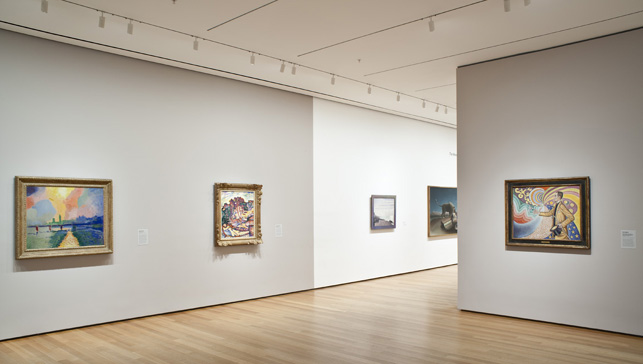
On one of my recent early-morning checks of the fifth-floor collection galleries—a daily duty of the curatorial staff, to spot any oddities—an elusive, visceral feeling gave me pause. It took me a moment to recognize that it was prompted by the wall color, which, as I moved from the European Expressionist gallery to the adjacent Matisse room, had changed from a light grey to what appeared to be a bright white. This color change is subtle enough to likely go unnoticed by many visitors, but deserves a brief moment of attention.

View of Cézanne to Picasso: Paintings from the David and Peggy Rockefeller Collection, July 17, 2009–August 31, 2009. The Museum of Modern Art, New York. Photo: John Wronn

March 10, 2010  |  Collection & Exhibitions, Film
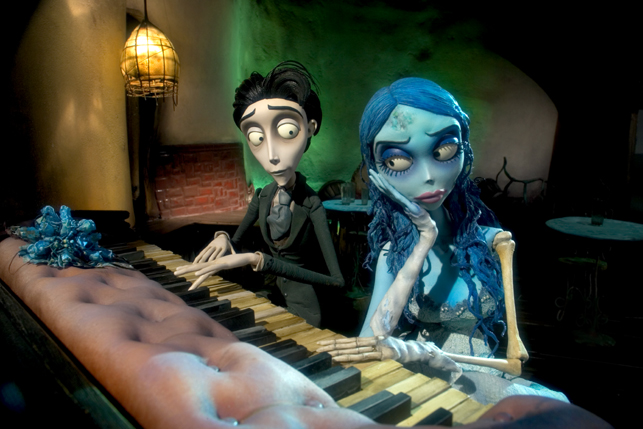
Arthur Freed, Vincente Minnelli…Tim Burton?

Corpse Bride. 2005. USA/Great Britain. Directed by Tim Burton and Mike Johnson. Photo courtesy of Warner Bros. Pictures

This year’s Academy Awards telecast paid tribute to horror films—a genre cited by the presenters as often neglected by the Academy—with a clip reel that featured select masterworks of cinema by directors such as Alfred Hitchcock, Stanley Kubrick, and Roman Polanski. As I watched the montage, I caught glimpses from Beetlejuice (1988), Edward Scissorhands (1990), and Sleepy Hollow (1999). Although I found their inclusion to be a bit incongruous among films like The Exorcist, Carrie, Friday the 13th, Nightmare on Elm Street, Scream, The Ring, and The Blair Witch Project, it nevertheless reaffirmed the popular perception of Tim Burton as a dark, gothic, and macabre filmmaker. Certainly, with Tim’s affinity for skeletons, graveyards, severed heads, and iron maidens—some of the recurrent motifs in his work—the classification of his films into the horror genre would surprise few. However, I propose another genre to be considered when examining Tim’s oeuvre: the musical film.

Can Art Change the World?

As Director of Digital Learning, I might just have the best job in the world. Take today as an example. At 10:00 a.m., I reviewed video for an online studio course about the materials and techniques of Willem de Kooning, Jackson Pollock, and Barnett Newman (among others) that my coworker Amy Horschak and I hope to run this summer (it is being developed by Corey d’Augustine). At 2:00, I brainstormed with colleagues about new content for the blog. At 5:00, I attended an exhibition opening for the Education department’s CreateAbility class, a monthly program for individuals with learning and developmental disabilities and their families. I brought in the camera just in time to hear parents talk about how meaningful the class was for their children. (We’ll be adding the video to the Learn section of the site, which is being updated later this spring.) By 7:00 I was watching a program organized by my colleagues Laura Beiles and Pablo Helguera: the artist William Kentridge on stage in Theater 1, performing I am not me, the horse is not mine.

March 4, 2010  |  Artists, Collection & Exhibitions
Levitt in Color, New at MoMA

There are no installation views of the Projects exhibition in which Helen Levitt first presented her color photographs to MoMA’s public, for one simple reason: all forty pictures were projected onto the wall, fading as quickly as they appeared. The year was 1974, and Levitt was in the midst of a creative outburst—unusual not only because she was at an age when most people contemplate retirement, but also because until 1959 her career had developed entirely in shades of gray. I love these black-and-white images, and put up a whole wall of them in 2006-07, including the first photograph by Levitt ever acquired by MoMA, New York, way back in 1941.

March 3, 2010  |  Collection & Exhibitions, Film
Searching for Tim Burton

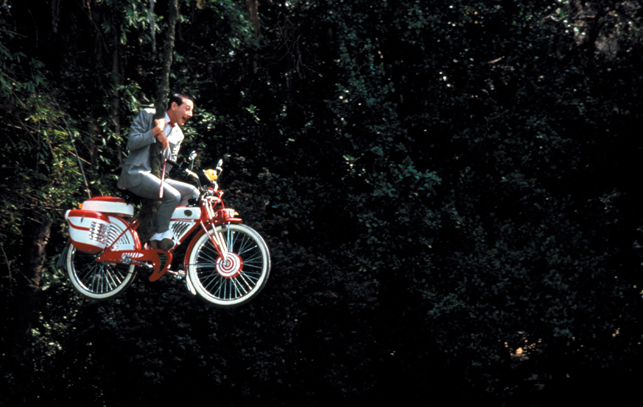
Pee-wee’s Big Adventure. 1985. USA. Directed by Tim Burton. Photo courtesy Warner Bros/Photofest. © 2010 Warner Bros.

The search for Tim Burton took us to four Hollywood studio archives, five independent production company collections, and four private lenders, exposing us to an interesting variety of archival situations. Studio archives are traditionally housed on the lots where their films and television programs are shot, or, if their collections are large enough and the demand great enough, in off-lot research centers and warehouses. When we visited Twentieth Century Fox and the Disney Corporate archives, we got to stroll the studio grounds, and we were hoping for a glimpse of a production in progress through the open door of a soundstage—readers who can recall Paul Reubens on a bicycle being chased around the Warner Bros lot at the end of Pee-wee’s Big Adventure (1985) will have a picture of the craziness we were expecting. But as it turned out, the lots were as quiet as an empty office park on summer weekends. Disney’s Animation Research Library is a sleek facility away from the studio, and the Warner Bros storage site is located in an industrial area. At each we were assigned teams of archive specialists who showed us carefully preserved art and film props. Half of the Los Angeles area sites we visited were in Tim’s hometown of Burbank, CA, which he used as a muse for such early films as Edward Scissorhands (1990) and The Nightmare Before Christmas (1993), so we made a particular point of soaking up the atmosphere of that city.

February 25, 2010  |  Artists, Collection & Exhibitions, Design
Signs of Life: The Life of the Exit Man

Freddie Yauner. Signs of Life. 2007-09. © Freddie Yauner

Signs of Life, the animated pictographic exit sign by British designer Freddie Yauner, takes the most banal everyday object—something that we see daily but rarely notice—and brings it to life.

February 24, 2010  |  Collection & Exhibitions
9 Screens: As Long as It Lasts

When MoMA Associate Director Kathy Halbreich invited me to observe the inner workings of the Museum and share my observations and critiques with both curators and administrators, I thought it was very important for MoMA to take a look at its interchange with artists—how the Museum is perceived by artists, and also its function and role within the artistic community. After several months of discussion with curatorial and administrative staff, I articulated some ideas for how MoMA might become a more nimble institution, one less constrained by the canonical history it had contributed to shaping. For example, I thought that the Museum needed to expand its entry point for young, local artists. I also suggested showing art in some of the building’s interstitial spaces—this would allow for extra display space, I thought, and also help MoMA to compress the long lead time required by large institutions to realize an exhibition.

February 11, 2010  |  Artists, Collection & Exhibitions
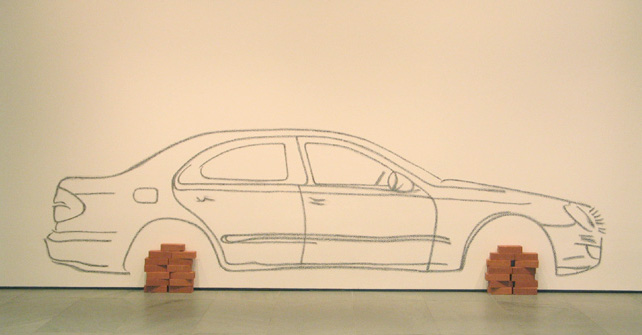
Robin Rhode’s Car on Bricks

Robin Rhode. Car on Bricks. 2008. Multiple of wall drawing and bricks. Publisher: Edition Schellmann, Munich. Edition: 15. The Museum of Modern Art, New York. Acquired through the generosity of The Contemporary Arts Council of The Museum of Modern Art. © 2010 Robin Rhode

As they reach the top of the escalators on the second floor at MoMA, visitors are greeted by a recent acquisition by the South African–born, German-based artist Robin Rhode. Car on Bricks (2008) consists essentially of an idea that the artist has issued in an edition of fifteen unusual multiples, each consisting of a wall drawing and two piles of bricks.