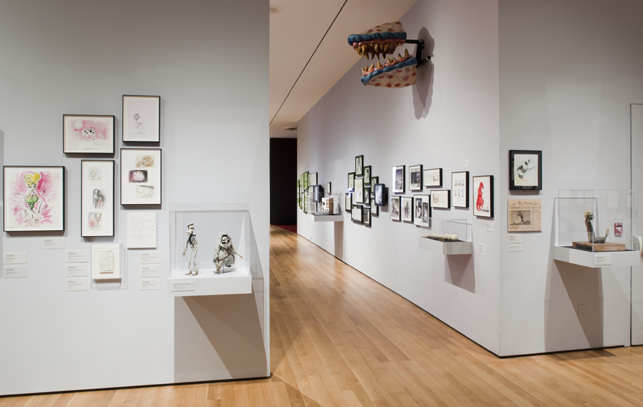

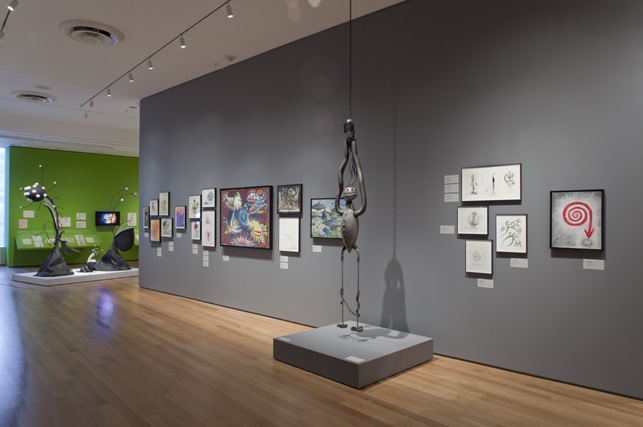
As we approach the midpoint of the five-month Tim Burton exhibition (November 22, 2009–April 26, 2010), I am reflecting on what may be our visitors’ first impressions of the show. Hopefully those who came to MoMA familiar with Tim’s films—whether they know him as the director responsible for cult favorite Edward Scissorhands (1990), the imaginative and innovative creator of The Nightmare Before Christmas (1993), the mischievous mind behind the irreverent Mars Attacks! (1996), or the filmmaker who brought the tale of tonsorial terror that is Sweeney Todd (2007) to the big screen—were pleasantly surprised to find another Tim Burton on display alongside the anticipated props and storyboards. Approximately 70 percent of the works in the exhibition had never been published or shown in public, and it is these works—projects both personal and professional, realized on paper and canvas, or via installations and sculptures—that give visitors a view of Tim as illustrator, cartoonist, photographer, and writer of verse, among other creative roles. These diverse works are united by their intimate, subjective nature; each conveys Tim’s distinctive way of viewing his world and the characters who populate it. The revelation of the private art of Tim Burton to MoMA’s visitors may be similar to my own personal revelation during our first meeting with Tim at his studio in London almost two years ago….
Posts in ‘Collection & Exhibitions’
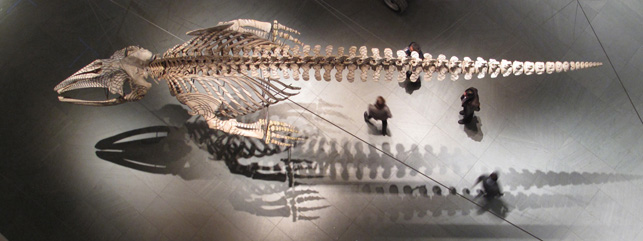
Biography of a Whale

Gabriel Orozco. Installation view of Mobile Matrix (2006) at The Museum of Modern Art, New York. Graphite on gray whale skeleton. Biblioteca Vasconcelos, Mexico City. Photo: Charles Watlington. © 2010 Gabriel Orozco
Every work at a museum may compel a viewer to wonder how it was made or where it came from. However, there are some works whose genesis provokes a special degree of collective fascination. Gabriel Orozco’s Mobile Matrix, currently on view in MoMA’s Gabriel Orozco exhibition, is one such work.
New Acquisition: Feng Mengbo’s Long March: Restart

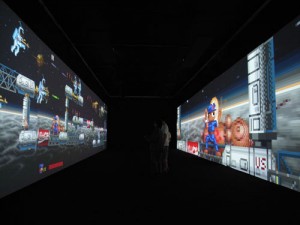
Feng Mengbo. Long March: Restart (installation view, Guangdong Museum, 2008). Video game installation (color, sound). The Museum of Modern Art. Given anonymously. © 2010 Feng Mengbo
We all know a little—and many of you know a lot!—about video games and gaming culture. Few of us, however, have actually attempted and succeeded in creating our own video game. Not only has the artist Feng Mengbo done so, but the video game he created is so large in scale that it requires installation in an exhibition hall. Mengbo started off this pursuit in a traditional enough way for an artist: in 1993 he created a series of paintings titled Game Over: Long March.
Turning Some Pages
For 9 Screens, which opens today at MoMA, Nicolás Guagnini, along with Kathy Halbreich, Luis Peréz-Oramas, and Klaus Biesenbach, commissioned five New York–based artists and collectives to create videos for display on the nine information screens above the ticketing desk in the Museum’s lobby.
My contribution, Turning Some Pages, greets the viewer with a series of questions, observations, and propositions—a fragmented narrative that sets the tone for a particular way of looking that is also a way of reading. The work plays with the idea of the intertitle, traditionally used in silent films, as a possible narrative equivalent to the space and function of the museum lobby. Turning Some Pages addresses, among other things, the conditions of pleasure, the affective reality of viewing art, memory, repetition, and art as a form of art history.
Documentation Diaries: Re-creating the Performance

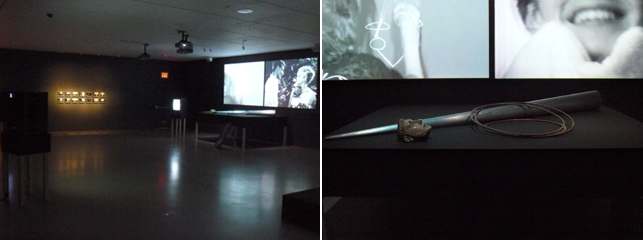
Joan Jonas. Mirage (installation details). 1976/1994/2003. The Museum of Modern Art. Gift of Richard Massey, Clarissa Alcock Bronfman, Agnes Gund, and Committee on Media Funds. Photos: Sydney Briggs
When the Department of Media and Performance Art collects and exhibits time-based media or performance, caring for and properly installing such work is a collaboration between the artist and the Museum. Time-based media commonly uses video, film, audio, and computer programs as platforms for creativity. Often such artwork is digitally based, and it depends upon technology that may become obsolete. In the case of performance art, the ability to re-perform the work mainly relies on the artist’s memory, with the aid of documentation. Both time-based media and performance are therefore mediums in which individual works are often replicated, migrated, or emulated in order to ensure their continued existence.
The Drawings of Guy de Cointet

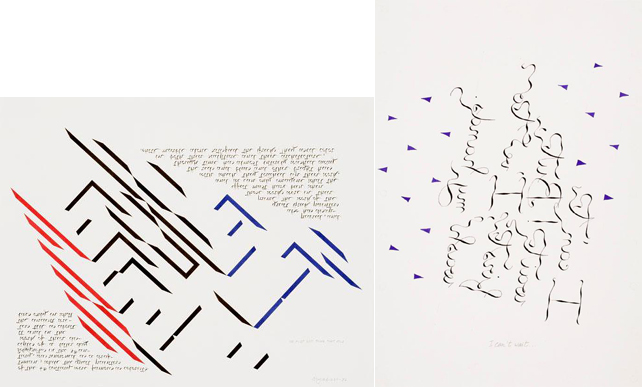
Left: Guy de Cointet. We must not think that cold… 1982. Ink and pencil on paper, 20 x 25 5/8" (50.8 x 65.1 cm). Committee on Drawings Funds. © 2010 Estate of Guy de Cointet. Right: Guy de Cointet. I can’t wait… 1982. Ink and pencil on paper, 21 x 14 3/4" (53.3 x 37.5 cm). Committee on Drawings Funds. © 2010 Estate of Guy de Cointet
The artist Guy de Cointet (French, 1934–1983) was fascinated with language, which he explored primarily through performance and drawing. His practice involved collecting random phrases, words, and even single letters from popular culture and literary sources—he often cited Raymond Roussel’s Surrealist novel Impressions of Africa as influential—and working these elements into non-linear narratives, which were presented as plays to his audience. Paintings and works on paper would then figure prominently within these performances. In his play At Sunrise . . . A Cry Was Heard (1976), a large painting depicting letters bisected by a white sash served as a main subject and prop, with the lead actress continuously referring to it and reading its jumble of letters as if it were an ordinary script. His drawings likewise are almost readable but just beyond comprehension.
Acquired for MoMA’s collection in May, these two drawings are strong examples of de Cointet’s scriptive compositions, which, alongside abstract forms, are reduced to algorithmic visual codes rather than narrative sentences. In these two particular works the artist meticulously reversed the direction of the inscriptions, a technique more commonly known as “mirror writing.” One must hold the drawing up to a mirror in order to read it—a performative act that was not lost on de Cointet. Building upon this mirroring technique, he further obscured the texts in these two works by altering their orientation as well: I can’t wait… has to be rotated once to the left for the text to be legible, and to read the text in We must not think that cold… one must turn the drawing upside down. Once deciphered, the texts read as snippets of mundane conversations, such as “I can’t wait! But first I’ve to wash my hands.” In other instances sentences are cut off mid-word, as in “work of their dis-,” only to have a new line of text begin below, leaving it up to the viewer to complete the sentence.
De Cointet is now recognized as one of the major figures in the Conceptual art movement that emerged in Los Angeles in the 1970s, having strongly influenced a number of prominent artists working in southern California today, including Paul McCarthy and Mike Kelley, for whom both drawing and performance figure significantly in their artistic practices.
Lights, Camera, Exhibition: Making Tim Burton
I like to compare the process of organizing a large-scale museum exhibition like Tim Burton to the process of producing a film. (What can I say, I’m a film person!) You start with an idea, and then research the subject as if you were writing a script—in the case of a gallery show, this means determining what art, objects, media, and documentation are available, and how they can most effectively be used to tell a “story.” Ideally, you want your interpretation of the materials to seem fresh and relevant to a contemporary audience. Typically you negotiate for the loan of materials to your show from various archives around the world—sort of like signing “stars” to a film—and then work with teams of exhibition designers, graphic artists, lighting technicians, A/V folks, carpenters, and so forth to bring your show to life in a gallery, just as the director and producers collaborate with a production department on the lot of a film studio during the making of a movie.
Joan Jonas: Synchronicity of Old and New
At the moment Joan Jonas is on a residency at Kita-Kyushu in western Japan. She has worked in Japan several times since her first visit in 1970, when she bought a portable video camera and began her exploration of media art. The immediacy and reality of video entranced Joan. It was so unlike the stark artificiality of traditional Japanese theater. There, the actors moved at a glacial, mesmerizing pace across a spare stage, and the productions, often stretching over an entire day, made time dissolve. The formality and ritual of Japanese performance became integral to Joan’s work, as can be seen in Mirage, the installation currently on view in the Media Gallery. She wrote that Noh and Kabuki, the two poles-apart forms of traditional Japanese theater, taken together contain every idea that has ever been realized on a stage.
R.H. Quaytman’s Storage Rack: An Archive of Images and Associations

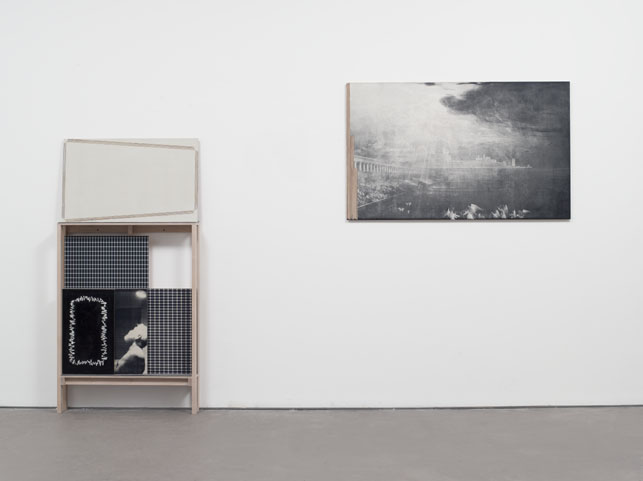
R. H. Quaytman. Iamb: Chapter 12, Excerpts and Exceptions, with Painting Rack. 2001–09. Silkscreen ink, oil paint, and gesso on wood, and wood rack, dimensions and installation variable. The Museum of Modern Art. Purchase
Last year MoMA’s Department of Painting and Sculpture acquired R. H. Quaytman’s Iamb: Chapter 12, Excerpts and Exceptions, with Painting Rack, a work comprised of six paintings, made between 2001 and 2009, set inside (and to the side of) a shallow wooden storage/display case. Two of the paintings were on view in Quaytman’s beautifully installed 2009 solo exhibition at the Miguel Abreu Gallery; the others joined the group in the artist’s studio before coming to the Museum. In general, I find Quaytman’s work to be complicated, but complicated in a completely satisfying way—this is especially true of Iamb: Chapter 12. Some of the panels in the set are minimal, such as an off-white gesso panel interrupted by four vectors; others maximal, like a panel displaying a silkscreen of John Martin’s mezzotint Heaven—The Rivers of Bliss (1824–25). The visual asynchronies of the series are undermined by a unified palette of whites, blacks, and half-tones, and by their placement within the rack, with the works’ absolute proximity to one another forcing a focused consideration of likeness.
Lessons from the Bauhaus

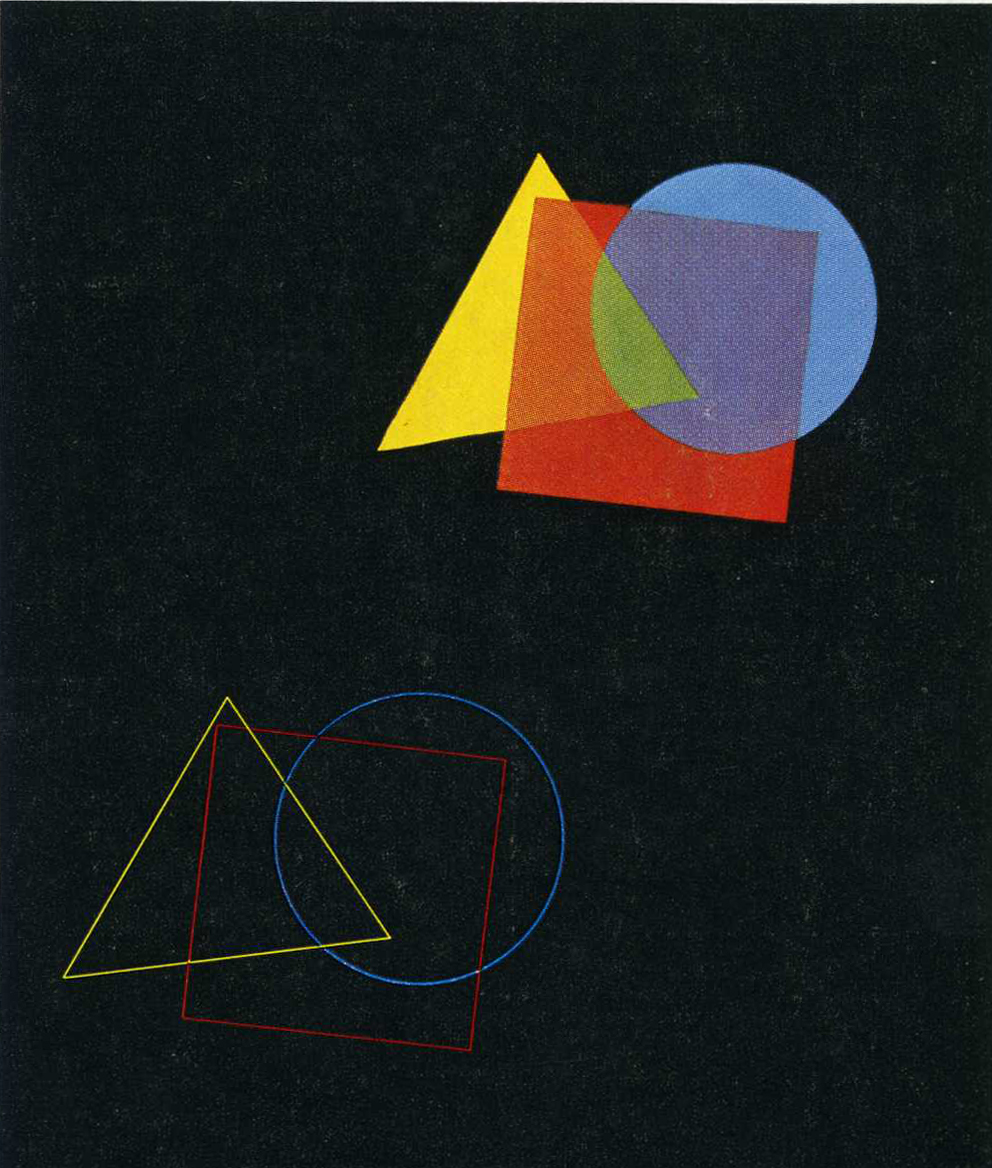
Eugen Batz. Exercise for color-theory course taught by Vasily Kandinsky. 1929–30. Tempera over pencil on black paper. Bauhaus-Archiv Berlin
The exhibition Bauhaus 1919–1933: Workshops for Modernity finally comes to an end next week. As a final event of the various public programs we have offered in conjunction with the exhibition, we will present a symposium this Friday, January 22, entitled Before and After 1933: The International Legacy of the Bauhaus. The event will bring together a vast array of international scholars to talk about the remarkable diaspora of Bauhaus intellectuals that, following the school’s closing in 1933, spread throughout various parts of Europe, the Americas, and even Africa, contributing to the establishment of a modern design style and branching out into various pedagogical models and practices that to this day lie at the core of the curricula of art and design schools worldwide.
Here at MoMA—both among staff members and those who came to the related public programs and workshops—we are also left with plenty of food for thought regarding the enduring legacy of that famous school.
If you are interested in reproducing images from The Museum of Modern Art web site, please visit the Image Permissions page (www.moma.org/permissions). For additional information about using content from MoMA.org, please visit About this Site (www.moma.org/site).
© Copyright 2016 The Museum of Modern Art