MoMA
Posts in ‘Collection & Exhibitions’
March 25, 2011  |  Artists, Collection & Exhibitions
Interactivity

Looking at Music 3.0 invites interaction. Visitors select songs to hear (and dance to), videos to watch, and zines to read. Three digital art projects go one step further, allowing user and machine to take an active role. Laurie Anderson, The Residents, and Perry Hoberman harnessed what in the 1990s were the latest digital tools to make truly interactive works.

March 24, 2011  |  Artists, Collection & Exhibitions
Body Language

Two recent acquisitions on view in the exhibition I Am Still Alive: Politics and Everyday Life in Contemporary Drawing, which just opened in the Drawings Galleries, prove that text-based art need not be disembodied. While On Kawara‘s series of telegrams sent to his Dutch gallerist—one of which lent the show its title—used neutral typewriting, modest scale, and the simplest of phrases to attest to a human presence, works by Fiona Banner and Paul Chan assert corporeality through scrawled handwriting, imposing size, and thick, evocative diction. This is art that describes the body at the same time that it re-creates it.

March 17, 2011  |  Collection & Exhibitions
Looking at Hip-Hop 1.0

As a grizzled hip-hop vet, I can’t tell you how thrilling it is that curator Barbara London’s Looking at Music series has burned past the 1960s and ’70s to arrive, in its third iteration, in the 1980s and ’90s. Finally, it’s time for my peoples to shine!

March 10, 2011  |  Artists, Collection & Exhibitions
Adam Pendleton and Mark Manders: Looking at Language in Two Recent Acquisitions

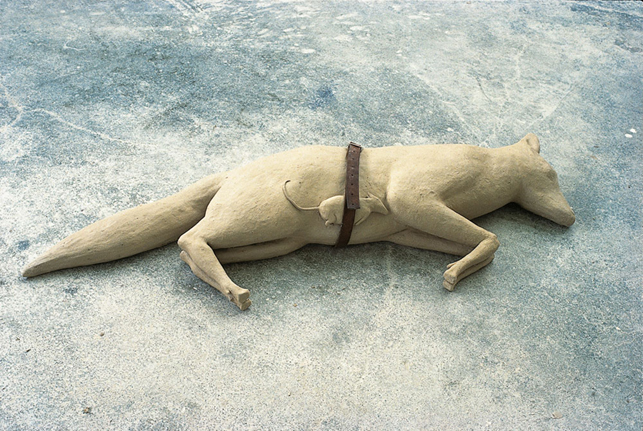
Mark Manders. Fox/Mouse/Belt. 1992. Painted bronze, belt. The Museum of Modern Art. Gift of the artist

As a student of art history, one of my favorite parts of exams was the slide comparison, looking at two works of art in relation to each other. Yes, perhaps it is a bit nerdy of me to admit, but what I found fascinating about this exercise was that it opened up a range of possible connections between the works that I might not normally explore.

March 9, 2011  |  Collection & Exhibitions, Tech
The Real and the Virtual Art Museum

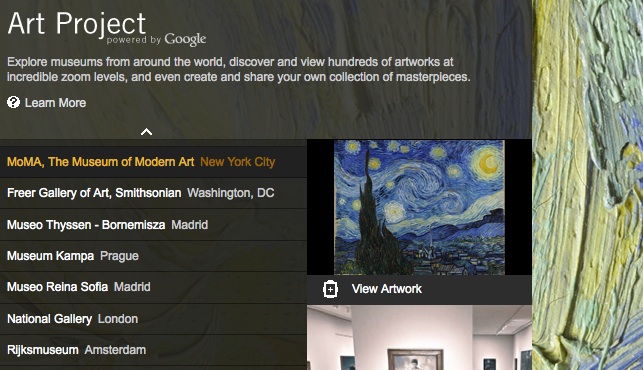
Screenshot of Google Art Project featuring Vincent Van Gogh's The Starry Night

So much of the press and discussion around the Google Art Project has focused on comparing the experience of the virtual gallery with the real, in-person experience. The question seems to be, will the Google Art Project replace or somehow despoil the experience of the museum visit? But I think this commentary overlooks an important part of the Google Art Project: the way it allows users to—in a way—remix and share their experience of so many great works of art.

Fandom for Phantom

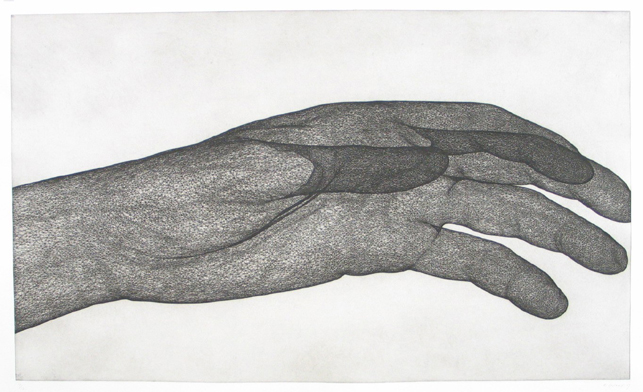
Richard Dupont. Phantom. 2007. Etching and aquatint. Publisher: Carolina Nitsch Contemporary Art, New York. Printer: Gregory Burnet, New York. Edition: 12. The Museum of Modern Art

Sometimes I just wish I were a printmaker. While I’ve embraced being able to familiarize myself with our department’s collection, mostly through preparation for study center visitors, it’s hard to avoid envying the person who gets to work in the studio and master the technical elements of printmaking. A work recently acquired by MoMA, Richard Dupont’s etching Phantom (2007)—which was among the artist’s earliest print projects—reveals the kind of artistic processes I am especially drawn to.

March 1, 2011  |  Collection & Exhibitions
A Monster-Like Force in the Transnational Lady-Made Movie Scene

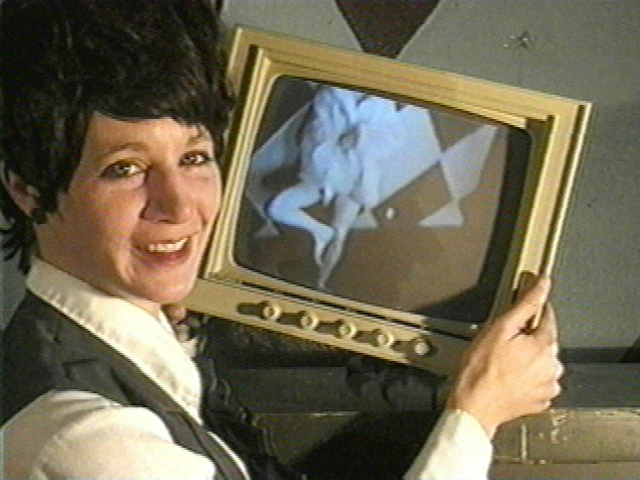
Miranda July. The Amateurist. 1998. Video still. Courtesy Miranda July

Before Miranda July became an acclaimed director, she was a film school dropout who moved to Portland and started a video chainletter for women, Big Miss Moviola (later Joanie4Jackie). My favorite chainletter intro opens with July in front of a skyscraper wearing a navy suit, demonstrating with delightful irony how her scrappy video ‘zine had grown into a corporate behemoth; a “monster-like force in the transnational lady-made movie scene.” In reality, July was dubbing over old VHS on outdated VCRs that she kept in the living room, and often struggled to get by.

February 28, 2011  |  Collection & Exhibitions
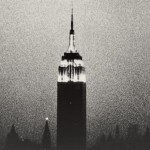
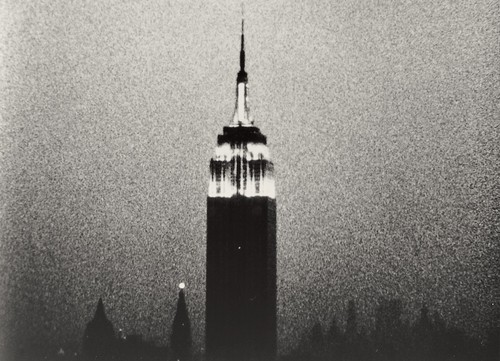
Empire Tweets Back

Andy Warhol. Empire. 1964. 16mm film transferred to video (black and white, silent), 8 hours 5 min. at 16 frames per second. Original film elements preserved by The Museum of Modern Art, New York. Collection of The Andy Warhol Museum, Pittsburgh Gift of The Andy Warhol Foundation for the Visual Arts, Inc. © 2011 Andy Warhol Foundation for the Visual Arts/Artists Rights Society (ARS), New York

As far as films go, it’s one of those that everyone talks about, but few get around to actually seeing. I’m talking about Andy Warhol’s Empire, his infamous 1964 film that consists of a single, stationary eight-hour view of the Empire State Building at night. Better yet: the film was shot at 24 frames per second and is projected at 16—which means that this epically-long stationary shot of the Empire State is actually seen in slow motion. Though heralded conceptually, it has been repeatedly described as unwatchable. Which is exactly why I wanted to see it. All eight hours of it.


February 24, 2011  |  Collection & Exhibitions
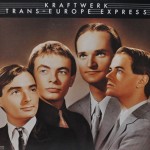
Riding the Trans-Europe Express
February 21, 2011  |  Collection & Exhibitions, Counter Space, Tech
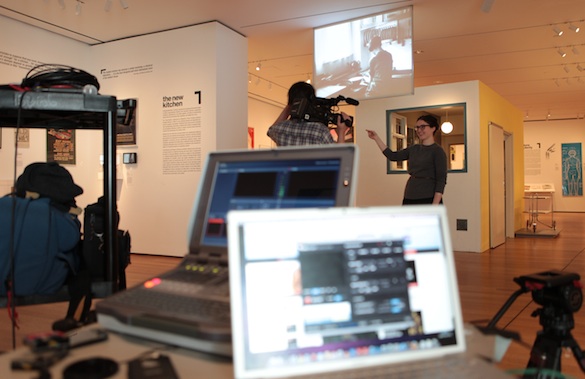
Today: A Live-Streaming Walkthrough of the Counter Space Exhibition

Nathaniel Longcope and Aidan O’Connor test out the live stream

As video-streaming technology becomes more ubiquitous, we’ve been antsy to try a walkthrough of an exhibition at MoMA. Department of Architecture and Design curator Juliet Kinchin and curatorial assistant Aidan O’Connor have been brave enough to be the first.