Not on view
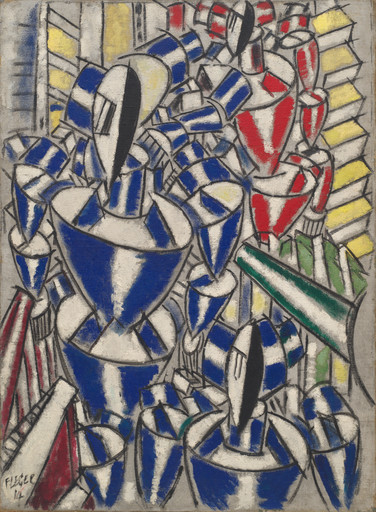
In 1913, Léger declared that “pictorial contrasts” were the essential element of modern art. The same year, he completed Contrast of Forms. The painting, as suggested by its title, is packed with clashing shapes that jostle across its patterned surface. Arranged in a loose pile, these geometric cones, cubes, and cylinders feature brightly colored stripes and patches that underscore their structural differences.
Like earlier Cubist works by Georges Braque and Pablo Picasso, fellow Paris-based artists, Contrast of Forms is organized around planes and solids depicted from multiple perspectives. Yet the painting is defiantly abstract, with none of the real-world subject matter that anchored Braque and Picasso’s Cubism. For Léger, it was the relationship between lines, forms, and colors that mattered most to modern art.
2026
Gallery label from Inventing Abstraction, 1910–1925 , December 23, 2012–April 15, 2013.
Toward the end of 1912, Léger made among the most defiantly abstract works yet seen. Over the next two years he worked intensely in this experimental idiom, producing the fifty or so canvases, and twice as many works on paper, that constitute his Contrastes de formes (Contrasts of forms) series. An inventory of repeated forms—geometric cones, cubes, cylinders—jostle and pile across the surfaces of these works. Here, Léger rejects illusion to focus on the mechanics of representation, drawing attention to them with roughly blocked forms, exposed supports, unmodulated color straight from the tube applied in painterly patches, and highlights detached from any light source. Chiaroscuro, the traditional technique of light and shadow used to create the illusion of three-dimensionality within the two-dimensional reality of the picture plane, becomes a language of absolute contrasts: strident black and white or colored striations clash with one another across the works.
Inventing Abstraction, 1910–1925, December 23, 2012–April 15, 2013.
Explore more



Audio
Audio from the playlist Inventing Abstraction, 1910–1925
Audio from the playlist 1880–1950: Works from the Collection
From MoMA Design Store


Installation views
We have identified this work in the following photos from our exhibition history.
Provenance Research Project
This work is included in the Provenance Research Project, which investigates the ownership history of works in MoMA's collection.
Galerie Kahnweiler, Paris. [1913 - 1914. Possibly sequestered in 1914, until 1923]
[4th auction sale of Kahnweiler collection, Hotel Drouot, Paris, May 7-8, 1923]
Prytec Gallery
Sidney Janis Gallery, New York. By 1952
Mr. and Mrs. John L. Senior, Jr. Purchased from Janis, November 13, 1952 - 1957
Philip L. Goodwin (1885-1958), New York. Purchased from John L. Senior, Jr., April 5, 1957 - 1958
The Museum of Modern Art, New York. Bequeathed by Philip L. Goodwin, May 1958
Provenance research is a work in progress, and is frequently updated with new information. If you have any questions or information to provide about the listed works, please email [email protected] or write to:
Provenance Research Project
The Museum of Modern Art
11 West 53 Street
New York, NY 10019
Licensing
Artwork or archival images
If you would like to reproduce an image of a work of art in MoMA's collection, or an image of a MoMA publication or archival material (including installation views, checklists, and press releases), please contact Art Resource (publication in North America) or Scala Archives (publication in all other geographic locations).
Audio and film clips
MoMA licenses archival audio and select out of copyright film clips from our film collection. At this time, MoMA produced video cannot be licensed by MoMA/Scala. All requests to license archival audio or out of copyright film clips should be addressed to Scala Archives at [email protected]. Motion picture film stills cannot be licensed by MoMA/Scala. For access to motion picture film stills for research purposes, please contact the Film Study Center at [email protected]. For more information about film loans and our Circulating Film and Video Library, please visit Circulating Film and Video Library.
Text from a publication or the archives
If you would like to reproduce text from a MoMA publication, please email [email protected]. If you would like to publish text from MoMA's archival materials, please fill out this permission form and send to [email protected].
Feedback
This record is a work in progress. If you have additional information or spotted an error, please fill out this feedback form.