Oil on wood
When Gauguin painted Still Life with Three Puppies he was living in Brittany among a group of experimental painters. He abandoned naturalistic depictions and colors, declaring that “art is an abstraction” to be derived “from nature while dreaming before it.” The puppies’ bodies, for example, are outlined in bold blue, and the patterning of their coats mirrors the botanical print of the tablecloth. It is thought that Gauguin drew stylistic inspiration for this painting from children’s-book illustrations and from Japanese prints, which were introduced to him by his friend and fellow artist Vincent van Gogh that year.
2011.
Gallery label from 2010.
This painting features three distinct zones: a still life of fruit in the foreground, a row of three blue goblets and apples diagonally bisecting the canvas, and three puppies drinking from a large pan. The incongruous scale and placement of these objects on a dramatically upturned tabletop results in a disorienting composition.
When Gauguin painted Still Life with Three Puppies, he was living in Brittany among a group of experimental painters. He abandoned naturalistic depictions and colors, declaring that "art is an abstraction" to be derived "from nature while dreaming before it." The puppies bodies, for example, are outlined in bold blue, and the patterning of their coats mirrors the botanic print of the tablecloth. It is thought that Gauguin drew stylistic inspiration for this painting from children's book illustrations and from Japanese prints, which were introduced to him by his friend and fellow artist Vincent van Gogh that same year.
2010.
Explore more
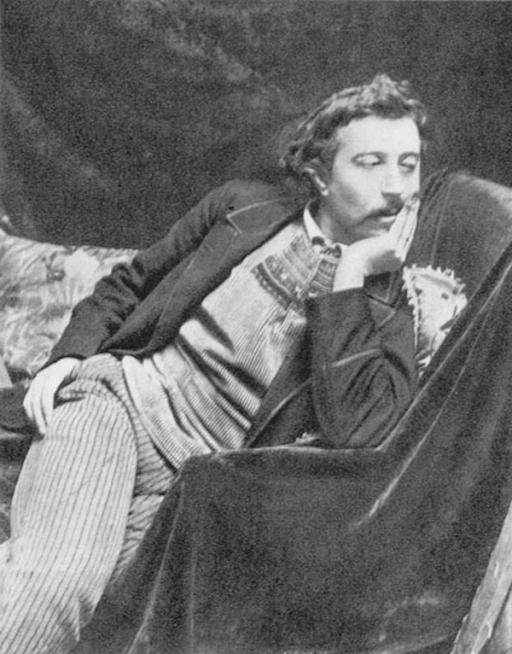
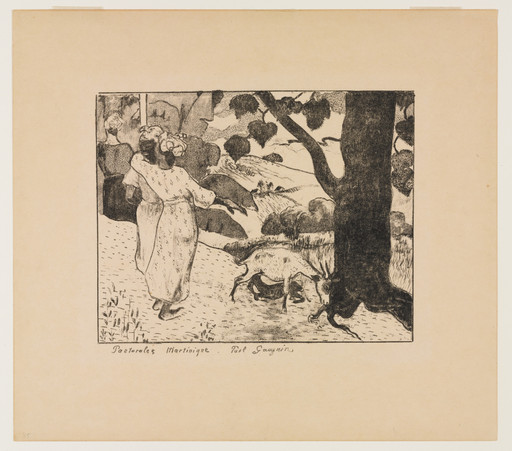
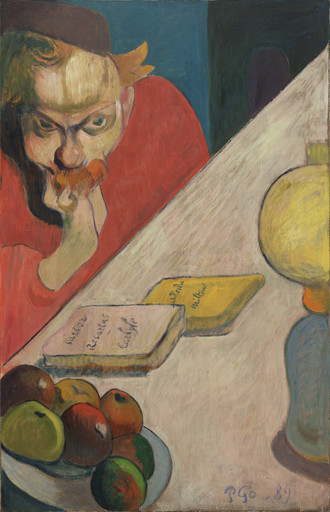
Paul Gauguin
French, 1848–1903 35 works onlineAlong with his contemporaries Vincent van Gogh and Paul Cézanne , Paul Gauguin was a pioneer of modernist art. His use of expressive colors, flat planes, and simplified, distorted forms in paintings, as well as a rough, semi-abstract aesthetic in sculptures and woodcuts , exerted a profound influence on avant-garde artists in the early 20th century, from Henri Matisse and Pablo Picasso to the German Expressionists .
Learn more →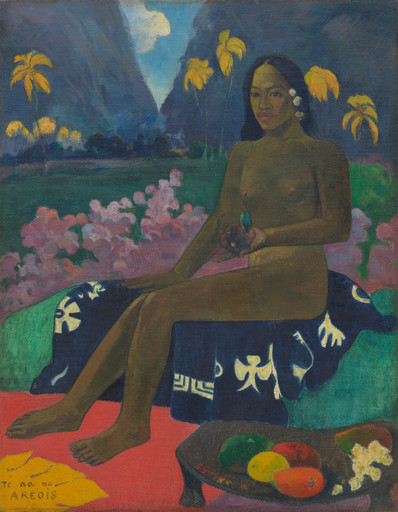
Still life
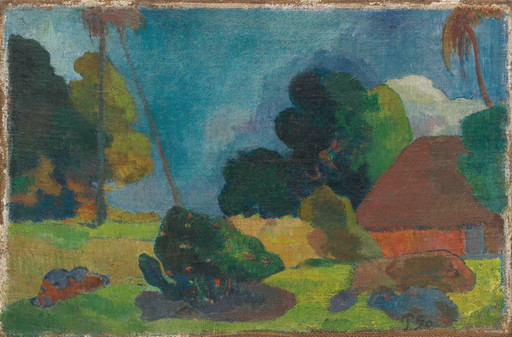
A representation of natural or manmade objects in any arrangement or combination an artist devises and in any medium.
Learn more →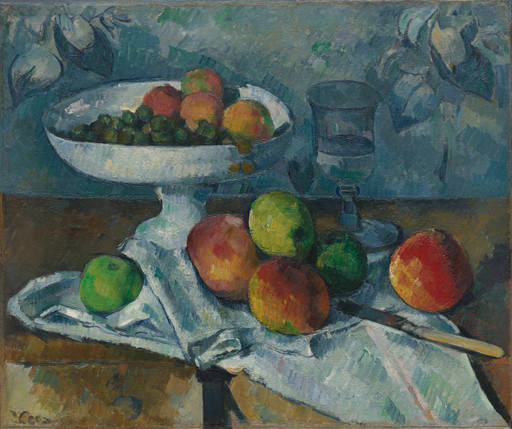
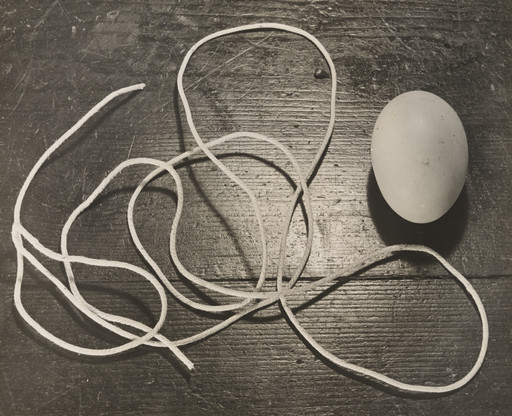
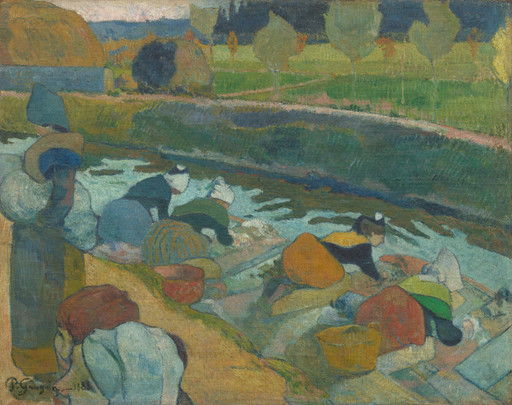
French Landscapes and Interiors
Gallery 501The late 19th century in France was an era of rapid change: the emergence of mass media, new and faster forms of transportation, urban expansion of cities like Paris, and developments in industry.
Learn more →
From MoMA Design Store


Installation views
We have identified this work in the following photos from our exhibition history.
Provenance Research Project
This work is included in the Provenance Research Project, which investigates the ownership history of works in MoMA's collection.
Amedée Schuffenecker, Paris [1]; Galerie Miethke (Carl Moll), Vienna, 1907 [2]. Acquired by Thea Sternheim (1883-1971), Munich/Brussels/Paris, 1912 [3]; on extended loan to The Museum of Modern Art, New York, April 4, 1939 [4]; seized by Alien Property Custodian, New York, July 1944; returned to Thea Sternheim, Paris, May 1951; sold (through Paul Rosenberg & Co., New York) to The Museum of Modern Art, New York, May 1952.
[1] Catalogue raisonne Wildenstein 2002, vol. 2, no. 311.
[2] Offered for sale at Gauguin exhibition at Galerie Miethke, Vienna (March 15-April 28, 1907), no. 35.
[3] Offered for sale at the "Internationale Kunstausstellung des Sonderbundes Westdeutscher Kunstfreunde und Künstler," Cologne, May 1912-September 30, 1912 (cat. no. 155: Tisch mit 3 fressenden Hündchen, 1888. Acquired from there by Thea Sternheim in 1912.
It is plausible that this work passed through Ambroise Vollard's hands at some stage before Sternheim's acquisition. See James Laver, French Painting and the Nineteenth Century. With Notes on Artists and Pictures by Michael Sevier and a Postscript by Alfred Flechtheim, New York: Charles Scribner's, 1937, p. 94, no. 129: "From the collection of M. Ambroise Vollard. / Coll.: Mme. Carl Sternheim, Paris."
Included in the auction "Van Gogh Gauguin - Renoir: Collection Mme Théa Sternheim," Frederik Muller & Cie, Amsterdam, February 11, 1919, lot 2. Unsold.
[4] Included in the exhibition Art in Our Time: 10th Anniversary Exhibition, The Museum of Modern Art, New York, May 10-September 30, 1939, no. 64.
Provenance research is a work in progress, and is frequently updated with new information. If you have any questions or information to provide about the listed works, please email [email protected] or write to:
Provenance Research Project
The Museum of Modern Art
11 West 53 Street
New York, NY 10019
Licensing
Artwork or archival images
If you would like to reproduce an image of a work of art in MoMA's collection, or an image of a MoMA publication or archival material (including installation views, checklists, and press releases), please contact Art Resource (publication in North America) or Scala Archives (publication in all other geographic locations).
Audio and film clips
MoMA licenses archival audio and select out of copyright film clips from our film collection. At this time, MoMA produced video cannot be licensed by MoMA/Scala. All requests to license archival audio or out of copyright film clips should be addressed to Scala Archives at [email protected]. Motion picture film stills cannot be licensed by MoMA/Scala. For access to motion picture film stills for research purposes, please contact the Film Study Center at [email protected]. For more information about film loans and our Circulating Film and Video Library, please visit Circulating Film and Video Library.
Text from a publication or the archives
If you would like to reproduce text from a MoMA publication, please email [email protected]. If you would like to publish text from MoMA's archival materials, please fill out this permission form and send to [email protected].
Feedback
This record is a work in progress. If you have additional information or spotted an error, please fill out this feedback form.