

An unusual approach is one of the key strategies that signal an ideological shift.
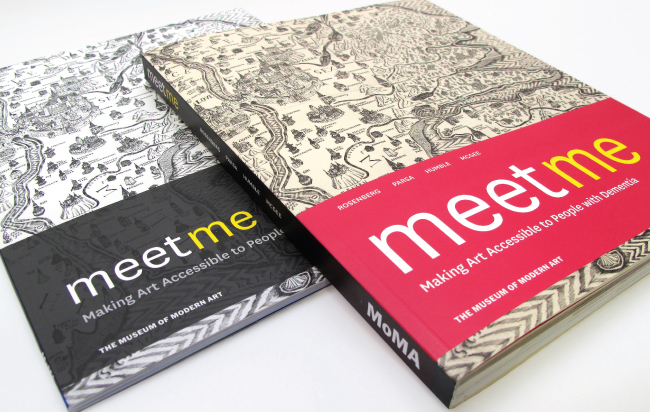
When approached by Francesca Rosenberg to design the Meet Me publication for MoMA’s Access Programs, we were given three criteria:
1. Must use hot-pink color. (I’m not kidding. If you know Francesca Rosenberg, MoMA’s Director of Access and Community Programs, you would know that this is a legitimate request.)
2. Don’t make it look like a guidebook (even though, in its essence, it is a guidebook).
3. Make the content accessible to three diverse audiences: museum professionals, care organizations, and individual families.
The unusual color request was just one sign of how MoMA’s Access Program educators were contributing to an ideological shift in the way both institutions and individuals think about Alzheimer’s disease. This was not going to be just another black-and-gray manual. The intention was to create a book that was uplifting in both function and form, focusing on the fact that life can still be meaningful and joyful for these families, a book that embodies the mission and focus of the Meet Me at MoMA program. This was going to be a book about inspiring meaningful interactive experiences, making connections between people and art, and making art accessible. It would be anything but a guidebook.