
MoMA
Posts tagged ‘Education’
April 12, 2010  |  Events & Programs
The Shape of Things

A seven- or eight-year-old boy sits at a table and carefully sifts through a pile of brightly-colored laminated shapes. I have posed a challenge: can you show a person running? At first, he is stumped. He picks up some pieces but then declares, “I can’t.” So I pose for him. I bend my arms and legs and ask him to look at the shapes they are making, and then ask him to see if he can find or even combine some shapes to show that movement. I leave him for a few minutes and then return. He proclaims, “I did it!” and indeed he did. Using shapes such as simple rectangles and squares, and the more complex “L” and rectangular “U”s, he has created an abstracted figure of a man running. Later I ask if he can document his creation with a drawing, which he does.

Such is a typical experience as a facilitator for Shape Lab, our latest interactive space at MoMA.
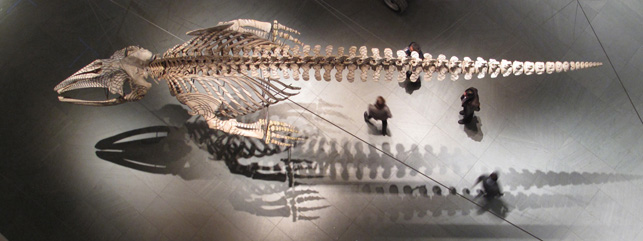
Biography of a Whale

Gabriel Orozco. Installation view of Mobile Matrix (2006) at The Museum of Modern Art, New York. Graphite on gray whale skeleton. Biblioteca Vasconcelos, Mexico City. Photo: Charles Watlington. © 2010 Gabriel Orozco

Every work at a museum may compel a viewer to wonder how it was made or where it came from. However, there are some works whose genesis provokes a special degree of collective fascination. Gabriel Orozco’s Mobile Matrix, currently on view in MoMA’s Gabriel Orozco exhibition, is one such work.

February 1, 2010  |  Events & Programs
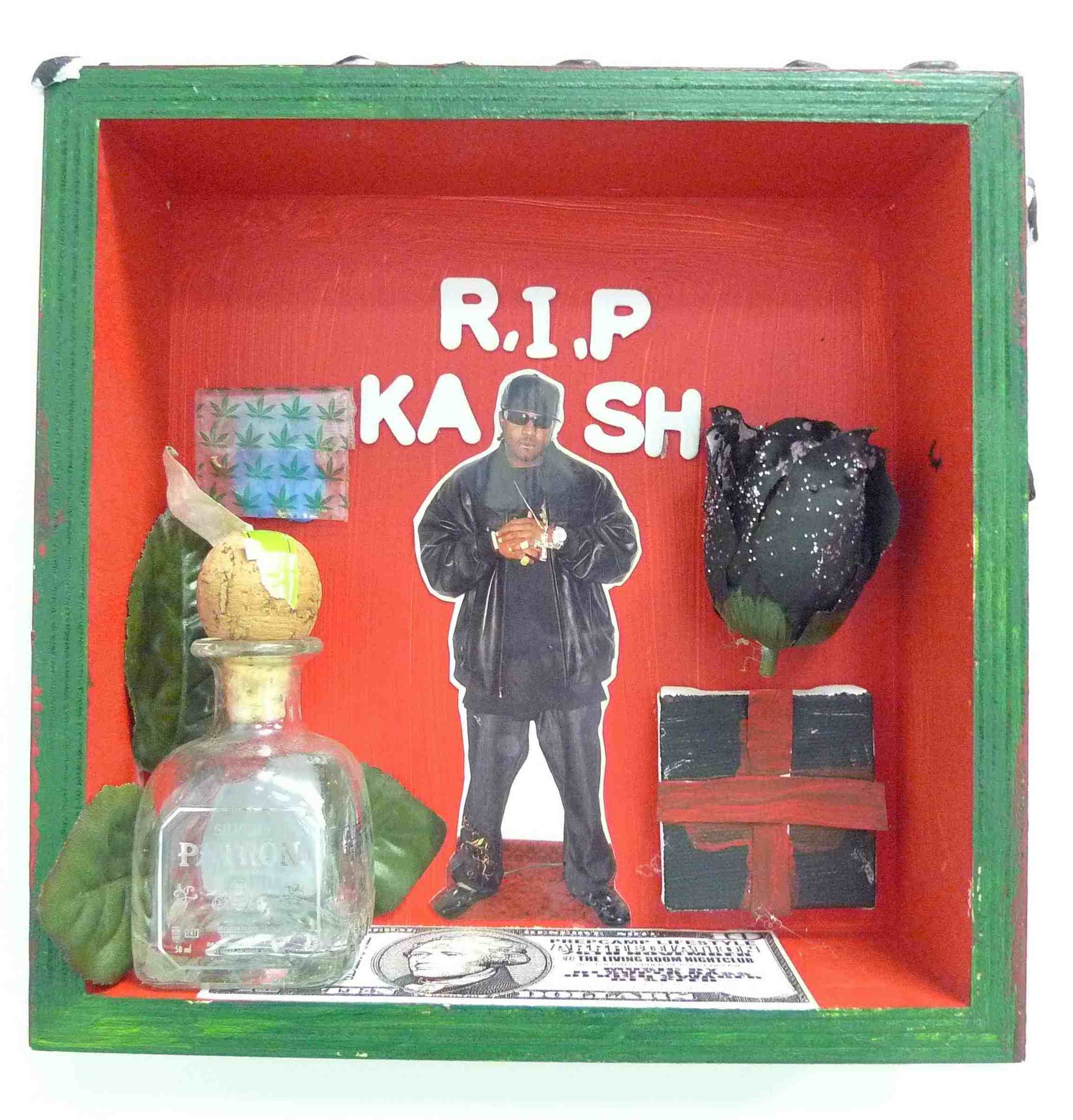
Things We Hold Close: Altars from the Women of Midtown Community Court’s WISE Program

Located just blocks away from The Museum of Modern Art, the WISE program at the Midtown Community Courthouse (MCC) is the only comprehensive initiative in New York City for women over the age of 21 who have been arrested for prostitution-related offenses. As victims of physical and sexual violence, exploitation and human trafficking, many of these women lack both the fortitude and the support that they need to escape the cycle of re-arrest and re-victimization. WISE (the name is an acronym for Women’s Independence, Safety, and Empowerment) provides this support through individual and group counseling, as well as by teaching financial literacy to promote economic self-sufficiency.

Museum Kids: Keeping It Real
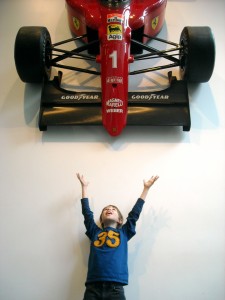
Ethan is delighted by the Formula 1 Racing Car hanging in the Education and Research building lobby.

Ethan is delighted by the Formula 1 Racing Car hanging in the Education and Research building lobby.

Just after I’d accepted my job at MoMA, I brought my six-year-old son along with me to visit. He entered the Marron Atrium and, with a sweeping, 360-degree review and an air of finality, announced, “I like your new museum, mom.” Good thing it passed muster.

I often wonder what it is to grow up in a museum. From the time he was two, Ethan had a steady diet of contemporary art. Bridges made of Meccano sets; entire cities built of pots and pans; rooms glowing with neon tubes; walls covered with “parades” of people made from ripped black construction paper; cars and trailers jack-knifed, emerging out of a museum plaza; metal squares on the floor, perfect for playing hopscotch—to Ethan, art always seems full of possibilities.

His own “work” attests to that, as we find colored-tape installations proliferating throughout our apartment—often accompanied by an objet trouvé repurposed in interesting ways, or a small love note to mom and dad.

Ethan, now nine, accompanied me to the office last week.

December 23, 2009  |  Behind the Scenes, Collection & Exhibitions
Bauhaus Lab

Bauhaus Lab has been a new experiment for us at MoMA: we sought to create a space where various audiences could both get a sense of the original curricula of the famed school, and participate in events and activities that carried the Bauhaus spirit into the twenty-first century. The planning of the Bauhaus Lab was an extensive process that involved several months of  research, planning, and experimentation, and represented a true collaborative effort amongst the Education Department staff. In this video, my colleagues Amy Horschak and Laura Beiles discuss some of the thinking behind the activities we developed and tell a few behind-the scenes anecdotes about the project.

Ellen Lupton Inspires a New Kind of Visual Literacy

After nearly a month of visiting the Bauhaus 1919–1933: Workshops for Modernity exhibition, many of us throughout the Museum took away at least one powerful message: don’t be afraid to cross disciplines. The fearlessness, enthusiasm, and collaboration of the students and masters is apparent in the show’s work.

So, upon learning that design education legend and DIY hero Ellen Lupton would be running several workshops in the Bauhaus Lab series, our Graphic Design department decided not to make a poster for her visit, but rather to shoot and edit a video. Of course, stepping out of your area of expertise requires collaboration, so we teamed up with two of the Museum’s video experts: Beth Harris, Director of Digital Learning, and David Hart, Associate Media Producer. It was a humbling and exciting experience.

A Bauhausian Ballet at MoMA
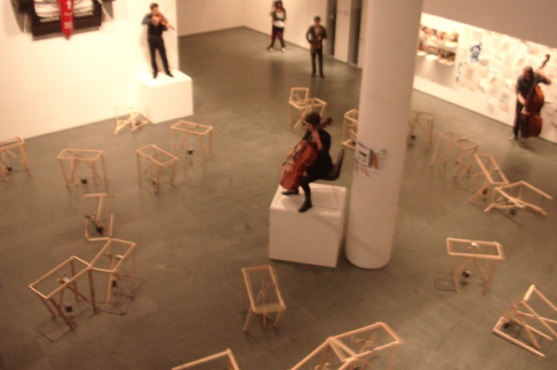
Machine Project's Walking Tables and Wrestling Foals

Machine Project's Walking Tables and Wrestling Foals

In planning the programs for MoMA’s Bauhaus Lab, we wanted to give the public the opportunity not only to experience original Bauhaus curricula, but also to meet contemporary artists with multidisciplinary practices in an experimental spirit similar to the Bauhaus. The L.A.-based collective Machine Project most definitely falls into this category. (Machine’s approach to pedagogy as performance was previously presented this year at MoMA during the symposium Transpedagogy: Contemporary Art and the Vehicles of Education.)

November 25, 2009  |  Collection & Exhibitions, Events & Programs
Bauhaus Lab: The Secret Ingredient?
Bauhaus Lab: Johannes Itten and Paul Klee Curricula Workshops, The Lewis B. and Dorothy Cullman Education and Research Building

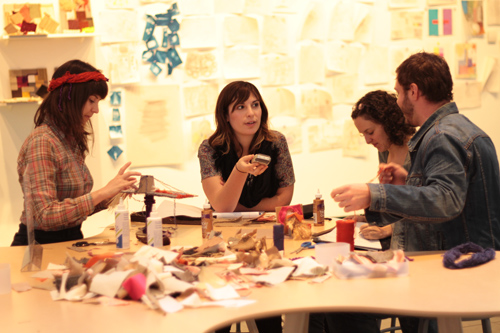
Bauhaus Lab: Johannes Itten and Paul Klee Curricula Workshops, The Lewis B. and Dorothy Cullman Education and Research Building

In MoMA’s Cullman Education and Research Building, you’ll find visitors sitting at clover-like Bauhaus tables (based on the original workshop photographs) working on drawing exercises devised by Bauhaus masters Johannes Itten and Paul Klee. Interestingly, Klee and Itten themselves were actually not so happy sharing a table—the dinner table, that is.

Bauhaus Lounge: When the Couch Matches the Art
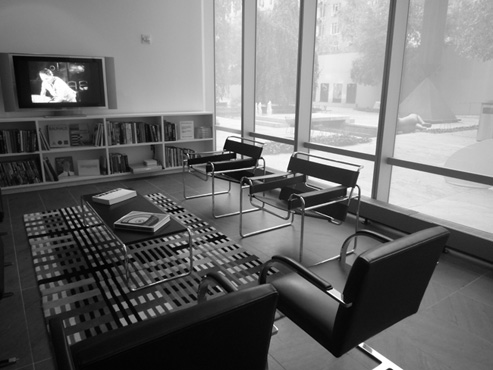
Bauhaus Lounge, The Lewis B. and Dorothy Cullman Education and Research Center

Bauhaus Lounge, The Lewis B. and Dorothy Cullman Education and Research Center

Matching the artwork with the living room couch is one of the perennial concerns of any collector. But when it comes to the Bauhaus, which was as much about designing couches as it was about artworks, finding the right furniture piece shouldn’t be a problem. Or so it seemed to us at the Education Department. During the exhibition Bauhaus 1919–1933: Workshops for Modernity, we imagined turning the reading room space in MoMA’s Cullman building into a Bauhaus Lounge, equipped with Bauhaus furniture for visitors to relax on while they watch a video of a reconstruction of Oskar Schlemmer’s Triadic Ballet or browse through Bauhaus literature. We thought we had enough original Bauhaus-designed chairs lying around MoMA’s buildings that it couldn’t be too hard to put such a lounge together. We do have a Wassily chair (no one remembers where it came from) that sits in the Education offices; we also snatched away a few other chairs from a conference room and two Mies van der Rohe Barcelona chairs from outside of Glenn Lowry’s office waiting area (his office wants them back after the show).