MoMA’s celebration of the landmark year 1913 continues with the third in a series of videos highlighting important works from 1913 in the Museum’s collection.


Posts in ‘Collection & Exhibitions’
January 25, 2013
|
1913 Centennial Celebration,
Collection & Exhibitions,
Videos
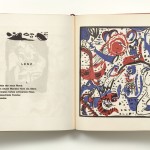
1913: Vasily Kandinsky’s Klänge (Sounds)
January 24, 2013
|
Artists,
Collection & Exhibitions
Avant-Abstraction: Kupka and Mondrian Represent
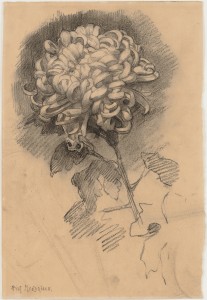
Piet Mondrian. Chrysanthemum. 1906. Charcoal on paper, 14 1/4 x 9 5/8″ (36.2 x 24.5 cm). The Museum of Modern Art, New York. Gift of Mr. and Mrs. Armand P. Bartos
Among the groundbreaking artists included in the exhibition Inventing Abstraction, 1910–1925, currently on view in MoMA’s sixth-floor galleries, are František Kupka (Czech, 1871–1957) and Piet Mondrian (Dutch, 1872–1944). Like the other luminaries represented in the show, beginning in the second decade of the 20th century, Kupka and Mondrian jettisoned figuration and pioneered an art of pure form.
January 23, 2013
|
Collection & Exhibitions
On Loan: Richard Artschwager’s Interior #2
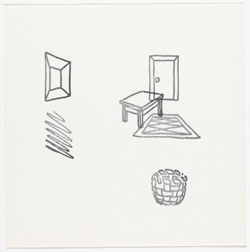
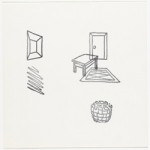
Richard Artschwager. Untitled from the Rubber Stamp Portfolio. 1976. Rubber stamp. Publisher: Parasol Press, New York. Edition: 1,000. Gift of Parasol Press, Ltd. and the Publications Department of The Museum of Modern Art. © 2013 Richard Artschwager/Artists Rights Society (ARS), New York
Door, window, table, basket, mirror, rug. These six simple elements—found in many a living room and throughout the glossy pages of any home furnishing catalogue—are the components of a series that Richard Artschwager began creating in 1974.
January 18, 2013
|
1913 Centennial Celebration,
Collection & Exhibitions,
Videos
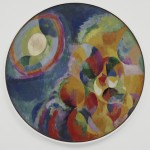
MoMA Celebrates 1913: Robert Delaunay’s Simultaneous Contrasts: Sun and Moon
MoMA’s celebration of the landmark year 1913 continues with the second in a series of videos highlighting important works from 1913 in the Museum’s collection.

January 18, 2013
|
Behind the Scenes,
Collection & Exhibitions,
Tech
Louise Bourgeois: Spider Bytes
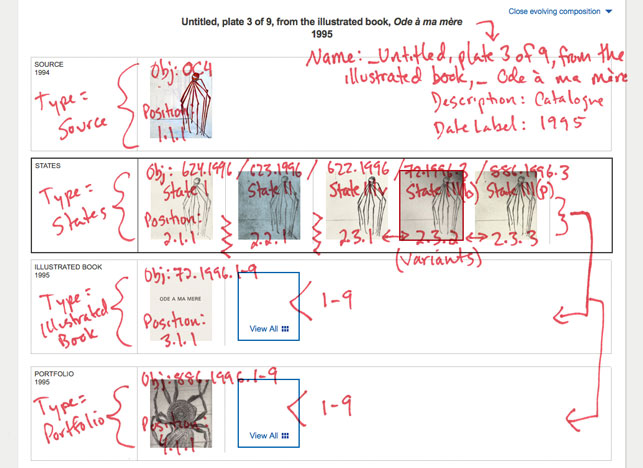
A finished diagram on the site with notes about underlying data
MoMA’s recently launched website, Louise Bourgeois: The Complete Prints & Books, seems to effortlessly reveal Bourgeois’s creative process. You might not suspect that a highly organized sea of intricate data lives behind that elegant design.
January 17, 2013
|
Artists,
Collection & Exhibitions
Taking a Slice Out of Modern Art: The Artists’ Books of Noriko Ambe
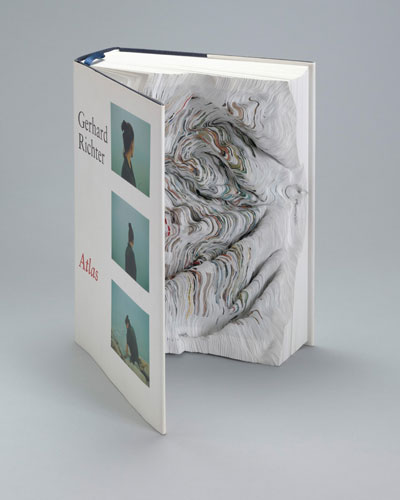
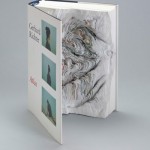
Noriko Ambe. Current—A Private Atlas: Gerhard Richter. 2009. Artist’s book. The Museum of Modern Art, New York. Fund for the Twenty-First Century. © 2013 Noriko Ambe

January 16, 2013
|
Behind the Scenes,
Collection & Exhibitions,
Performance Series
Being Moved: The Caravan Project
That thing that looks like a hollowed-out vintage caravan in MoMA’s Agnes Gund Garden Lobby, from now until January 21, is just that. And those bulky, muscular curtains—clinging to all sides—are in fact made of leaves, sweet potato stems, and other organic detritus. And yes, those are real people—dressed in gauzy, powdery garb—moving slowing around, or nestling inside of, the vehicle.
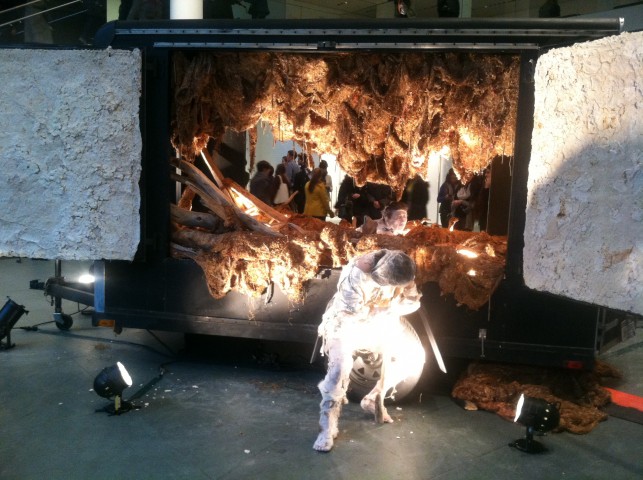
Eiko & Koma. The Caravan Project. 1999/2011/2012/2013. Installation image courtesy of Leora Morinis
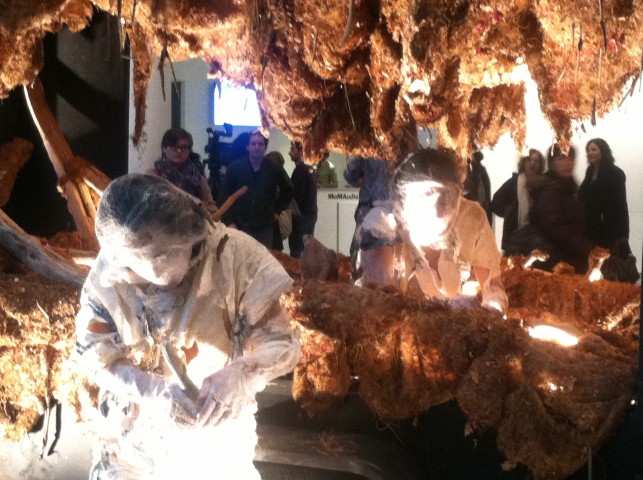
Eiko & Koma. The Caravan Project. 1999/2011/2012/2013. Installation image courtesy of Leora Morinis
What you’re seeing is The Caravan Project (1999/2011/2012/2013) a work by legendary dance duo Eiko & Koma. They have been making work together since 1972, and their history is detailed at length on the Internet and in many books, so I’ll focus here on the lesser-known story of the Caravan’s journey to MoMA and the performance about to unfold inside it.
On Monday afternoon, the Caravan arrived at MoMA from its storage space in Hackensack, New Jersey. We had to stop traffic on 54th Street for a few minutes as Koma expertly reversed it into the loading dock. And from then on, there was very little margin for error as the art handlers guided it through MoMA’s mezzanine. Despite being sealed and unadorned, it had already taken on anthropomorphic airs—seeming to me like some sort of oversized, burrowing animal, ungainly in its slow but determined movement.
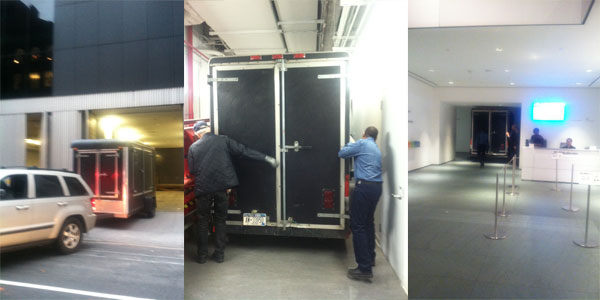
Installation images courtesy of Leora Morinis
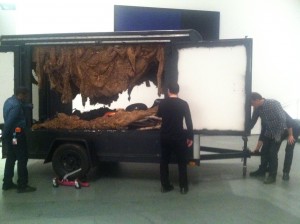
Eiko & Koma. The Caravan Project. 1999/2011/2012/2013. Installation image courtesy of Leora Morinis
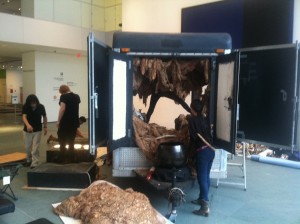
Eiko & Koma. The Caravan Project. 1999/2011/2012/2013. Installation image courtesy of Leora Morinis
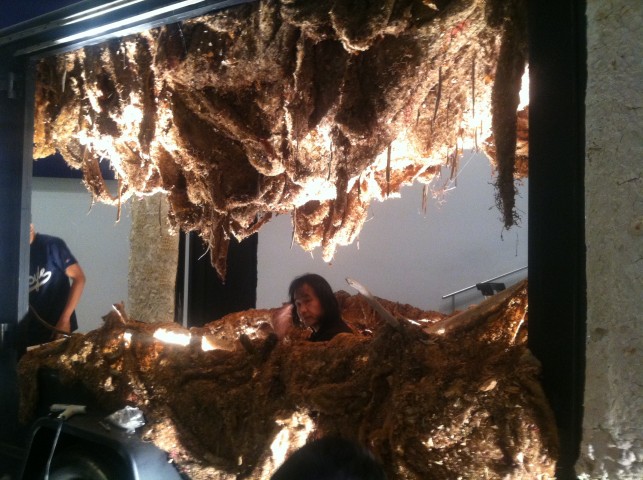
Eiko & Koma. The Caravan Project. 1999/2011/2012/2013. Installation image courtesy of Leora Morinis
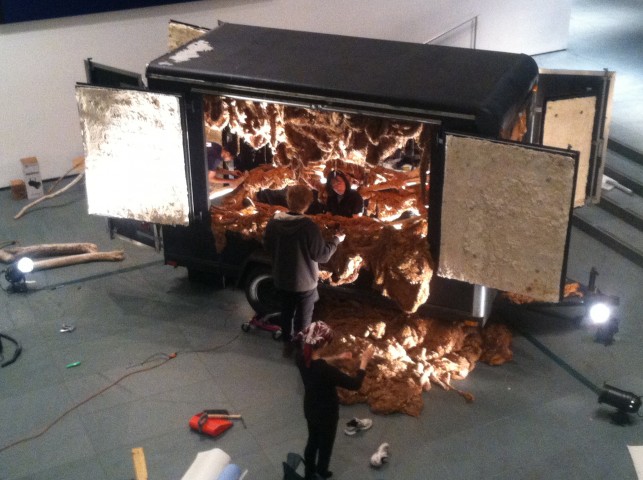
Eiko & Koma. The Caravan Project. 1999/2011/2012/2013. Installation image courtesy of Leora Morinis
The last image above depicts what the Caravan looked like as the installation was wrapping up late Tuesday evening. Illuminated from the inside and parked askew, it sits below Tony Smith’s Untitled (1962), and in front of Rodin’s Monument to Balzac (1898). That unlikely grouping—each a figure in its own right—and the nearly finalized Caravan itself, has left me with a couple of observations:
Even though the performance has yet to begin, the Caravan feels fleeting. As though it had been on-the-move and needed a quick parking space, and MoMA graciously obliged. On the other hand, it appears as though it was abandoned here decades ago, and somehow managed to remain invisible until now. Decaying in plain sight. These impressions of either happenstance or near-permanence each lend the Caravan a serenity I did not anticipate. In the busiest thoroughfare of the Museum, it seems at ease.
I’m reminded here of a story about Eiko & Koma recently told to me by a friend who’d had them as teachers at Wesleyan University. She described how, in class, they asked students to isolate under-loved or under-danced body parts: “Dance from the back of your neck,” “dance from your armpits.” In another exercise, they encouraged students to dance as if each finger had a separate persona, and in a third, students were asked to move as though plants were blooming from their bodies. These requests—dancing from minor parts of the body; reconceiving hands as a quorum of autonomous subjects; trying to adopt an arboreal pace—resonate with the Caravan’s feel and function in the Museum (albeit on a different scale). The Caravan is a slow moving organism, operating in a minor key and with a temporal sensibility that seems to rub MoMA against the grain. It invites close and extended looking, an unanticipated meditation in and on an often frenzied space.
Eiko & Koma: The Caravan Project, held in conjunction with the exhibitions </em>Tokyo 1955–1970: A New Avant-Garde</a> and </em>Performing Histories: Live Artworks Examining the Past</em>, is presented in the Museum’s Agnes Gund Garden Lobby during Museum hours from Wednesday, January 16 through Monday, January 21.</p>
January 14, 2013
|
Collection & Exhibitions,
Family & Kids
Exploring sound and space with the MoMA Studio: Common Senses Sound Map
Sound and space are closely linked. Our ears help define our surroundings by picking up on spatial clues in reflected sound waves. This innate ability to situate ourselves in our soundscape was probably more overtly useful in the days before electricity, when we had to rely on our ears to alert us to danger our eyes could not detect. There is, however, a movement in the visually impaired community to cultivate this ability
January 10, 2013
|
1913 Centennial Celebration,
Collection & Exhibitions,
Videos
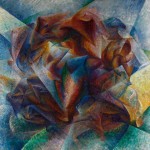
MoMA Celebrates 1913
1913 was a landmark year—a moment of highly concentrated, seemingly boundless innovation. Developments in the fields of science, technology, art, music, literature, and philosophy signaled a radical shift in the cultural landscape.
January 9, 2013
|
Artists,
Collection & Exhibitions
MoMA Launches Louise Bourgeois Website
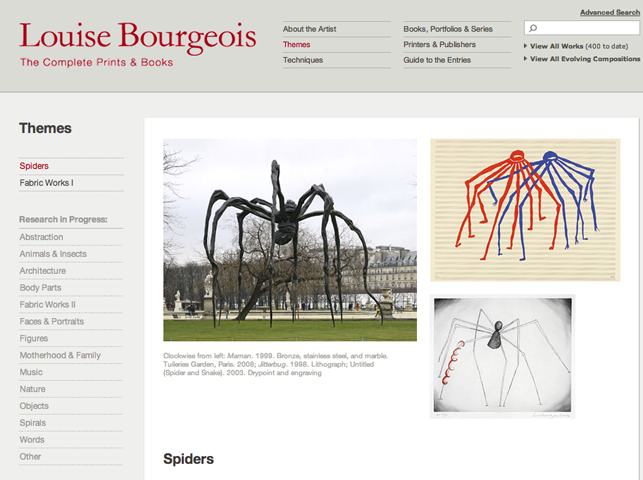
Spider theme page on MoMA.org/bourgeoisprints
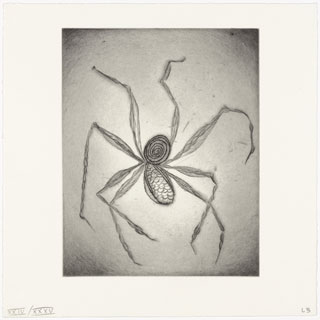
Untitled, plate 8, from the illustrated book, Ode à ma mère. 1995. Drypoint. Plate: 9 3/8 x 7 7/16” (23.8 x 18.9 cm). © 2013 Louise Bourgeois Trust
The Museum of Modern Art has launched Louise Bourgeois: The Complete Prints & Books, a major website documenting Bourgeois’s extensive work in the printmaking medium. This site offers a range of innovative, interactive approaches to the artist’s work, including the ability to examine her creative process, and to place her prints and illustrated books within the broader context of her sculpture and drawings. When discussing the various mediums, Bourgeois said: “There is no rivalry…they say the same things in different ways.” All of these works explore her fundamental themes of loneliness, anxiety, fear, jealousy, anger, and pain.
In 1990, Bourgeois decided to donate a full archive of her printed work to MoMA. This includes all completed compositions, as well as the many states and variations leading up to them. Numbering some 3,500 sheets, this unique collection makes it possible to reconstruct the artist’s step-by-step working methods. The website presents, diagrammatically, all the stages of Bourgeois’s evolving compositions and reveals the myriad ways in which she altered shapes, added tiny scratched lines, or experimented with vivid color, all in pursuit of a final vision. In addition, individual works can be examined at close range through a “Zoom” feature—particularly useful for studying prints—or compared and contrasted with a pioneering “Compare Works” mode.
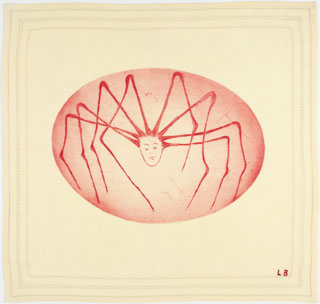
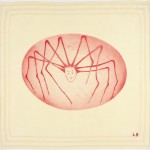
Spider Woman. 2004. Drypoint on fabric, sheet: 13 1/8 x 13 ¾” (33.3 x 34.9 cm). © 2013 Louise Bourgeois Trust
The Louise Bourgeois: The Complete Prints & Books website is the work of an integrated team of contributors, including MoMA’s curatorial, digital media, and collection and exhibition technologies staffs, as well as independent web designers and programmers and the staff of the Louise Bourgeois Studio. My own involvement with Bourgeois began when we met in 1976. I have been a committed scholar of her work ever since, and a friend until her death in 2010. The launch of what will be the definitive scholarly resource on Bourgeois’s prints—aimed also at the general art public—is a source of great pride and a sense of accomplishment for me, as well as for the entire Department of Prints and Illustrated Books at MoMA.
Please visit MoMA.org/bourgeoisprints to learn more about Louise Bourgeois’s prints and illustrated books, and her creative process.
If you are interested in reproducing images from The Museum of Modern Art web site, please visit the Image Permissions page (www.moma.org/permissions). For additional information about using content from MoMA.org, please visit About this Site (www.moma.org/site).
© Copyright 2016 The Museum of Modern Art
Welcome to MoMA.org. To take full advantage of all the site’s features, including the option to save works in the collection, please upgrade your browser to Firefox,
Google Chrome, Safari, or Internet Explorer 9.
See our help page for more information.
To take full advantage of all of the features on MoMA.org, please upgrade your browser to Firefox, Google Chrome,
Safari, or Internet Explorer 9.