The Unité d’Habitation was a landmark in modern architecture and design, and one of the first attempts to create highly designed spaces for low-income families. Along with apartments, the building included a half floor reserved for merchants, a pre-school, and a rooftop playground with wading pool and gymnasium. Le Corbusier was extremely efficient in the use of space, modeling his design on that of cruise ships,


Posts in ‘Collection & Exhibitions’

March 13, 2013
|
Behind the Scenes,
Collection & Exhibitions,
Conservation,
Le Corbusier Kitchen Conservation
Le Corbusier Kitchen Conservation: Focus on Design
March 7, 2013
|
Artists,
Collection & Exhibitions
Dating Brandt
One of the underlying principles of Bill Brandt: Shadow and Light, currently on view in MoMA’s third-floor Photography Galleries, is the importance of vintage prints to understanding Brandt’s oeuvre—and by vintage print I mean a photographic print that was made around the same time as its negative. Anyone who visits the exhibition will surely be impressed by the fine quality of prints
March 1, 2013
|
Collection & Exhibitions
The Making of Louise Bourgeois’s The Fragile
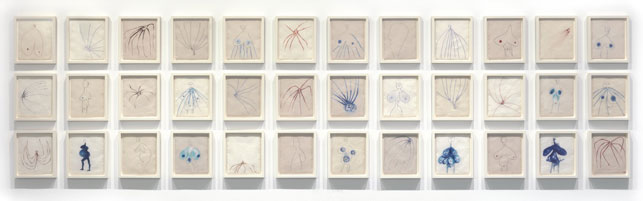
Louise Bourgeois. The Fragile. 2007. Series of 36 compositions: 29 digital prints and 7 screenprints, 30 with dye additions, sheet (each approx.): 11 1/2 x 9 1/2″ (29.2 x 24.1 cm). © 2013 Louise Bourgeois Trust
Don’t miss Louise Bourgeois’s The Fragile, on view through March 8 on MoMA’s second-floor landing, outside the entrance to the Prints and Illustrated Books Galleries. The Fragile is included in the first 400 works on the Museum’s recently launched online catalogue raisonné, Louise Bourgeois: The Complete Prints & Books.
February 28, 2013
|
Collection & Exhibitions
Watching the Wind: Viégas and Wattenberg’s Wind Map
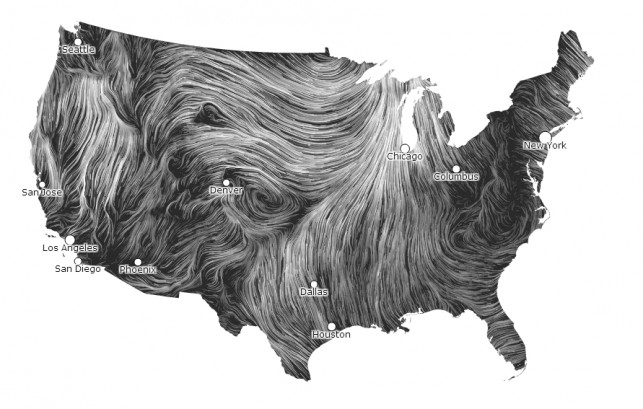
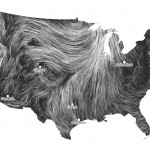
Fernanda Viégas and Martin Wattenberg. Wind Map. 2012. Interactive software
What’s more poetic than the wind? The moon comes close I suppose, but I wonder if even the moon can hold a candle to the wind.
February 18, 2013
|
Artists,
Behind the Scenes,
Collection & Exhibitions
Louise Bourgeois: A Flashback of Something that Never Existed
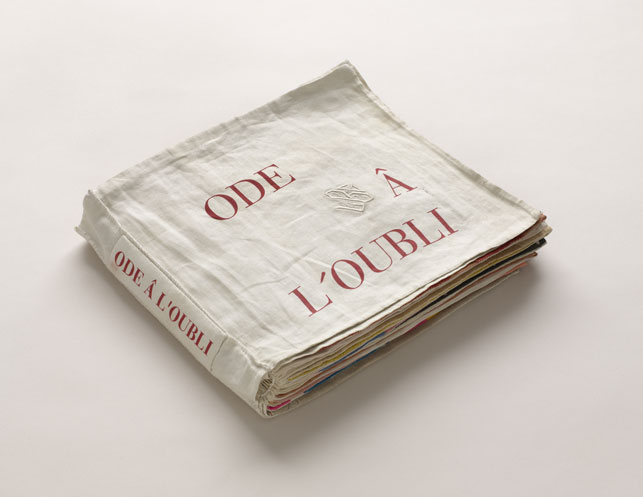
Louise Bourgeois. Ode à l’oubli. 2002. Fabric illustrated book with 35 compositions: 32 fabric collages, 2 with ink additions, and 3 lithographs (including cover), page (each approx.): 11 3/4 x 13” (29.8 x 33 cm); overall: 11 x 12 3/16 x 1 ¾” (28 x 31 x 4.5cm). © 2013 Louise Bourgeois Trust
The first installment of MoMA’s new online project Louise Bourgeois: The Complete Prints & Books includes Bourgeois’s fabric book Ode à l’oubli. In 2002, at the beginning of her 90th decade, Bourgeois constructed the book’s linen binding and pages out of 60-year-old, monogrammed hand towels from her 1938 wedding.
February 12, 2013
|
1913 Centennial Celebration,
Collection & Exhibitions,
Videos
MoMA Celebrates 1913: Emil Nolde’s Young Couple
MoMA’s celebration of the landmark year 1913 continues with the fifth in a series of videos highlighting important works from 1913 in the Museum’s collection.

February 7, 2013
|
Behind the Scenes,
Collection & Exhibitions,
Conservation,
Le Corbusier Kitchen Conservation
Le Corbusier Kitchen Conservation: Getting Resourceful
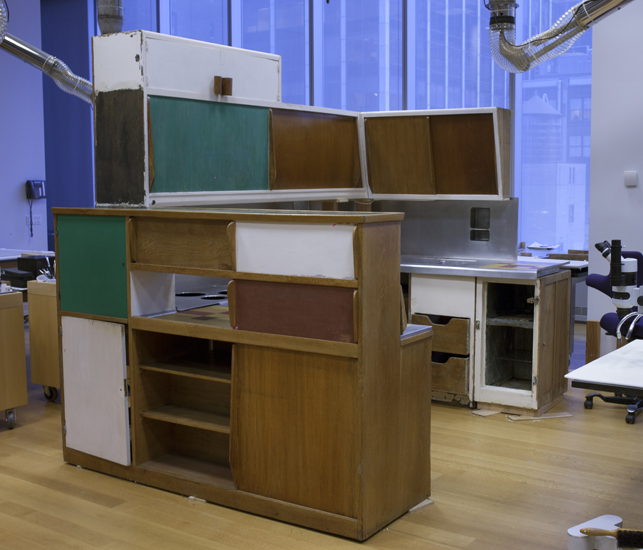
Charlotte Perriand and Le Corbusier. Kitchen from the Unité d’Habitation, Boulevard Michelet, Marseilles, France
One of the initial challenges in conserving a design piece that has been in use for over 60 years is assessing where the work has been modified over the years by the owners, and if it is truly complete. Like in our own homes, parts of this Le Corbusier kitchen have been replaced, painted over, lost, and damaged.
February 4, 2013
|
1913 Centennial Celebration,
Collection & Exhibitions,
Videos
MoMA Celebrates 1913: Fernand Léger’s Contrast of Forms
MoMA’s celebration of the landmark year 1913 continues with the fourth in a series of videos highlighting important works from 1913 in the Museum’s collection.
January 30, 2013
|
Artists,
Collection & Exhibitions,
Fluxus
Exhibiting Fluxus: Mapping Hi Red Center in Tokyo 1955–1970: A New Avant-Garde
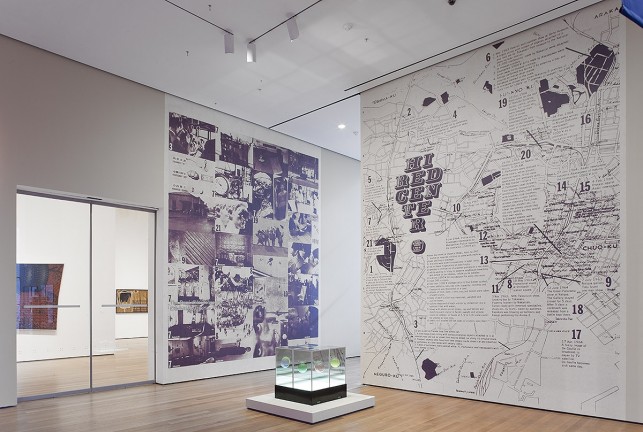
Installation view of entrance to Tokyo 1955–1970: A New Avant-Garde at The Museum of Modern Art, November 19, 2012–February 25, 2013. Photo: Jonathan Muzikar
Fluxus currents flow throughout the exhibition Tokyo 1955-1970: A New Avant-Garde, not only in the graphic scores discussed in my last blog post, but also in a section devoted to the experimental art collective Hi Red Center.
January 25, 2013
|
Collection & Exhibitions,
Publications
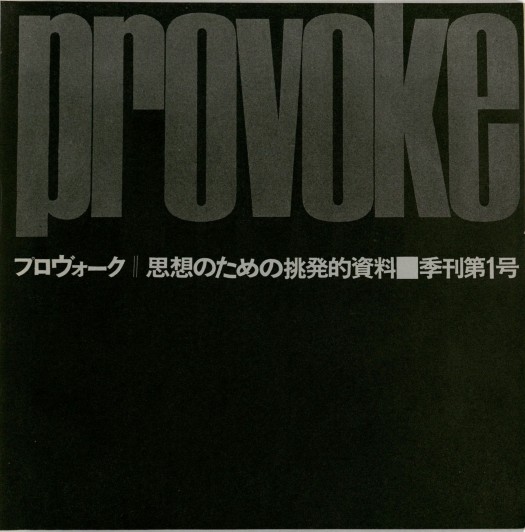
For the sake of thought: Provoke, 1968–1970
</em></em> Provoke (Purovōku) was an experimental magazine founded by photographers Yutaka Takanashi and Takuma Nakahira, critic Koji Taki, and writer Takahiko Okada in 1968. The magazine’s subtitle read as: shisō no tame no chōhatsuteki shiryō (Provocative documents for the sake of thought). Photographer Daido Moriyama is most often associated with the publication, but Moriyama did not join the magazine until the second issue.
</p>
If you are interested in reproducing images from The Museum of Modern Art web site, please visit the Image Permissions page (www.moma.org/permissions). For additional information about using content from MoMA.org, please visit About this Site (www.moma.org/site).
© Copyright 2016 The Museum of Modern Art
Welcome to MoMA.org. To take full advantage of all the site’s features, including the option to save works in the collection, please upgrade your browser to Firefox,
Google Chrome, Safari, or Internet Explorer 9.
See our help page for more information.
To take full advantage of all of the features on MoMA.org, please upgrade your browser to Firefox, Google Chrome,
Safari, or Internet Explorer 9.