
75 Watt, Revital Cohen and Tuur Van Balen’s performance design project, brings new meaning to the concept of the medium is the message.


Posts in ‘Collection & Exhibitions’

August 21, 2014
|
Artists,
Collection & Exhibitions,
Publications
A Literary Guide to a Sensory Experience

Cover of Lygia Clark: The Abandonment of Art, 1948–1988, published by the Museum of Modern Art, New York
Lygia Clark: The Abandonment of Art, 1948–1988 is the companion catalogue to the exhibition under the same title, co-organized by Luis Pérez-Oramas, The Estrellita Brodsky Curator of Latin American Art, MoMA, and Connie Butler, Chief Curator, Hammer Museum, with Geaninne Gutiérrez-Guimarães and Beatriz Rabelo Olivetti, Curatorial Assistants, Department of Drawings and Prints, MoMA. The first comprehensive retrospective to take place in North America, this landmark exhibition is matched by the accompanying publication, containing 13 chapters and 380 plates.
August 14, 2014
|
Artists,
Collection & Exhibitions
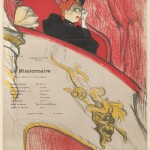
A Window into MoMA’s Collection of Parisian Avant-Garde Theater Programs
Henri de Toulouse-Lautrec (1864–1901) was a modern chronicler of Belle Époque Paris. Entrenched in Montmartre life, Lautrec eagerly recorded the late 19th-century dance halls, cabarets, and restaurants integral to his social life with honesty, humor, and liveliness. One of his favorite forms of entertainment was the theater;

August 7, 2014
|
Artists,
Collection & Exhibitions,
Publications,
Tech
The Art of Picasso as You’ve Never Seen It Before
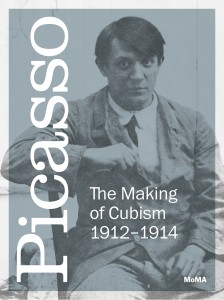
Cover image of the e-book Picasso: The Making of Cubism 1912–1914, published by MoMA.
MoMA recently launched its first digital-only publication, Picasso: The Making of Cubism 1912–1914, edited by Anne Umland and Blair Hartzell, with Scott Gerson. This immersive, interactive study features over 400 high-resolution images and the latest research on 15 groundbreaking Cubist works created by Picasso between 1912 and 1914, and is available as an iPad app through the App Store, or an interactive PDF through MoMAstore.org.

July 31, 2014
|
Artists,
Collection & Exhibitions
MoMA’s Tiniest Drawing: A Max Ernst Microbe
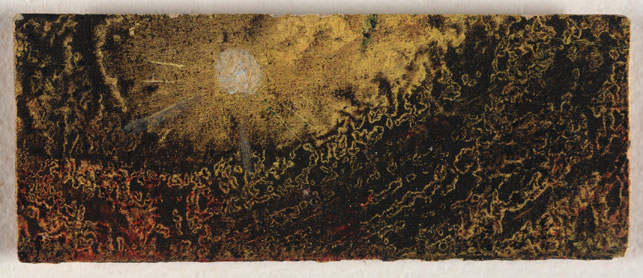
Max Ernst (French, born Germany. 1891–1976). Adam and Eve Expelled from the Garden of Eden. 1946–47. Gouache on cardstock, 1/2″ x 1 3/8″ (1.4 x 3.6 cm). The Museum of Modern Art, New York. Gift of Pierre Matisse in memory of Patricia Kane Matisse. © 2014 Artists Rights Society (ARS), New York/ADAGP, Paris
One of the great privileges of being a curator at MoMA is firsthand access to the works that make up our outstanding collection. Yet, even in the case of the Drawings collection, with its share of easily handled, two-dimensional works, this access often begins with an exploration of our digital database. The basic information on a work—artist, title, date, etc.—is readily available here, and makes it an invaluable resource for early research on any project.
July 24, 2014
|
Artists,
Collection & Exhibitions
“But Is It Art?” Constantin Brancusi vs. the United States
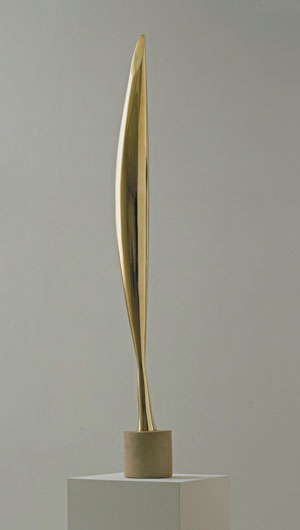
Constantin Brancusi. Bird in Space. 1928. Bronze, 54 x 8 1/2 x 6 1/2″ (137.2 x 21.6 x 16.5 cm). Given anonymously
Constantin Brancusi (1876–1957) was born in Romania, but from 1904 he lived and worked as a sculptor in Paris.
July 3, 2014
|
Collection & Exhibitions,
Learning and Engagement
Polke Pop-Up Activity Space
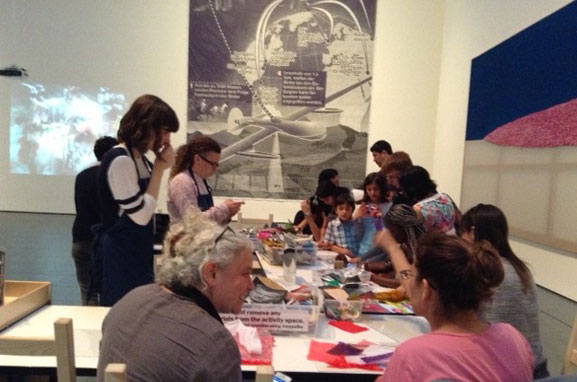
MoMA visitors participate in a Polke Pop-Up Activity
If you happen to visit the exhibition Alibis: Sigmar Polke 1963–2010 on Tuesday afternoons you will notice something different: the sight of Museum visitors making art inspired by Sigmar Polke’s processes, in close proximity to his works of art. This shift toward more hands-on learning experiences is not something that happened overnight.
June 25, 2014
|
Collection & Exhibitions
The Cien House: Building Conceptions in Space
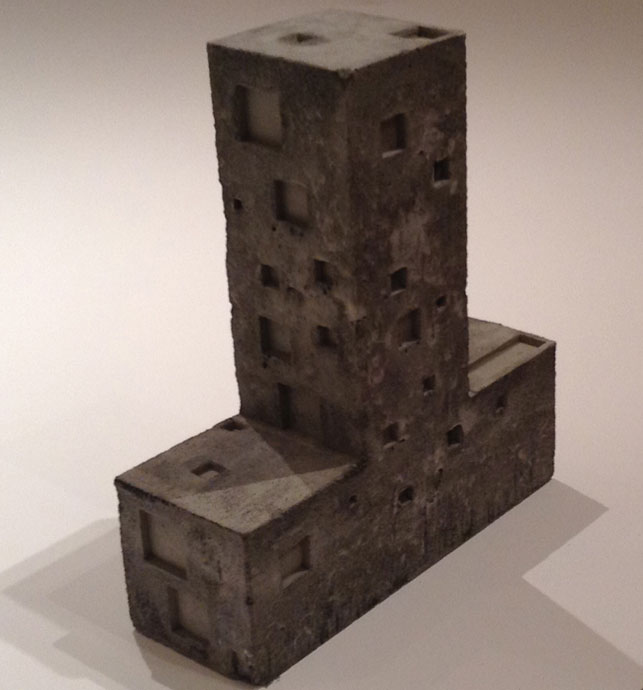
Pezo von Ellrichshausen, Mauricio Pezo, Sófia von Ellrichshausen. Cien House, Concepción, Chile. 2009–11. Concrete model, 14 × 14 × 5″ (35.6 × 35.6 × 12.7 cm). Photo: Pamela Popeson
I’m a big fan of buildings, which is to say walking around looking at buildings, taking city architecture tours by bike, or car trips out to a particular site, checking out exteriors, interiors—all of it. But for me, architects’ models and drawings are really where it’s at.
There’s an intimacy to architectural drawings and models that fosters a feeling of a sort of partnership, offering an insider’s invitation to that place where it’s clear that the ideas behind making buildings are about so much more than the plans for access elevators or where to put the closets.

June 23, 2014
|
Artists,
Collection & Exhibitions
The Subway and the City: Massimo Vignelli, 1931–2014

Massimo and Lella Vignelli. Photo: Barry McKinley. Courtesy AIGA
When Massimo Vignelli, one of the greatest graphic designers of the 20th century, was close to death in mid-May, his son Luca informed the whole design community—at Vignelli’s request—so we could say goodbye with our thoughts and with a letter.
June 20, 2014
|
Collection & Exhibitions
Talking John Cage with David Platzker and Jon Hendricks
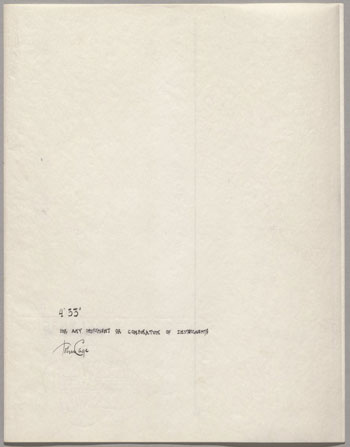
John Cage. 4’33” (In Proportional Notation). 1952/53. Ink on paper, each page: 11 x 8 1/2″ (27.9 x 21.6 cm). The Museum of Modern Art, New York. Acquired through the generosity of Henry Kravis in honor of Marie-Josée Kravis, 2012. © 2014 John Cage Trust
If you are interested in reproducing images from The Museum of Modern Art web site, please visit the Image Permissions page (www.moma.org/permissions). For additional information about using content from MoMA.org, please visit About this Site (www.moma.org/site).
© Copyright 2016 The Museum of Modern Art
Welcome to MoMA.org. To take full advantage of all the site’s features, including the option to save works in the collection, please upgrade your browser to Firefox,
Google Chrome, Safari, or Internet Explorer 9.
See our help page for more information.
To take full advantage of all of the features on MoMA.org, please upgrade your browser to Firefox, Google Chrome,
Safari, or Internet Explorer 9.