MoMA
Posts in ‘Events & Programs’
March 15, 2010  |  Events & Programs
My Life in Museums: The Importance of Community Outreach and Teen Programs

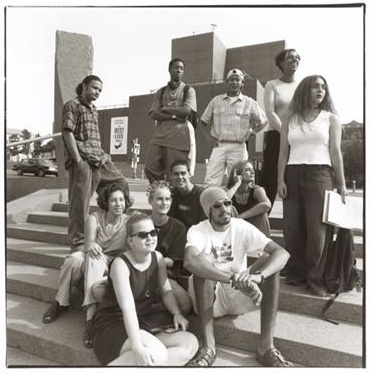
The author (center, in black shirt) with the Walker's first Teen Arts Council, 1996

Yesterday afternoon I was teaching printmaking to students at a nonsecure educational facility run by the Juvenile Justice Department, when one of the teens showed me what he was working on and said, “My work looks good, man. You should put it up in your museum.”

He meant it jokingly, the sort of statement teens make when they’re proud of themselves and overcome with a bit of adolescent bravado. But behind all of that was a clear yearning to be seen, for his hard work to be recognized. Today, his group visited the Museum for a guided tour, and I was able to hand them information on MoMA’s teen programs. I told them that if they wanted their art to hang here, a first step to take is signing up for one of our free classes. These students are being educated at their facility because, for whatever reason, mainstream education isn’t working for them. But I have utter faith that, high school dropout or honor roll student, rich or poor, attending teen programs at a museum will irrevocably alter their lives for the better. That isn’t hyperbole. It’s personal history.

March 8, 2010  |  Events & Programs
Eavesdropping and Poetry in the MoMA Galleries

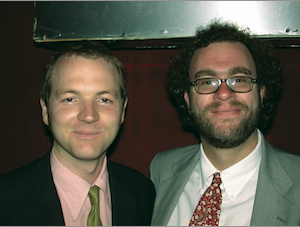
Matthew Rohrer and Joshua Beckman

“You know who has a really cool Christopher Walken impersonation? Oh wait, you don’t know this person…” “I’m a real bot…”  Do you ever catch the tail end of a stranger’s conversation, then begin to weave the rest of the tale on your own? How much do you embellish what might be a very simple story? And have you ever eavesdropped on other people’s conversations at MoMA?

While you might imagine that a lot of the discussions taking place in the Museum galleries have to do with the art on the walls, poets Matthew Rohrer and Joshua Beckman have discovered otherwise. Roaming the Museum and riding its elevators for three days in February and March, they have been snooping on other people’s chatter, and they found that it’s not so much about the art. Many of the conversations are incomprehensible to them, not because Rohrer and Beckman only understand art-speak, but because so many MoMA visitors these days are speaking other languages besides English

Can Art Change the World?

As Director of Digital Learning, I might just have the best job in the world. Take today as an example. At 10:00 a.m., I reviewed video for an online studio course about the materials and techniques of Willem de Kooning, Jackson Pollock, and Barnett Newman (among others) that my coworker Amy Horschak and I hope to run this summer (it is being developed by Corey d’Augustine). At 2:00, I brainstormed with colleagues about new content for the blog. At 5:00, I attended an exhibition opening for the Education department’s CreateAbility class, a monthly program for individuals with learning and developmental disabilities and their families. I brought in the camera just in time to hear parents talk about how meaningful the class was for their children. (We’ll be adding the video to the Learn section of the site, which is being updated later this spring.) By 7:00 I was watching a program organized by my colleagues Laura Beiles and Pablo Helguera: the artist William Kentridge on stage in Theater 1, performing I am not me, the horse is not mine.

March 1, 2010  |  Events & Programs
The Masks We Wear: Identity, Art, and AIDS

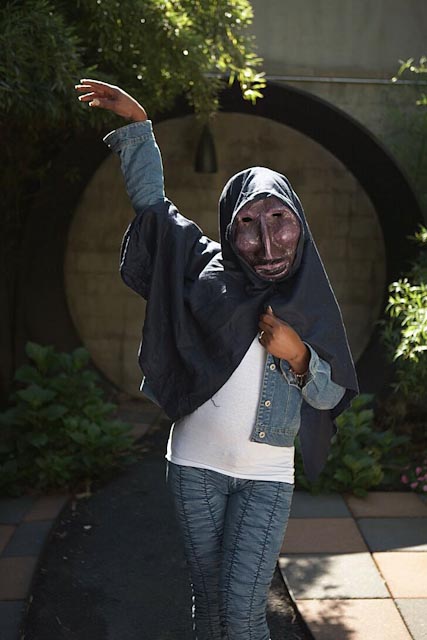
Photo: Aaron Wojack

When I took over the Community Outreach Coordinator position three years ago, Housing Works was the first organization that I reached out to and brought in as a new Community Partner. The largest community-based AIDS organization in the United States, for the past 20 years they have tackled the twin crises of HIV/AIDS and homelessness, offering housing, medical and mental health care, meals, job training, drug treatment, HIV prevention education, and social support to over 20,000 New York City residents.

February 15, 2010  |  Events & Programs
Art in School in Prison: Isabel Rosado, Passages Academy & the Juvenile Justice Department

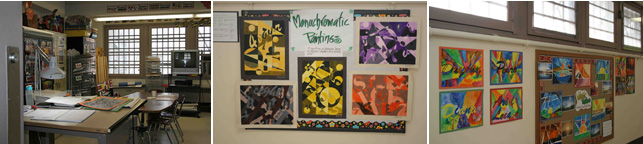
From left: Art room at Bridges Juvenile Detention Center; student work displayed in the hallway of the Detention Center

Bridges Juvenile Detention Center is a secure facility located in the Hunts Point section of the Bronx, surrounded by a strip of used auto-parts stores and wholesale supply outlets. It houses both boys and girls, although the two groups are kept at a far remove from one another, and it has all of the familiar trappings of your standard-issue television or film depiction of prison: guards, jumpsuits, concrete, barbed wire, and barred windows. But it also has an art room. And a library. And hallways full of drawings and paintings and poetry.

Biography of a Whale

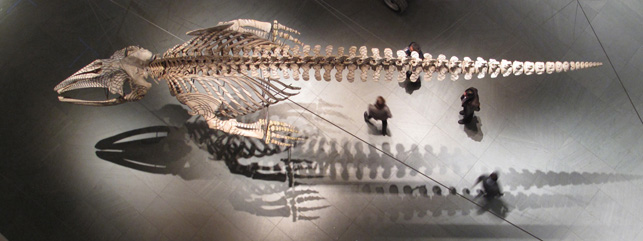
Gabriel Orozco. Installation view of Mobile Matrix (2006) at The Museum of Modern Art, New York. Graphite on gray whale skeleton. Biblioteca Vasconcelos, Mexico City. Photo: Charles Watlington. © 2010 Gabriel Orozco

Every work at a museum may compel a viewer to wonder how it was made or where it came from. However, there are some works whose genesis provokes a special degree of collective fascination. Gabriel Orozco’s Mobile Matrix, currently on view in MoMA’s Gabriel Orozco exhibition, is one such work.

February 5, 2010  |  Design, Events & Programs, Tech
Meet Me: From Paper to Pixels

The Graphic Design and Digital Media departments work on the same floor in the MoMA offices, and though we may disagree on how many overhead fluorescent lights should be on (the correct answer is zero), we all enjoy getting the chance to work together. It’s not often that we get the chance to work on a project from its inception, so the Meet Me website was a unique opportunity.

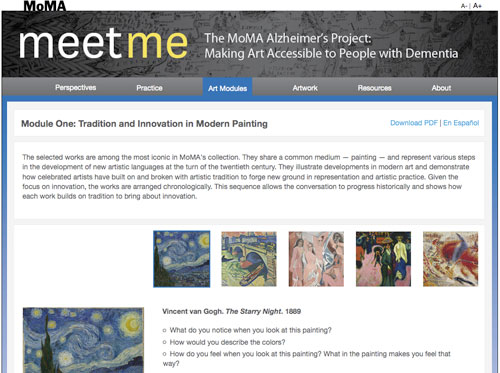
Screenshot from the Meet Me site

Screenshot from the Meet Me site

Last week, Ingrid Chou explained the process of creating the lovely Meet Me publication. For the website, we worked with Ingrid and designer Sam Sherman (as well as the Education Department) to translate elements from the publication into a digital format. We also wanted to take advantage of some of the new features and frameworks we created for the MoMA.org redesign.

February 1, 2010  |  Events & Programs
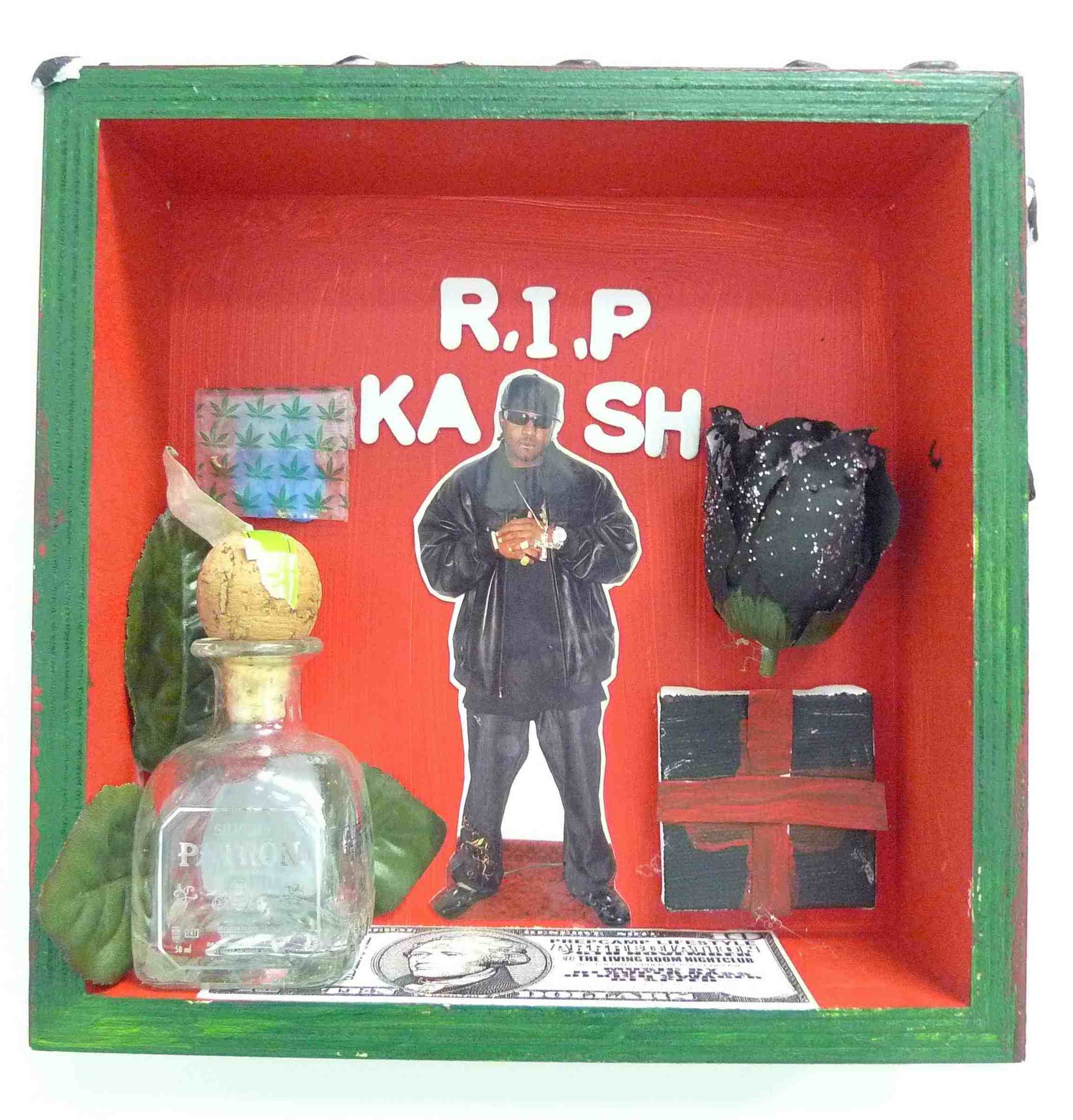
Things We Hold Close: Altars from the Women of Midtown Community Court’s WISE Program

Located just blocks away from The Museum of Modern Art, the WISE program at the Midtown Community Courthouse (MCC) is the only comprehensive initiative in New York City for women over the age of 21 who have been arrested for prostitution-related offenses. As victims of physical and sexual violence, exploitation and human trafficking, many of these women lack both the fortitude and the support that they need to escape the cycle of re-arrest and re-victimization. WISE (the name is an acronym for Women’s Independence, Safety, and Empowerment) provides this support through individual and group counseling, as well as by teaching financial literacy to promote economic self-sufficiency.

January 29, 2010  |  Design, Events & Programs
Anything but a Guidebook

An unusual approach is one of the key strategies that signal an ideological shift.

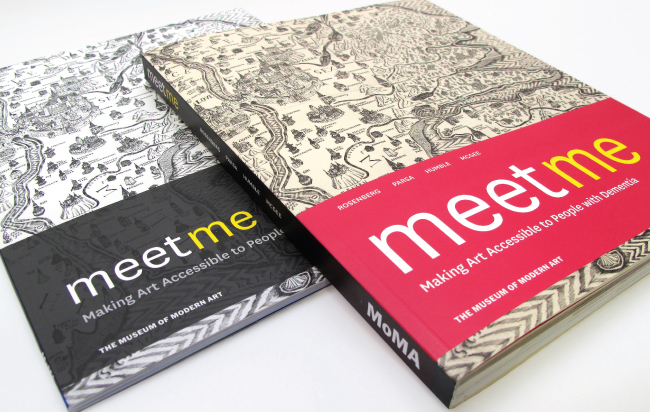
When approached by Francesca Rosenberg to design the Meet Me publication for MoMA’s Access Programs, we were given three criteria:

1. Must use hot-pink color. (I’m not kidding. If you know Francesca Rosenberg, MoMA’s Director of Access and Community Programs, you would know that this is a legitimate request.)

2. Don’t make it look like a guidebook (even though, in its essence, it is a guidebook).

3. Make the content accessible to three diverse audiences: museum professionals, care organizations, and individual families.

The unusual color request was just one sign of how MoMA’s Access Program educators were contributing to an ideological shift in the way both institutions and individuals think about Alzheimer’s disease. This was not going to be just another black-and-gray manual. The intention was to create a book that was uplifting in both function and form, focusing on the fact that life can still be meaningful and joyful for these families, a book that embodies the mission and focus of the Meet Me at MoMA program. This was going to be a book about inspiring meaningful interactive experiences, making connections between people and art, and making art accessible. It would be anything but a guidebook.

January 22, 2010  |  Events & Programs
The Communicative Power of Art
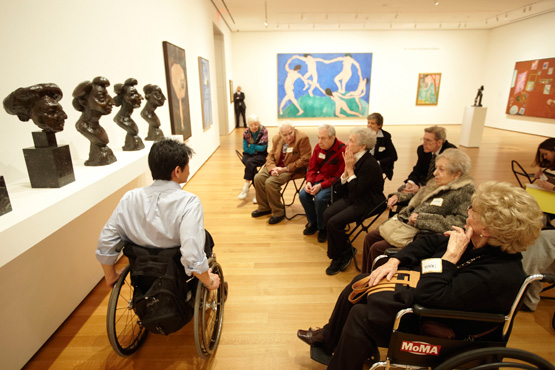
Gordon Sasaki, MoMA Educator, leads a Meet Me at MoMA program

Gordon Sasaki, MoMA Educator, leads a Meet Me at MoMA program

One of the reasons I enjoy working in Access Programs at MoMA is that we get to experience things with our program participants that other visitors would like to do, but can’t. For instance, visitors who are blind and partially sighted have the opportunity to touch sculptures on display in the galleries and in the Sculpture Garden. Who wouldn’t love to get their hands on an original bronze bust by Picasso or Matisse? Another bonus for Access Programs participants is that many of our programs are scheduled on Tuesdays, when the Museum is otherwise closed to the public. Ah, to be in a room with Vincent van Gogh’s The Starry Night and not have to dodge the crowds!

This is exactly the situation when we hold our monthly Meet Me at MoMA program, an interactive gallery tour for people with dementia and their care partners. During these ninety-minute sessions, the Museum becomes theirs, and the quiet galleries are the perfect setting for MoMA’s educators to lead the individuals in the group in sharing their thoughts and interpretations of artworks from MoMA’s collection or special exhibitions. The stimulation and socialization that are fundamental to the MoMA program not only help to improve behavior and mood, but also dramatically improve quality of life. I have experienced numerous situations in which people come to MoMA in a non-communicative, anxious, or withdrawn state. For many, a transformation occurs in the galleries. Art can tap into old memories. It was in front of Marc Chagall’s I and the Village that a man with Alzheimer’s disease shared a story about the cemetery where his mother is buried, information that his wife had never been aware of. Piet Mondrian’s Broadway Boogie Woogie led another man to talk about his days as a single man enjoying the nightclubs in New York in the 1940s—just like Mondrian himself. Other comments reveal how the art stimulates the participants in the here and now. For example, a woman with dementia spoke insightfully about how the colors and light in Claude Monet’s Water Lilies were inviting and joyful to her. After leading many art programs with people with dementia, I have seen firsthand that satisfying emotional and intellectual experiences are possible on both sides of the care partnership.

We wanted to share these meaningful experiences and results with a broader audience, so Museum educators worked with Graphic Design and Digital Media staff to develop a publication and website that would reflect the experience of the Meet Me at MoMA program. These resources also provide additional information in the form of interviews with experts in the fields of art, aging, and Alzheimer’s; findings from our evidence-based research study; and guides for developing and implementing art programs in a variety of settings.

I encourage you to take a look at the site!