
MoMA
Posts in ‘Design’
February 5, 2010  |  Design, Events & Programs, Tech
Meet Me: From Paper to Pixels

The Graphic Design and Digital Media departments work on the same floor in the MoMA offices, and though we may disagree on how many overhead fluorescent lights should be on (the correct answer is zero), we all enjoy getting the chance to work together. It’s not often that we get the chance to work on a project from its inception, so the Meet Me website was a unique opportunity.
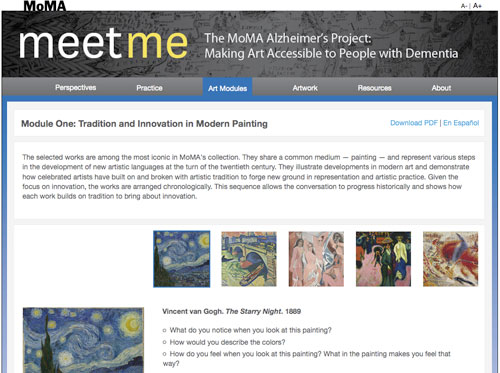
Screenshot from the Meet Me site

Screenshot from the Meet Me site

Last week, Ingrid Chou explained the process of creating the lovely Meet Me publication. For the website, we worked with Ingrid and designer Sam Sherman (as well as the Education Department) to translate elements from the publication into a digital format. We also wanted to take advantage of some of the new features and frameworks we created for the MoMA.org redesign.
January 29, 2010  |  Design, Events & Programs
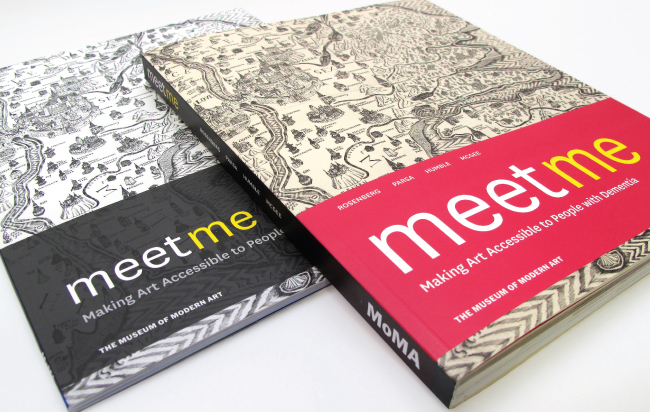
Anything but a Guidebook

An unusual approach is one of the key strategies that signal an ideological shift.

When approached by Francesca Rosenberg to design the Meet Me publication for MoMA’s Access Programs, we were given three criteria:

1. Must use hot-pink color. (I’m not kidding. If you know Francesca Rosenberg, MoMA’s Director of Access and Community Programs, you would know that this is a legitimate request.)

2. Don’t make it look like a guidebook (even though, in its essence, it is a guidebook).

3. Make the content accessible to three diverse audiences: museum professionals, care organizations, and individual families.

The unusual color request was just one sign of how MoMA’s Access Program educators were contributing to an ideological shift in the way both institutions and individuals think about Alzheimer’s disease. This was not going to be just another black-and-gray manual. The intention was to create a book that was uplifting in both function and form, focusing on the fact that life can still be meaningful and joyful for these families, a book that embodies the mission and focus of the Meet Me at MoMA program. This was going to be a book about inspiring meaningful interactive experiences, making connections between people and art, and making art accessible. It would be anything but a guidebook.

January 8, 2010  |  Design
From the Archives, Part 1: Ivan Chermayeff

As the days remain short and post-holiday gloom sets in, we wanted to spread some cheer from our latest trip to the archives.

Any creative rut can be cured by a quick dive into historic printed ephemera. The Museum Archives are quite extensive, and we’ll often use their finding aids before beginning on new exhibition or advertising projects. Recently we all took a trip to the archives to look through our department’s files

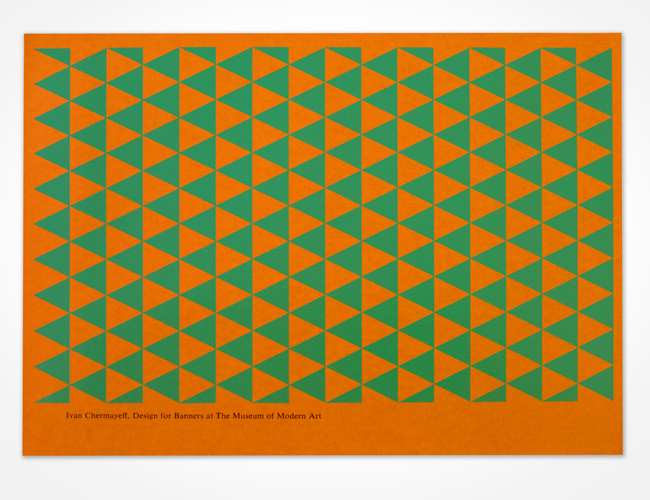
Below is a small sampling of work created in the 1960s by design legend Ivan Chermayeff and his firm Chermayeff & Geismar. Enjoy!

Chermayeff_Banners

Ivan Chermayeff, design for banners for The Museum of Modern Art

January 7, 2010  |  Artists, Collection & Exhibitions, Design
A Home for PIG 05049

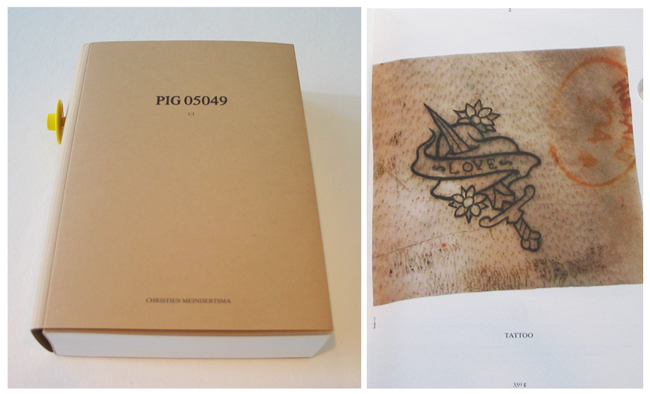
Christien Meindertsma with Julie Joliat. PIG 05049. 2004-2006.

Christien Meindertsma with Julie Joliat. PIG 05049. 2004–06.

The growing concern for the world’s environment (hotly debated last month in Copenhagen) has inspired people to question the origins of the things they consume, leading to trends like the slow food and fair trade movements, and films like Food, Inc. A similar curiosity led the Dutch artist/designer Christien Meindertsma to track all the products made from “05049,” an actual pig selected at random from a commercial farm in the Netherlands. After its slaughter, Meindertsma discovered that the single pig was used in 185 different products, all of which are pictured in her book. PIG 05049, a collaboration between Meindertsma and the graphic designer Julie Joliat, is a visual catalog of the “afterlife” of one animal that reveals the complexity of the meat-processing industry and of our manmade world.

Ellen Lupton Inspires a New Kind of Visual Literacy

After nearly a month of visiting the Bauhaus 1919–1933: Workshops for Modernity exhibition, many of us throughout the Museum took away at least one powerful message: don’t be afraid to cross disciplines. The fearlessness, enthusiasm, and collaboration of the students and masters is apparent in the show’s work.

So, upon learning that design education legend and DIY hero Ellen Lupton would be running several workshops in the Bauhaus Lab series, our Graphic Design department decided not to make a poster for her visit, but rather to shoot and edit a video. Of course, stepping out of your area of expertise requires collaboration, so we teamed up with two of the Museum’s video experts: Beth Harris, Director of Digital Learning, and David Hart, Associate Media Producer. It was a humbling and exciting experience.

November 27, 2009  |  Behind the Scenes, Design
An Average Day At the Museum reinterpreted by Christoph Niemann
an_average_day_at_the_museum

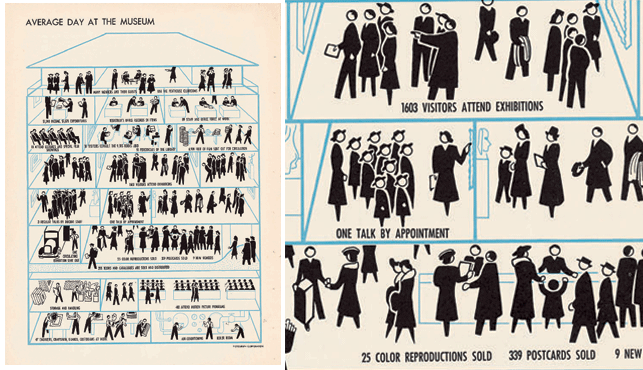
Left: Diagram, Average Day at the Museum: The Year's Work: Annual Report to the Board of Trustees and Corporation Members of the Museum of Modern Art for the Year June 30, 1939–July 1, 1940. Annual reports 1931–40. MoMA Archives. Right: Detail.

An average day at the Museum, which appeared in MoMA’s annual report in 1940, was designed by the in-house graphic design department as a way to show the diverse activities taking place at the Museum. The design has been resurrected in recent years on products such as totebags and notepads in the MoMA Design Store. We always liked this infographic, and wondered what a cross-section of MoMA would look like today, seventy years later? Christoph Niemann, whose illustrations appear in The New Yorker and on his NYTimes.com blog Abstract City, was the perfect candidate to update the illustration for 2009. While the activities stayed roughly the same, the physical space has changed drastically. For this post I asked Niemann to shed some light on his process and the challenges involved in creating this new illustration, which we used to announce this year’s fall exhibition season.

November 19, 2009  |  Artists, Collection & Exhibitions, Design
Musical MoMA: The TENORI-ON by Toshio Iwai and Yamaha

Toshio Iwai. TENORI-ON. 2004

Toshio Iwai. TENORI-ON. 2004

One of the greatest parts of my job is getting to geek out over the many brilliant examples of design that are considered for the Museum’s collection. Among the most exciting (and drop-dead gorgeous) works we acquired last year is the TENORI-ON, by the Japanese artist Toshio Iwai, manufactured by Yamaha. Promoted by Yamaha as “a digital musical instrument for the twenty-first century,” the TENORI-ON’s “visible music” interface is suitable for both serious musicians and beginners to electronic music.

“In days gone by, a musical instrument had to have a beauty, of shape as well as of sound, and had to fit the player almost organically…. Modern electronic instruments don’t have this inevitable relationship between the shape, the sound, and the player. What I have done is to try to bring back these…elements and build them in to a true musical instrument for the digital age.” —Toshio Iwai

Iwai is an established multimedia artist, musician, and inventor, who seeks “the feeling of childhood in the digital world.” He has worked in television and created a number of computer and video games, including the acclaimed (and addictive) Electroplankton (2005) for the Nintendo DS, in which players generate atmospheric music by manipulating sea creatures.

November 17, 2009  |  Design, Rising Currents
Rising Currents: Meet the Project Teams

As of yesterday, the Rising Currents teams are now in residence at P.S.1. I’ve asked each of the team leaders to share some of their initial thoughts with you. Here are their reflections on their designated sites and the architects-in-residence program.

ZONE 1: David J. Lewis, Marc Tsurumaki, Paul Lewis, LTL Architects

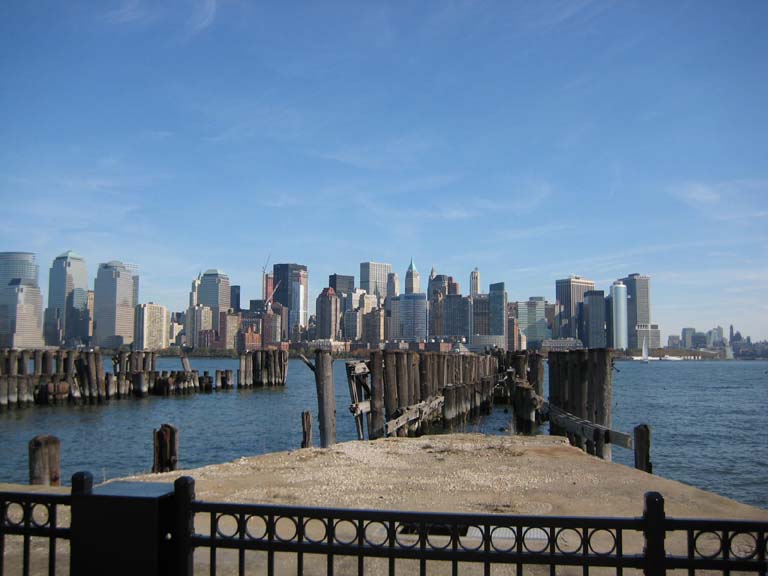
Team LTL hits the ground running or, to be precise, the ambiguous line between ground and water in a site mostly constructed by dredging and infill over the past hundred years. We are thrilled to be given the opportunity by MoMA to work collaboratively at P.S.1 through Rising Currents to investigate the challenges and opportunities that face the uncertain future of the harbor area. While the site given is local, primarily defined by Liberty State Park and the two historic islands, the challenge is global. We look forward to collaborating with our colleagues gathered at P.S.1.

Zone 1

View of Historic Ferry Slip

zone 1

View of New Jersey Turnpike from LTL Architects site

The Making of Tim Burton’s MoMA Animation

To help promote MoMA’s Tim Burton retrospective, we asked Burton himself to animate the MoMA logo for a thirty-second video that would be used to promote the exhibition on television, at the Museum, and online. Tim quickly came up with a concept utilizing stop-motion animation, and he asked Allison Abbate, his producer on Corpse Bride (2005) and the upcoming full-length version of Frankenweenie, if she could help pull things together.

November 6, 2009  |  Behind the Scenes, Design
Bauhaus: The Graphic Design Department Goes Back to School
01

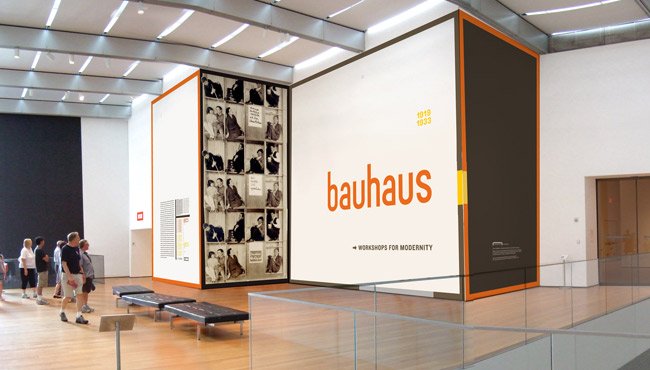
Rendering of the title wall for Bauhaus 1919-1933: Workshops for Modernity

In December 1938, hordes of visitors packed the opening of MoMA’s Bauhaus retrospective in the temporary galleries at 14 West Forty-ninth Street in Rockefeller Center. Guests followed painted footprints and abstract graphics on the floor guiding them through the show’s seven hundred items, while reading titles rendered in handsome pin-mounted condensed letterforms. The Bauhaus’s own graphic design and typography legend, Herbert Bayer came to New York to design the exhibition himself. And today, over seventy years later, it was both the Bauhaus and Bayer’s legacy that kept most of MoMA’s Department of Graphic Design awake at night, as we began to design the title wall for Bauhaus 1919–1933: Workshops for Modernity.