
MoMA
Posts in ‘Behind the Scenes’
Documentation Diaries: Re-creating the Performance

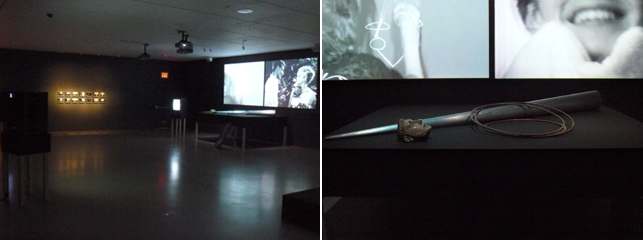
Joan Jonas. Mirage (installation details). 1976/1994/2003. The Museum of Modern Art. Gift of Richard Massey, Clarissa Alcock Bronfman, Agnes Gund, and Committee on Media Funds. Photos: Sydney Briggs

When the Department of Media and Performance Art collects and exhibits time-based media or performance, caring for and properly installing such work is a collaboration between the artist and the Museum. Time-based media commonly uses video, film, audio, and computer programs as platforms for creativity. Often such artwork is digitally based, and it depends upon technology that may become obsolete. In the case of performance art, the ability to re-perform the work mainly relies on the artist’s memory, with the aid of documentation. Both time-based media and performance are therefore mediums in which individual works are often replicated, migrated, or emulated in order to ensure their continued existence.
January 15, 2010  |  Behind the Scenes, Tech
Time-Lapse Videos: The Joy of Watching Paint Dry and Tons of Steel Moving

The second half of the 2000s (is it too early to say that?) saw the rapid rise of online video (read a good summary here), and we’ve been actively experimenting here at MoMA. What started over three years ago as a small trial with myself, Zoe Jackson from the Marketing Department, a laptop, and a cheap miniDV camera has turned into a larger production—with a team drawn from MoMA’s Education, Marketing, Graphic Design, and Digital Media departments collaborating (in addition to all of our other day-to-day responsibilities). One of the most common types of videos we’ve produced are time-lapse videos of exhibition installations. Our first (shown above) was of Richard Serra’s sculptures being installed in the Sculpture Garden.

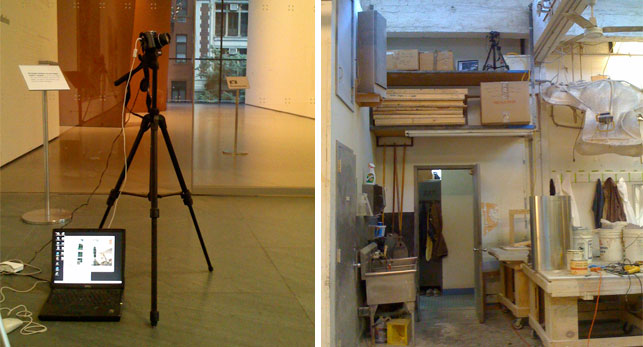
From a technical standpoint, the setup is pretty simple: an old PC laptop, an inexpensive piece of software to control a Canon still camera, a tripod, and a few power cords. It’s very easy to set up, move, or leave running overnight or over multiple days. The individual still images are then run through a QuickTime script or imported into Final Cut and compiled to create a kind of stop-motion film.

Time-lapse setup in the Marron Atrium (left), and on a shelf at the studios of ATTA Inc. (top right) for the fabrication of the topiary for the Tim Burton exhibition

Time-lapse setup in the Marron Atrium (left), and on a shelf at the studios of ATTA Inc. (top right) for the fabrication of the topiary for the Tim Burton exhibition

December 23, 2009  |  Behind the Scenes, Collection & Exhibitions
Bauhaus Lab

Bauhaus Lab has been a new experiment for us at MoMA: we sought to create a space where various audiences could both get a sense of the original curricula of the famed school, and participate in events and activities that carried the Bauhaus spirit into the twenty-first century. The planning of the Bauhaus Lab was an extensive process that involved several months of  research, planning, and experimentation, and represented a true collaborative effort amongst the Education Department staff. In this video, my colleagues Amy Horschak and Laura Beiles discuss some of the thinking behind the activities we developed and tell a few behind-the scenes anecdotes about the project.

November 27, 2009  |  Behind the Scenes, Design
An Average Day At the Museum reinterpreted by Christoph Niemann
an_average_day_at_the_museum

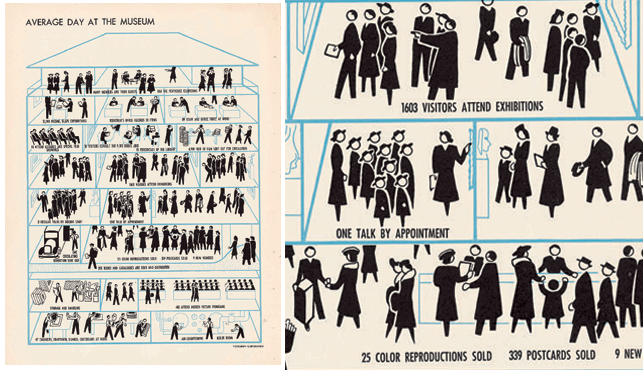
Left: Diagram, Average Day at the Museum: The Year's Work: Annual Report to the Board of Trustees and Corporation Members of the Museum of Modern Art for the Year June 30, 1939–July 1, 1940. Annual reports 1931–40. MoMA Archives. Right: Detail.

An average day at the Museum, which appeared in MoMA’s annual report in 1940, was designed by the in-house graphic design department as a way to show the diverse activities taking place at the Museum. The design has been resurrected in recent years on products such as totebags and notepads in the MoMA Design Store. We always liked this infographic, and wondered what a cross-section of MoMA would look like today, seventy years later? Christoph Niemann, whose illustrations appear in The New Yorker and on his NYTimes.com blog Abstract City, was the perfect candidate to update the illustration for 2009. While the activities stayed roughly the same, the physical space has changed drastically. For this post I asked Niemann to shed some light on his process and the challenges involved in creating this new illustration, which we used to announce this year’s fall exhibition season.

The Tim Burton Website: It’s Aliiiiiive!

Months before an exhibition opens we meet to plan out any related online features. Since we’re a small team we often get developers or designers to help for bigger sites. For the Tim Burton exhibition, we worked with the Brooklyn company Big Spaceship, who built the site for our Contemporary Voices exhibition in 2005.

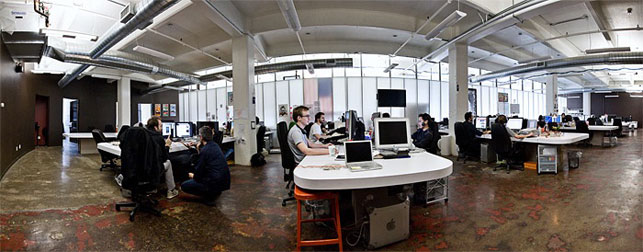
The Big Spaceship offices. No, they don't eat astronaut ice cream.

The Big Spaceship offices. No, they don't eat astronaut ice cream.

Having nearly broken my VHS copy of Beetlejuice from overuse while growing up, I knew the project would be an exciting one for a design firm to sink their teeth into. In the words of Big Spaceship, “Having the opportunity to work with MoMA for an artist as admirable as Tim Burton was amazing. The quality and imagination inherent to his art speak for themselves—we’re particularly inspired by his breadth of work and desire to experiment.”

One of the most exciting parts of the process is the concept meeting with the designers. After an initial meeting to discuss the exhibition, the crew from Big Spaceship put together three different directions for the site, and we sat down together with the curators to pick a design to build out. We asked them to talk about the three directions they proposed.

The Making of Tim Burton’s MoMA Animation

To help promote MoMA’s Tim Burton retrospective, we asked Burton himself to animate the MoMA logo for a thirty-second video that would be used to promote the exhibition on television, at the Museum, and online. Tim quickly came up with a concept utilizing stop-motion animation, and he asked Allison Abbate, his producer on Corpse Bride (2005) and the upcoming full-length version of Frankenweenie, if she could help pull things together.

Bauhaus Lounge: When the Couch Matches the Art
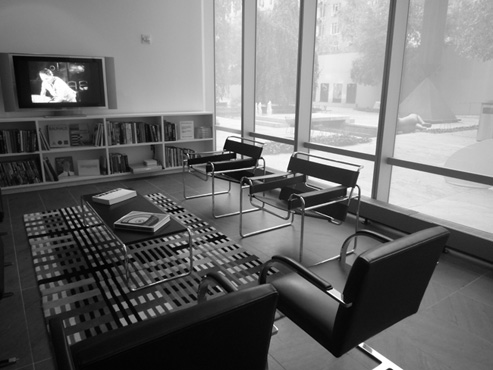
Bauhaus Lounge, The Lewis B. and Dorothy Cullman Education and Research Center

Bauhaus Lounge, The Lewis B. and Dorothy Cullman Education and Research Center

Matching the artwork with the living room couch is one of the perennial concerns of any collector. But when it comes to the Bauhaus, which was as much about designing couches as it was about artworks, finding the right furniture piece shouldn’t be a problem. Or so it seemed to us at the Education Department. During the exhibition Bauhaus 1919–1933: Workshops for Modernity, we imagined turning the reading room space in MoMA’s Cullman building into a Bauhaus Lounge, equipped with Bauhaus furniture for visitors to relax on while they watch a video of a reconstruction of Oskar Schlemmer’s Triadic Ballet or browse through Bauhaus literature. We thought we had enough original Bauhaus-designed chairs lying around MoMA’s buildings that it couldn’t be too hard to put such a lounge together. We do have a Wassily chair (no one remembers where it came from) that sits in the Education offices; we also snatched away a few other chairs from a conference room and two Mies van der Rohe Barcelona chairs from outside of Glenn Lowry’s office waiting area (his office wants them back after the show).

November 6, 2009  |  Behind the Scenes, Design
Bauhaus: The Graphic Design Department Goes Back to School
01

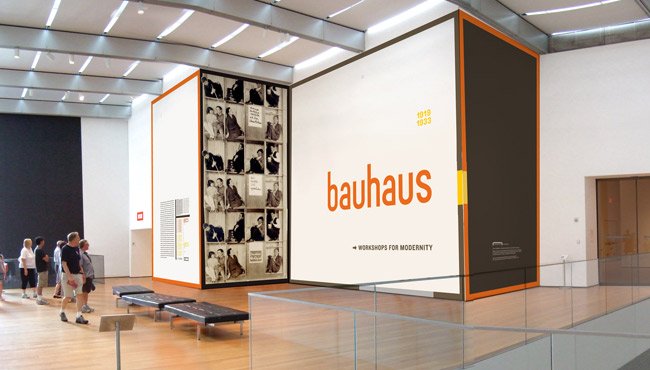
Rendering of the title wall for Bauhaus 1919-1933: Workshops for Modernity

In December 1938, hordes of visitors packed the opening of MoMA’s Bauhaus retrospective in the temporary galleries at 14 West Forty-ninth Street in Rockefeller Center. Guests followed painted footprints and abstract graphics on the floor guiding them through the show’s seven hundred items, while reading titles rendered in handsome pin-mounted condensed letterforms. The Bauhaus’s own graphic design and typography legend, Herbert Bayer came to New York to design the exhibition himself. And today, over seventy years later, it was both the Bauhaus and Bayer’s legacy that kept most of MoMA’s Department of Graphic Design awake at night, as we began to design the title wall for Bauhaus 1919–1933: Workshops for Modernity.

October 31, 2009  |  Artists, Behind the Scenes, Conservation
Claes Oldenburg: Conservation of Floor Cake

This is the first post by the Conservation Department at MoMA. We plan to give you a behind-the-scenes look at one of our current projects. In this project, Sculpture and Painting Conservation collaborate on an investigation into one of MoMA’s iconic Pop sculptures.

Claes Oldenburg - Floor Cake (Giant Piece of Cake) 1962

Claes Oldenburg. Floor Cake. 1962

Claes Oldenburg’s Floor Cake (1962) entered into the Painting and Sculpture Department at MoMA in 1975. Measuring five by nine feet, this popular piece of painted cake has been heavily exhibited in the Museum and across the United States, and has made three transatlantic voyages. The forty-seven-year old sculpture is now in the Conservation Department lab for study and treatment.