
MoMA
Posts in ‘Artists’
January 25, 2010  |  Artists, Collection & Exhibitions
Joan Jonas: Synchronicity of Old and New
Yokohama Tobacco Shop

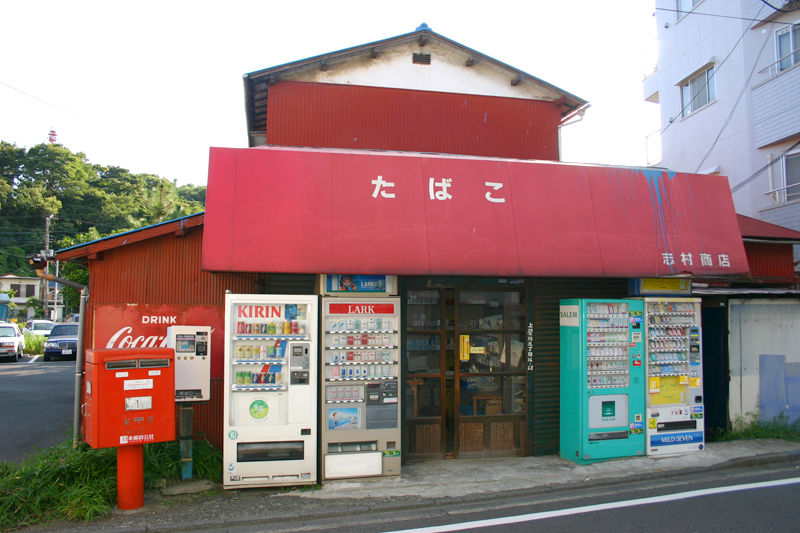
Tobacco shop in Yokohama, Japan. Photo: Azby Brown

At the moment Joan Jonas is on a residency at Kita-Kyushu in western Japan. She has worked in Japan several times since her first visit in 1970, when she bought a portable video camera and began her exploration of media art. The immediacy and reality of video entranced Joan. It was so unlike the stark artificiality of traditional Japanese theater. There, the actors moved at a glacial, mesmerizing pace across a spare stage, and the productions, often stretching over an entire day, made time dissolve. The formality and ritual of Japanese performance became integral to Joan’s work, as can be seen in Mirage, the installation currently on view in the Media Gallery. She wrote that Noh and Kabuki, the two poles-apart forms of traditional Japanese theater, taken together contain every idea that has ever been realized on a stage.
January 21, 2010  |  Artists, Collection & Exhibitions
R.H. Quaytman’s Storage Rack: An Archive of Images and Associations

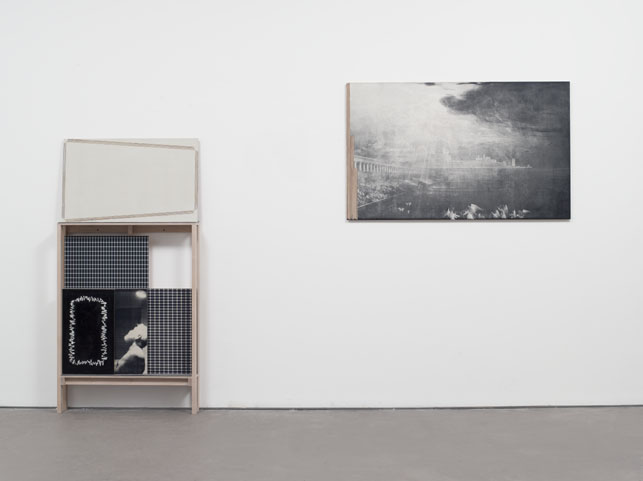
R. H. Quaytman. Iamb: Chapter 12, Excerpts and Exceptions, with Painting Rack. 2001–09. Silkscreen ink, oil paint, and gesso on wood, and wood rack, dimensions and installation variable. The Museum of Modern Art. Purchase

Last year MoMA’s Department of Painting and Sculpture acquired R. H. Quaytman’s Iamb: Chapter 12, Excerpts and Exceptions, with Painting Rack, a work comprised of six paintings, made between 2001 and 2009, set inside (and to the side of) a shallow wooden storage/display case. Two of the paintings were on view in Quaytman’s beautifully installed 2009 solo exhibition at the Miguel Abreu Gallery; the others joined the group in the artist’s studio before coming to the Museum. In general, I find Quaytman’s work to be complicated, but complicated in a completely satisfying way—this is especially true of Iamb: Chapter 12. Some of the panels in the set are minimal, such as an off-white gesso panel interrupted by four vectors; others maximal, like a panel displaying a silkscreen of John Martin’s mezzotint Heaven—The Rivers of Bliss (1824–25). The visual asynchronies of the series are undermined by a unified palette of whites, blacks, and half-tones, and by their placement within the rack, with the works’ absolute proximity to one another forcing a focused consideration of likeness.

January 14, 2010  |  Artists, Collection & Exhibitions
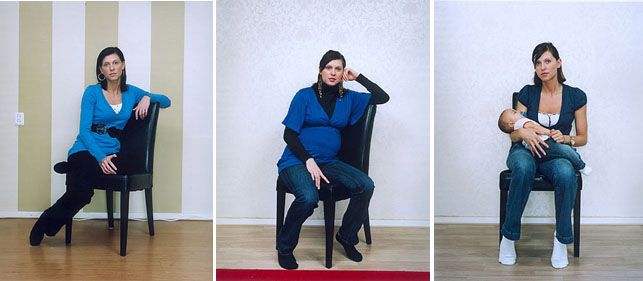
What’s in a Portrait? Rineke Dijkstra’s Almerisa
combo copy

Rineke Dijkstra. From left: Almerisa, Zoetermeer, The Netherlands. March 24, 2007; Almerisa, Zoetermeer, The Netherlands. January 4, 2008; Almerisa, Zoetermeer, The Netherlands. June 19, 2008

One of the reasons I like Rineke Dijkstra’s photographic portraits so much is because of how she manages to convey the vulnerable side of her subjects, caught at a decisive moment of transition in their lives, usually from adolescence to incipient adulthood. Dijkstra was trained at the Gerrit Rietveld Academie in Amsterdam, and since the mid-1990s she has gained international acclaim for her penetrating pictures of teenagers and young adults. Using a 4×5-inch field camera with a standard lens and a tripod, she creates exacting portraits—frontal views, centered in the frame, posed against a minimal background—that offer remarkable observation and emotional force. Her subjects gaze directly at the camera, combining brooding psychological intensity with the formal classicism of seventeenth-century Dutch portraits by painters such as Johannes Vermeer.

January 11, 2010  |  Artists, Collection & Exhibitions
JoanJonas_iterations of a theme
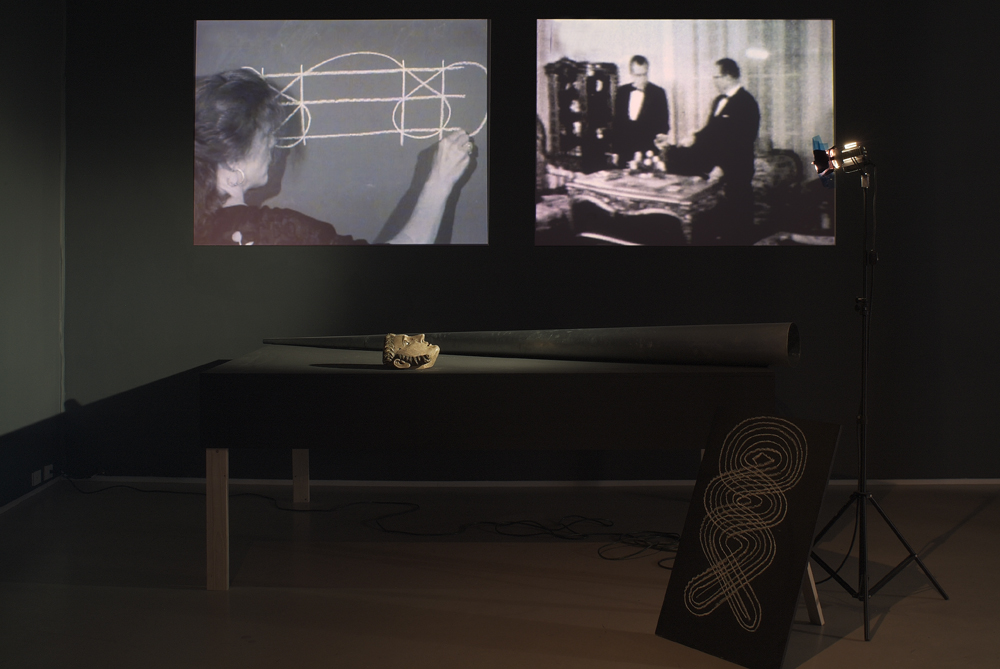
Joan Jonas. Mirage. 1976/2005. Installation with six videos (black and white, sound and silent), props, stages, photographs. The Museum of Modern Art. Gift of Richard Massey, Clarissa Alcock Bronfman, Agnes Gund, and Committee on Media Funds. Installation view, Yvon Lambert, New York, 2005. © 2009 Joan Jonas. Courtesy Yvon Lambert, Paris and New York. Photo: David Regen.

Joan Jonas. Mirage. 1976/2005. Installation with six videos (black and white, sound and silent), props, stages, photographs. The Museum of Modern Art. Gift of Richard Massey, Clarissa Alcock Bronfman, Agnes Gund, and Committee on Media Funds. Installation view, Yvon Lambert, New York, 2005. © 2010 Joan Jonas. Courtesy Yvon Lambert, Paris and New York. Photo: David Regen

Joan Jonas works by developing iterations of a theme. I saw the first version of Mirage as a young MoMA curator in 1975. It was performed at the Anthology Film Archives Theater, then in SoHo on a boutique-free Wooster Street. Joan transfixed me, moving slowly about the stage, stomping her feet to the rhythm of a heartbeat. Images from the cameras focused on her were projected onto a large screen and several monitors dotted around the stage. Interacting with her apparitions, Joan transformed the performance into a dense, many-actor theater piece. Then she disappeared behind the projection screen to appear merely as a silhouette.

January 7, 2010  |  Artists, Collection & Exhibitions, Design
A Home for PIG 05049

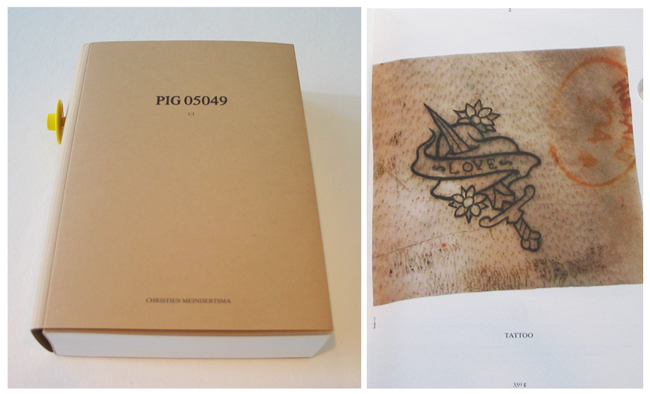
Christien Meindertsma with Julie Joliat. PIG 05049. 2004-2006.

Christien Meindertsma with Julie Joliat. PIG 05049. 2004–06.

The growing concern for the world’s environment (hotly debated last month in Copenhagen) has inspired people to question the origins of the things they consume, leading to trends like the slow food and fair trade movements, and films like Food, Inc. A similar curiosity led the Dutch artist/designer Christien Meindertsma to track all the products made from “05049,” an actual pig selected at random from a commercial farm in the Netherlands. After its slaughter, Meindertsma discovered that the single pig was used in 185 different products, all of which are pictured in her book. PIG 05049, a collaboration between Meindertsma and the graphic designer Julie Joliat, is a visual catalog of the “afterlife” of one animal that reveals the complexity of the meat-processing industry and of our manmade world.

Museum Kids: Keeping It Real
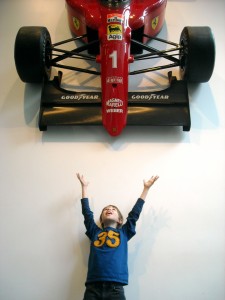
Ethan is delighted by the Formula 1 Racing Car hanging in the Education and Research building lobby.

Ethan is delighted by the Formula 1 Racing Car hanging in the Education and Research building lobby.

Just after I’d accepted my job at MoMA, I brought my six-year-old son along with me to visit. He entered the Marron Atrium and, with a sweeping, 360-degree review and an air of finality, announced, “I like your new museum, mom.” Good thing it passed muster.

I often wonder what it is to grow up in a museum. From the time he was two, Ethan had a steady diet of contemporary art. Bridges made of Meccano sets; entire cities built of pots and pans; rooms glowing with neon tubes; walls covered with “parades” of people made from ripped black construction paper; cars and trailers jack-knifed, emerging out of a museum plaza; metal squares on the floor, perfect for playing hopscotch—to Ethan, art always seems full of possibilities.

His own “work” attests to that, as we find colored-tape installations proliferating throughout our apartment—often accompanied by an objet trouvé repurposed in interesting ways, or a small love note to mom and dad.

Ethan, now nine, accompanied me to the office last week.

December 18, 2009  |  Artists, Collection & Exhibitions, Tech
The Gabriel Orozco Website: Stacking the Deck
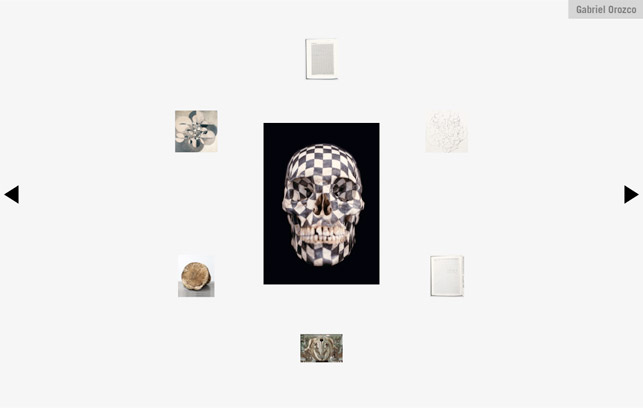
The <i>Gabriel Orozco</i> website

The Gabriel Orozco website

“There is no way to identify a work by Orozco in terms of physical product. Instead, it must be discerned through leitmotifs and strategies that constantly recur, but in always mutating forms and configurations.”
—Ann Temkin, the Marie-Josée and Henry Kravis Chief Curator of Painting and Sculpture, from the Gabriel Orozco exhibition catalogue

Uh oh.

That was my first reaction to Ann’s description of Gabriel Orozco’s practice. We were researching the artist, looking for persistent visual themes, devices, or elements in his work that could be used to anchor or accent the design of the exhibition website. The works that I was familiar with at the time—Black Kites, Citroen DL, the Atomist series—didn’t share obvious aesthetic connections, so I assumed that a common thread would be found in the pages of the catalogue. But here Ann was saying that Orozco’s mercurial practice provided little in the way of overt physical similarity. And that, given a looming deadline, was daunting.

 More fruitful were meetings Allegra Burnette (Creative Director of Digital Media) and I had with Ann and Paulina Pobocha, a curatorial assistant who worked on the exhibition. Though we didn’t come up with concrete ideas about the look of the site, the curators did provide insight as to its desired spirit: simple and playful. Simple, because the curators wanted something that was easy to use and understand, and playful, because what better way to conceptualize a website dedicated to an artist whose work has included the customization of both billiard and ping pong tables (Carambole with Pendulum, 1996, and Ping-Pond Table, 1998) and chess- and checkerboards (Horses Running Endlessly, 1995, and Lemon Game, 2001)?


December 17, 2009  |  Artists, Collection & Exhibitions
A Surrealist Sketchbook: Enrico Donati
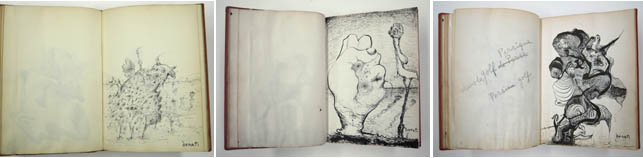
Enrico Donati, American, born Italy. 1909-2008. Untitled (Sketchbook). c. 1944. Ink on paper ( three details shown), 10 x 8" (25.4 x 20.3 cm). The Museum of Modern Art, New York. Gift of Adele Donati. © The Museum of Modern Art, New York

Enrico Donati. Untitled (Sketchbook). c. 1944. Ink on paper (three details shown), 10 x 8" (25.4 x 20.3 cm). The Museum of Modern Art. Gift of Adele Donati. © 2009 The Museum of Modern Art

One of the little-known highlights in the collection of the Department of Drawings is our vast array of artists’ sketchbooks, which range from intimate diaristic notations and markings, to explicit studies for complete works in other mediums, to accomplished works unto themselves, rendered as carefully and thoughtfully as paintings, for example, of the same subject matter.

This past May we received, as a gift, an outstanding example of an artist’s sketchbook. Enrico Donati, who passed away last year at the age of 99, was considered to be “the last of the Surrealists.” His wife, Adele Donati, approached the Museum about donating one of his sketchbooks to the collection.

December 10, 2009  |  Artists
Picasso on Rembrandt

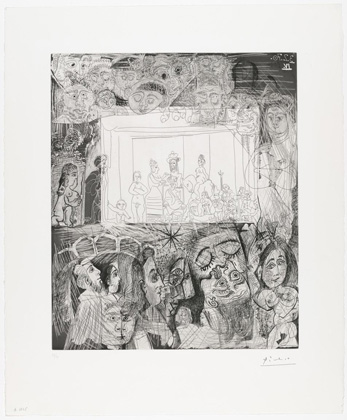
Pablo Picasso. After Rembrandt: Ecce Homo. 1970, published 1978.

Pablo Picasso. After Rembrandt: Ecce Homo. 1970, published 1978. Etching and aquatint. The Museum of Modern Art. The Edgar Wachenheim III Fund, 2009. © 2009 Estate of Pablo Picasso/Artists Rights Society (ARS), New York

There are lots of reasons why a work might be acquired for MoMA’s collection. Sometimes, the intense preparations for an upcoming exhibition provide a great opportunity to step back, take a careful look at what we already have, and see if there are gaps that need to be filled in our holdings of an artist’s work. This was recently the case as we researched an upcoming exhibition that, along with an accompanying catalogue and website, will explore Pablo Picasso’s creative process through the lens of printmaking. We took a close look at MoMA’s Picasso prints by theme, by technique, and by chronology, and discovered that we didn’t have a strong enough representation of Picasso’s late period (from about 1965 to his death in 1973), which has often been overlooked and underappreciated.

December 3, 2009  |  Artists, Collection & Exhibitions
A Close Look: Frida Kahlo’s Fulang-Chang and I
Frida Kahlo. Fulang-Chang and I. 1937

Frida Kahlo. Fulang-Chang and I. 1937

When curators Leah Dickerman, Luis Pérez-Oramas, and I began to discuss our plans for creating a new gallery dedicated to Mexican Modernist art made in the 1930s and 1940s—which opened in May of this year—Frida Kahlo’s Fulang-Chang and I was one of the works we were determined to include. We were intent not only to show the painting, but also to display it alongside the mirror that Kahlo made to accompany it, for reasons I’ll elaborate on a bit later.