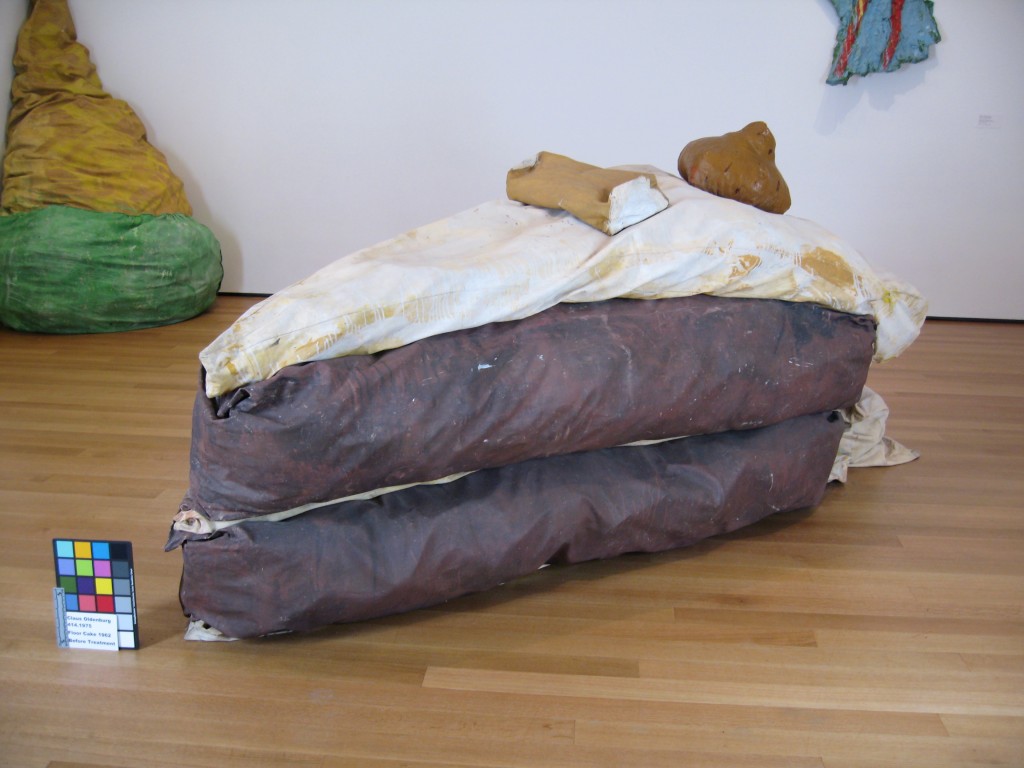
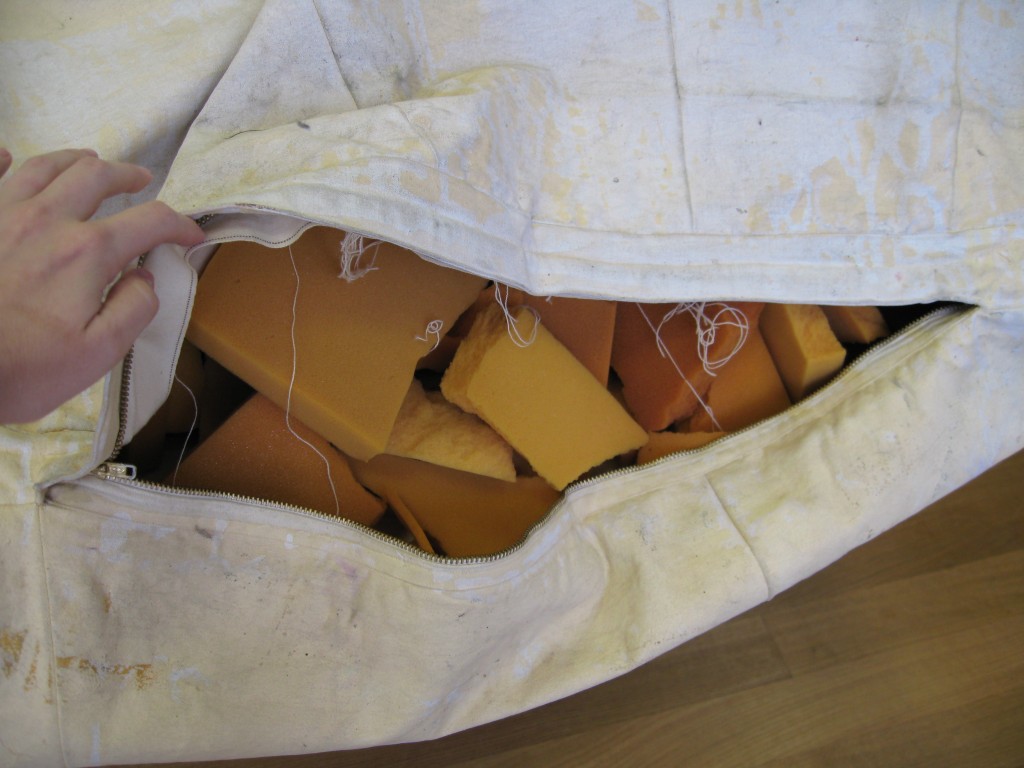
Looking forward, our preservation of Claes Oldenburg’s Floor Cake aims to bring the object to a state that more closely resembles the artist’s original intent. It will also stabilize the condition of the sculpture so that it can both endure a rigorous exhibition schedule and be safe in long-term storage. To develop a successful treatment plan, we considered the sculpture in distinct sections based on its materials:
Posts in ‘Artists’
Musical MoMA: The TENORI-ON by Toshio Iwai and Yamaha
One of the greatest parts of my job is getting to geek out over the many brilliant examples of design that are considered for the Museum’s collection. Among the most exciting (and drop-dead gorgeous) works we acquired last year is the TENORI-ON, by the Japanese artist Toshio Iwai, manufactured by Yamaha. Promoted by Yamaha as “a digital musical instrument for the twenty-first century,” the TENORI-ON’s “visible music” interface is suitable for both serious musicians and beginners to electronic music.
“In days gone by, a musical instrument had to have a beauty, of shape as well as of sound, and had to fit the player almost organically…. Modern electronic instruments don’t have this inevitable relationship between the shape, the sound, and the player. What I have done is to try to bring back these…elements and build them in to a true musical instrument for the digital age.” —Toshio Iwai
Iwai is an established multimedia artist, musician, and inventor, who seeks “the feeling of childhood in the digital world.” He has worked in television and created a number of computer and video games, including the acclaimed (and addictive) Electroplankton (2005) for the Nintendo DS, in which players generate atmospheric music by manipulating sea creatures.

Vik Muniz: Painting with Chocolate

Vik Muniz. Action Photo, after Hans Namuth from Pictures of Chocolate. 1997. Chromogenic color print. The Museum of Modern Art. Gift of Patricia Phelps de Cisneros in honor of Adriana Cisneros de Griffin through the Latin American and Caribbean Fund. © The Estate of Hans Namuth and Vik Muniz/Licensed by VAGA, New York, NY
Vik Muniz is one of the smartest and funniest artists that I have had the pleasure of working with. Last year, as part of the Artist’s Choice exhibition series, Muniz curated a show drawn from the Museum’s collection, and I worked closely with him to realize the project, titled Rebus. Muniz’s installation was one of the most memorable exhibitions from the series, and it gave me insight into the artist’s working process. This collaboration resulted from a long and ongoing relationship—since Muniz first exhibited his work at MoMA in 1997 in New Photography 13, the Museum has been showing and collecting his photographs. MoMA has recently added to the collection a key picture by Muniz, Action Photo, after Hans Namuth from Pictures of Chocolate, and we hope to continue our exploration and appreciation of this leading artist’s work.
Claes Oldenburg: Conservation of Floor Cake (Week 2)
Last Monday, we talked about the history of Claes Oldenburg’s iconic Floor Cake sculpture, which is currently in MoMA’s Conservation Department for study and treatment. In this post we’ll discuss how the sculpture was made and how Floor Cake’s condition has resulted from natural aging combined with a heavy exhibition schedule.

The filling inside Floor Cake consists of polyurethane foam and cardboard boxes.
For his seminal 1962 triptych Floor Cake, Floor Burger, and Floor Cone, Oldenburg enlisted the help of his first wife, Patti Mucha, who used a portable Singer sewing machine and heavyweight canvas to sew the covers of these large objects. Oldenburg then coated the objects’ surfaces with paint. These works might be described as sewn object-paintings. Floor Cake, for example, consists of five layers of sewn-and-painted canvas, with two chocolate-colored layers alternating with three thinner beige layers, topped by yellow-ocher drops of decorative “icing.”
Claes Oldenburg: Conservation of Floor Cake
This is the first post by the Conservation Department at MoMA. We plan to give you a behind-the-scenes look at one of our current projects. In this project, Sculpture and Painting Conservation collaborate on an investigation into one of MoMA’s iconic Pop sculptures.
Claes Oldenburg’s Floor Cake (1962) entered into the Painting and Sculpture Department at MoMA in 1975. Measuring five by nine feet, this popular piece of painted cake has been heavily exhibited in the Museum and across the United States, and has made three transatlantic voyages. The forty-seven-year old sculpture is now in the Conservation Department lab for study and treatment.
If you are interested in reproducing images from The Museum of Modern Art web site, please visit the Image Permissions page (www.moma.org/permissions). For additional information about using content from MoMA.org, please visit About this Site (www.moma.org/site).
© Copyright 2016 The Museum of Modern Art