American painter Jackson Pollock came of age at a time when jazz was very popular; the big bands were swinging on the radio, and he was drawn to it. In selecting the seven painters for the Portrait in Seven Shades suite, I was drawn to Pollock and his work because although he was reclusive, I believe music gave him a sense of belonging, a connection to society. Pollock moved away from figurative art and became known as an Abstract Expressionist. Once, when asked, “What is modern art?” he answered, “Modern art to me is nothing more than the expression of contemporary aims of the age that we’re living in.”


Posts in ‘Artists’

February 11, 2010
|
Artists
Portrait in Seven Shades: Chagall
“When Matisse dies,” Pablo Picasso remarked in the 1950s, “Chagall will be the only painter left who understands what color really is.” The work of this pioneer of modernism and master of color is the inspiration for “Chagall,” the sixth movement of Portrait in Seven Shades, a suite of music based on seven artists in MoMA’s collection. This piece is inspired by two of Chagall’s iconic works—I and the Village (1911) and Calvary (1912)—and by costume designs and renderings Chagall created for the character of Zemphira, a gypsy from the ballet Aleko.
February 11, 2010
|
Artists,
Collection & Exhibitions
Robin Rhode’s Car on Bricks
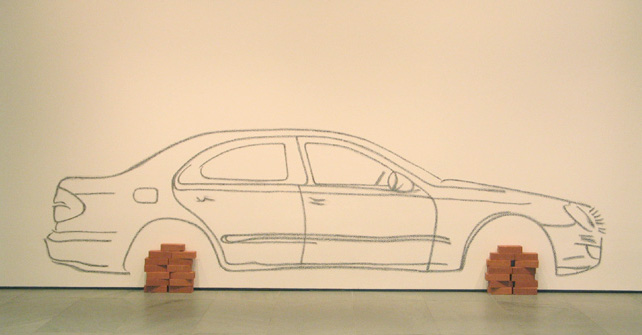
Robin Rhode. Car on Bricks. 2008. Multiple of wall drawing and bricks. Publisher: Edition Schellmann, Munich. Edition: 15. The Museum of Modern Art, New York. Acquired through the generosity of The Contemporary Arts Council of The Museum of Modern Art. © 2010 Robin Rhode
As they reach the top of the escalators on the second floor at MoMA, visitors are greeted by a recent acquisition by the South African–born, German-based artist Robin Rhode. Car on Bricks (2008) consists essentially of an idea that the artist has issued in an edition of fifteen unusual multiples, each consisting of a wall drawing and two piles of bricks.
February 10, 2010
|
Artists,
Viewpoints
Portrait in Seven Shades: Van Gogh
The tragically unrequited love, the driving need to be accepted as a serious artist, the longing for success that never quite came (he sold only one painting during his lifetime)—most people are just as familiar with the story of Vincent van Gogh‘s life as they are with his art. Full of thick strokes and rich colors, van Gogh’s paintings express his passion and pathos. His many self-portraits show him to be sad or dispirited. Aware of his struggles, we are drawn into his paintings. The reality he captures is one we want to experience.
February 9, 2010
|
Artists
Portrait in Seven Shades: Picasso
When Wynton Marsalis, the Music Director at Jazz at Lincoln Center, asked me to compose a long-form piece that could take any direction as long as it had a theme, it didn’t take me long to come up with a truly inspiring concept: music based on art. In Portrait in Seven Shades, each movement is dedicated to a different painter, and while it was hard to narrow my selection down to only seven artists, there were a few choices that were obvious to me—one of them being Picasso.
February 8, 2010
|
Artists
Portrait in Seven Shades: Matisse
For the Portrait in Seven Shades piece—which we performed last week at Jazz at Lincoln Center’s Rose Theater—my goal was to select seven recognizable artists whose different styles would help create a contrast between each of the seven movements in the piece.
I’ve already talked about the “Monet” and “Dalí” movements, and today am moving on to “Matisse,” which very much expresses the reaction I have when I see Henri Matisse‘s paintings such as Dance (I): joy.
February 5, 2010
|
Artists
Portrait in Seven Shades: Dalí
In my first post I talked about how seven master painters in MoMA’s collection inspired me to write Portrait in Seven Shades, an hour-long piece of music being performed by the Jazz at Lincoln Center Orchestra over the next several nights. The piece has seven movements, each dedicated to a different painter. Yesterday, I wrote about how I was inspired by Monet’s treatment of light and surface in his triptych Water Lilies. Today I’d like to talk about another movement in the suite, this one inspired by Salvador Dalí’s The Persistence of Memory.
Dalí‘s work incorporates familiar images and objects in unfamiliar settings and combinations, creating a sense of discomfort or insecurity in the viewer. His paintings allude to violence, sexuality, and secrets living in one’s subconscious. The Persistence of Memory depicts a barren landscape populated by melting clocks; I was inspired by this surreal scene to develop an unusual time signature, 13/8. Embracing the effect of this painting I have found sounds and approaches to harmony that are familiar on their own, but take on an unsettling effect with the particular way they are combined.
In “Dalí,” which is basically a disguised blues, the persistent drum groove exposes a little of the aggressive quality of this painting, and the melody, played in thirds by trumpet and alto, exists in a different tonal center from the bass, like a lost creature searching. A flamenco-like clave—supporting a drum solo and emphasized by the orchestra’s hand clapping—references Dalí’s Spanish heritage.
February 4, 2010
|
Artists
Portrait in Seven Shades: Monet
Portrait in Seven Shades tells a story about seven painters—not through words, as in a museum description, but through music. Many parallels can be drawn between art and music. Like painters, musicians talk of colors, layers and composition. Several stylistic descriptors—impressionistic, abstract, pop—are common to both fields. And of course there is the blues.
When Wynton Marsalis, artistic director of Jazz at Lincoln Center, asked me to compose a long-form piece, it didn’t take me long to come up with a concept that would truly inspire me to write an hour’s worth of music: it would be a piece with seven movements, each dedicated to a different painter. It was hard narrowing it down to only seven painters, as there are so many artists that I truly admire, but the list ultimately included Monet, Dali, Matisse, Picasso, van Gogh, Chagall, and Pollock. I wanted the listener to hear music that evokes images with which they are already familiar, and to see these paintings in a new, fresh way.
For the Monet movement, I used the triptych Water Lilies as a main inspiration. I feel that Monet embellished reality by diffusing it, using colors and textures to create fantasy. We feel nature, water, air – things that are very basic. When you stand up close to this sprawling canvas you lose sight of reality; instead you see the strokes, gesture, and textures.
I hope that you’ll return to INSIDE/OUT to experience the six other movements, as I’ll be writing about each one over the next seven days.
February 4, 2010
|
Artists,
Collection & Exhibitions
New Acquisition: Feng Mengbo’s Long March: Restart
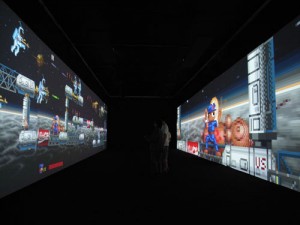
Feng Mengbo. Long March: Restart (installation view, Guangdong Museum, 2008). Video game installation (color, sound). The Museum of Modern Art. Given anonymously. © 2010 Feng Mengbo
We all know a little—and many of you know a lot!—about video games and gaming culture. Few of us, however, have actually attempted and succeeded in creating our own video game. Not only has the artist Feng Mengbo done so, but the video game he created is so large in scale that it requires installation in an exhibition hall. Mengbo started off this pursuit in a traditional enough way for an artist: in 1993 he created a series of paintings titled Game Over: Long March.
January 28, 2010
|
Artists,
Collection & Exhibitions
The Drawings of Guy de Cointet
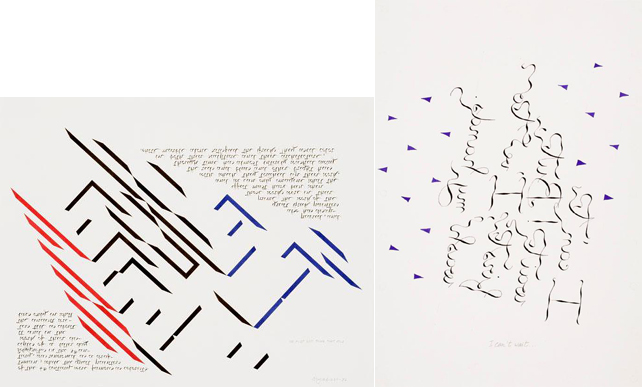
Left: Guy de Cointet. We must not think that cold… 1982. Ink and pencil on paper, 20 x 25 5/8" (50.8 x 65.1 cm). Committee on Drawings Funds. © 2010 Estate of Guy de Cointet. Right: Guy de Cointet. I can’t wait… 1982. Ink and pencil on paper, 21 x 14 3/4" (53.3 x 37.5 cm). Committee on Drawings Funds. © 2010 Estate of Guy de Cointet
The artist Guy de Cointet (French, 1934–1983) was fascinated with language, which he explored primarily through performance and drawing. His practice involved collecting random phrases, words, and even single letters from popular culture and literary sources—he often cited Raymond Roussel’s Surrealist novel Impressions of Africa as influential—and working these elements into non-linear narratives, which were presented as plays to his audience. Paintings and works on paper would then figure prominently within these performances. In his play At Sunrise . . . A Cry Was Heard (1976), a large painting depicting letters bisected by a white sash served as a main subject and prop, with the lead actress continuously referring to it and reading its jumble of letters as if it were an ordinary script. His drawings likewise are almost readable but just beyond comprehension.
Acquired for MoMA’s collection in May, these two drawings are strong examples of de Cointet’s scriptive compositions, which, alongside abstract forms, are reduced to algorithmic visual codes rather than narrative sentences. In these two particular works the artist meticulously reversed the direction of the inscriptions, a technique more commonly known as “mirror writing.” One must hold the drawing up to a mirror in order to read it—a performative act that was not lost on de Cointet. Building upon this mirroring technique, he further obscured the texts in these two works by altering their orientation as well: I can’t wait… has to be rotated once to the left for the text to be legible, and to read the text in We must not think that cold… one must turn the drawing upside down. Once deciphered, the texts read as snippets of mundane conversations, such as “I can’t wait! But first I’ve to wash my hands.” In other instances sentences are cut off mid-word, as in “work of their dis-,” only to have a new line of text begin below, leaving it up to the viewer to complete the sentence.
De Cointet is now recognized as one of the major figures in the Conceptual art movement that emerged in Los Angeles in the 1970s, having strongly influenced a number of prominent artists working in southern California today, including Paul McCarthy and Mike Kelley, for whom both drawing and performance figure significantly in their artistic practices.
If you are interested in reproducing images from The Museum of Modern Art web site, please visit the Image Permissions page (www.moma.org/permissions). For additional information about using content from MoMA.org, please visit About this Site (www.moma.org/site).
© Copyright 2016 The Museum of Modern Art
Welcome to MoMA.org. To take full advantage of all the site’s features, including the option to save works in the collection, please upgrade your browser to Firefox,
Google Chrome, Safari, or Internet Explorer 9.
See our help page for more information.
To take full advantage of all of the features on MoMA.org, please upgrade your browser to Firefox, Google Chrome,
Safari, or Internet Explorer 9.