Lignum vitae, walnut, steel rods, and painted wood
Although Gibraltar is abstract, a connection is easily made between its base—a weighty lump of lignum vitae (a tropical hardwood)—and the Mediterranean rock that gives the work its name. This mass of wood is rough and solid and seemingly unshaped. More delicate, and more clearly marked by human artifice, are the work’s sloping plane of walnut, its painted wood ball, and its two steel rods topped with a crescent and a sphere, respectively. Gibraltar’s biomorphic forms recall those of Surrealism, and Calder’s whimsical vocabulary is rooted in the movement’s legacy.
The sculpture is contradictory in its qualities. The rods are thin and linear and express an upward, airborne drive and eccentric balance; the lignum vitae is heavy, earth-hugging, and solid. The surfaces, too, featuring various materials variously treated, imply methods from machine making to hand-polishing to leaving well enough alone. These disjunctions have a good-humored wit that does not disguise the work’s grace. Calder once said that “the underlying sense of form” in his work was “the system of the Universe,” and Gibraltar, with its sun, moon, and heavy earth, explores the spatial drama of the solar system in miniature.
MoMA Highlights: 375 Works from The Museum of Modern Art, New York (New York: The Museum of Modern Art, 2019)
Explore more
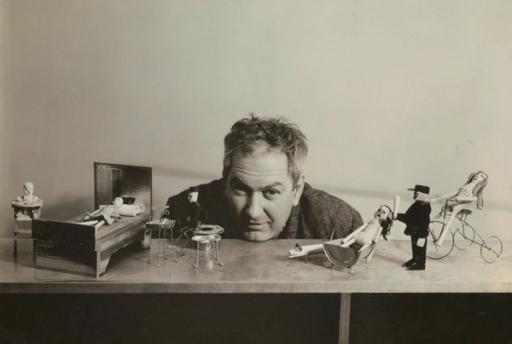
Alexander Calder
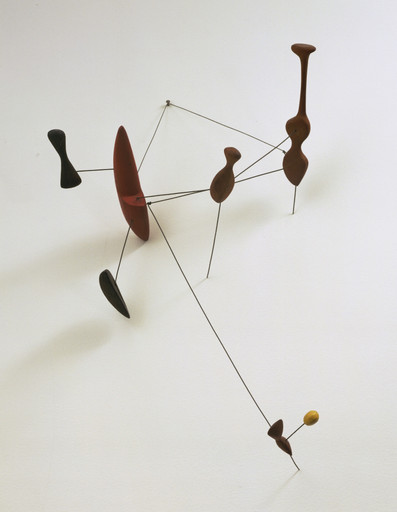
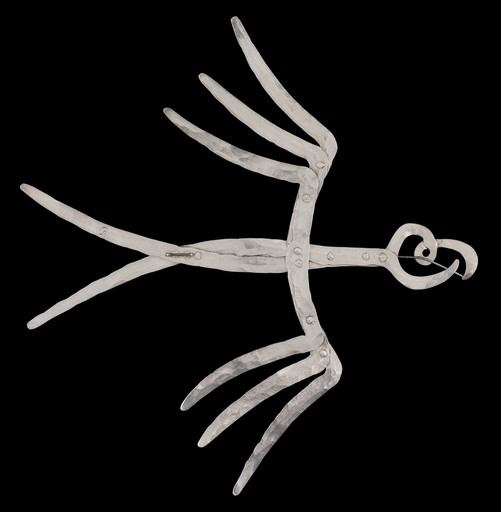
American, 1898–1976 294 works onlineAlexander Calder conceived of sculpture as an experiment in space and motion. Ranging from delicate, intimate, figurative objects in wood and wire, to hanging sculptures that move, to monumentally scaled abstract works in steel and aluminum, Calder’s art suggests the elemental systems that animate life itself.
Learn more →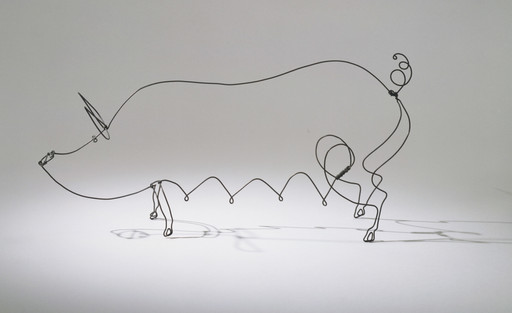
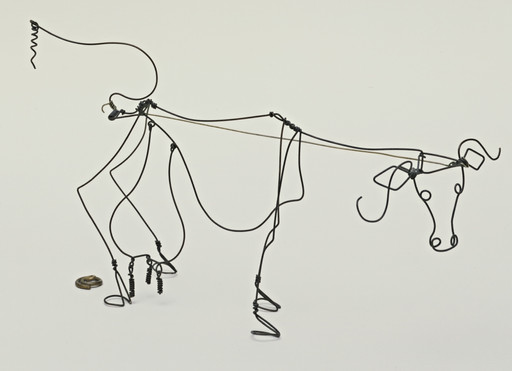
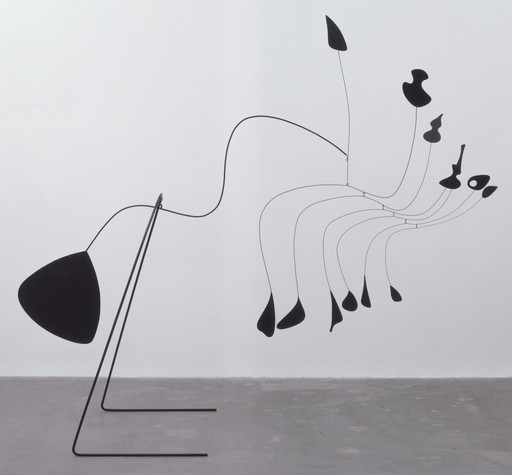
Art of This Century
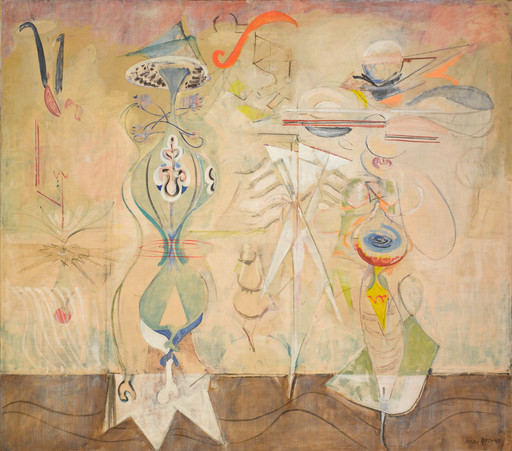
Gallery 522In the 1940s the New York City art world expanded with the arrival of European émigrés escaping World War II.
Learn more →


From MoMA Design Store


Installation views
We have identified this work in the following photos from our exhibition history.
Provenance Research Project
This work is included in the Provenance Research Project, which investigates the ownership history of works in MoMA's collection.
The artist
The Museum of Modern Art, New York. Gift of the artist, 1966
Provenance research is a work in progress, and is frequently updated with new information. If you have any questions or information to provide about the listed works, please email [email protected] or write to:
Provenance Research Project
The Museum of Modern Art
11 West 53 Street
New York, NY 10019
Licensing
Artwork or archival images
If you would like to reproduce an image of a work of art in MoMA's collection, or an image of a MoMA publication or archival material (including installation views, checklists, and press releases), please contact Art Resource (publication in North America) or Scala Archives (publication in all other geographic locations).
Audio and film clips
MoMA licenses archival audio and select out of copyright film clips from our film collection. At this time, MoMA produced video cannot be licensed by MoMA/Scala. All requests to license archival audio or out of copyright film clips should be addressed to Scala Archives at [email protected]. Motion picture film stills cannot be licensed by MoMA/Scala. For access to motion picture film stills for research purposes, please contact the Film Study Center at [email protected]. For more information about film loans and our Circulating Film and Video Library, please visit Circulating Film and Video Library.
Text from a publication or the archives
If you would like to reproduce text from a MoMA publication, please email [email protected]. If you would like to publish text from MoMA's archival materials, please fill out this permission form and send to [email protected].
Feedback
This record is a work in progress. If you have additional information or spotted an error, please fill out this feedback form.