Painted wood and steel wire
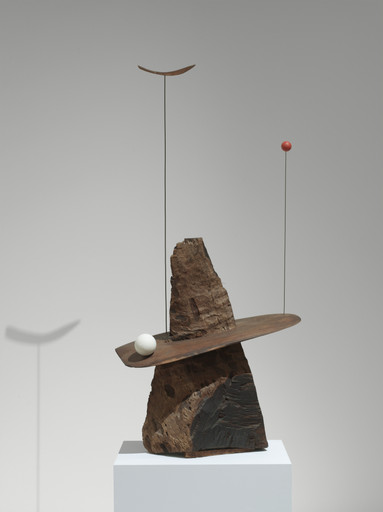
In the 1930s, after a period of traveling back and forth between Europe and the United States, Calder settled in Connecticut, establishing a studio where he experimented with metal sculpture. During World War II, however, “there wasn’t much metal around, so I tried my hand at wood carving,” he said. “I have always liked wood carving, but these were now completely abstract shapes.” This work is part of a series of hanging and standing mobiles inspired by astrology. The year Calder created it, Pierre Matisse, son of artist Henri Matisse, hosted an exhibition of these works at his gallery, another central site for dialogue between European and American artists.
522: Art of This Century, 2025
Gallery label from Focus: Alexander Calder , 2007.
A taut web of wire connects hand–carved wooden forms that project from the wall. Calder made this work in 1943, the year the Museum hosted a major retrospective of his work. At the time, he was the youngest artist to receive this honor.
"There wasn't much metal around during the war years, so I tried my hand at wood carving," Calder said. "I have always liked wood carving, but these were now completely abstract shapes." With its spare, evocative forms, this work underscores the persistent influence Surrealism wielded on his art. It also strikes a note of ambiguity and tension characteristic of much of Surrealist art: does the wire link these disparate elements, or is it a web that traps them? The title suggests a starry vision of night, but the wood elements possess a slightly figurative presence and appear locked irrevocably into place. In 1948 the Brazilian architect Henrique Mindlin wrote, "Calder's work shows more than just the youthful inventive American spirit. Their 'humor,' their instability, their accidental qualities also betray the anxieties of our era. And the subtle elusive lyricism of his forms bespeaks our disillusionment with the obvious and explicit."
Focus: Alexander Calder, 2007.
Explore more
Alexander Calder
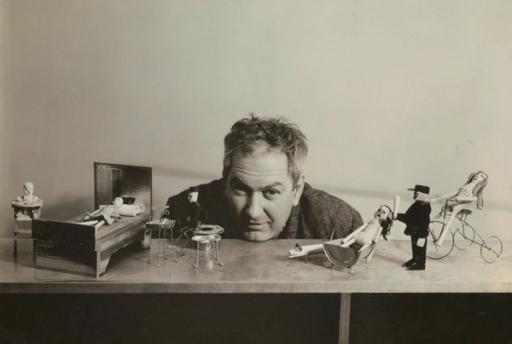
American, 1898–1976 294 works onlineAlexander Calder conceived of sculpture as an experiment in space and motion. Ranging from delicate, intimate, figurative objects in wood and wire, to hanging sculptures that move, to monumentally scaled abstract works in steel and aluminum, Calder’s art suggests the elemental systems that animate life itself.
Learn more →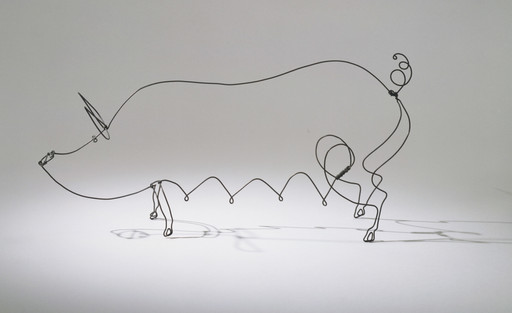
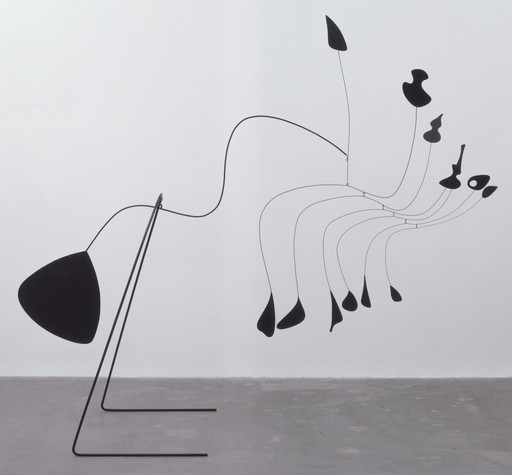
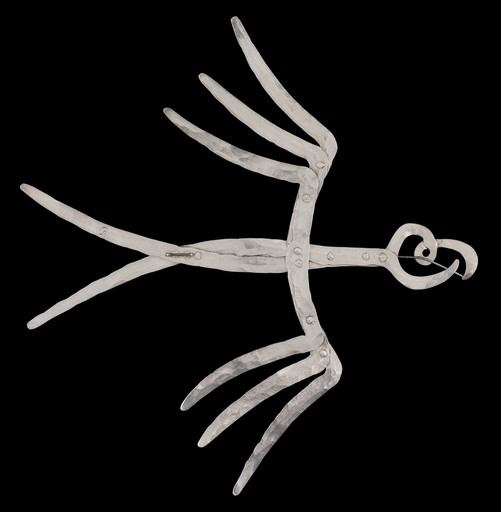
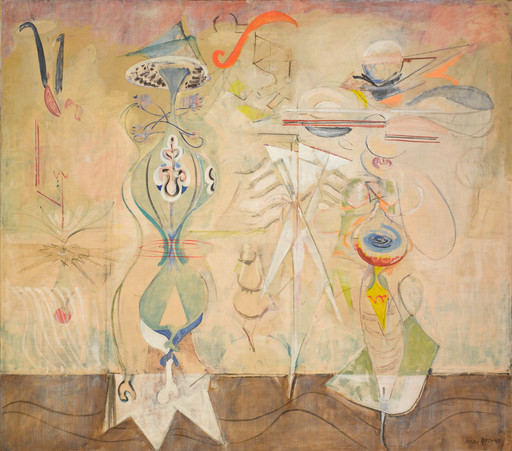
Art of This Century
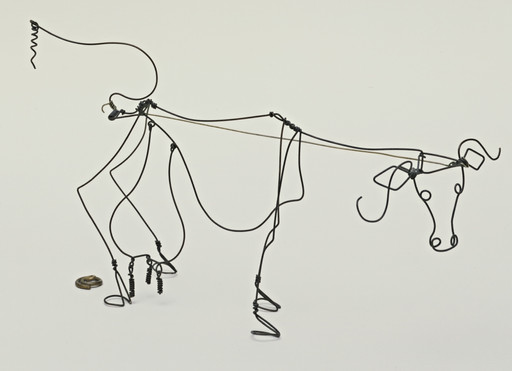
Gallery 522In the 1940s the New York City art world expanded with the arrival of European émigrés escaping World War II.
Learn more →
From MoMA Design Store


Installation views
We have identified this work in the following photos from our exhibition history.
Licensing
Artwork or archival images
If you would like to reproduce an image of a work of art in MoMA's collection, or an image of a MoMA publication or archival material (including installation views, checklists, and press releases), please contact Art Resource (publication in North America) or Scala Archives (publication in all other geographic locations).
Audio and film clips
MoMA licenses archival audio and select out of copyright film clips from our film collection. At this time, MoMA produced video cannot be licensed by MoMA/Scala. All requests to license archival audio or out of copyright film clips should be addressed to Scala Archives at [email protected]. Motion picture film stills cannot be licensed by MoMA/Scala. For access to motion picture film stills for research purposes, please contact the Film Study Center at [email protected]. For more information about film loans and our Circulating Film and Video Library, please visit Circulating Film and Video Library.
Text from a publication or the archives
If you would like to reproduce text from a MoMA publication, please email [email protected]. If you would like to publish text from MoMA's archival materials, please fill out this permission form and send to [email protected].
Feedback
This record is a work in progress. If you have additional information or spotted an error, please fill out this feedback form.