Not on view
Frail yet erect, a man gestures with his left arm and points with his right. We have no idea what he points to, or why. Anonymous and alone, he is also almost a skeleton. For the Existentialist philosopher Jean-Paul Sartre, in fact, Giacometti's sculpture was "always halfway between nothingness and being."
Such sculptures were full of meaning to Sartre, who said of them, "At first glance we seem to be up against the fleshless martyrs of Buchenwald. But a moment later we have a quite different conception: these fine and slender natures rise up to heaven. We seem to have come across a group of Ascensions."
In the years leading up to World War II, Giacometti abandoned his earlier Surrealism. Dissatisfied with the resource of imagination, he returned to the resource of vision, focusing on the human figure and working from live models. Under his eyes, however, these models seem virtually to have dissolved. Working in clay (the preparation to casting in bronze), Giacometti scraped away the body's musculature, so that the flesh seems eaten off by a terrible surrounding emptiness, or to register the air around it as a hostile pressure. Recording the touch of the artist's fingers, the surface of Man Pointing is as rough as if charred or corroded. At the same time, the figure dominates its space, even from a distance.
The Museum of Modern Art, MoMA Highlights, New York: The Museum of Modern Art, revised 2004, originally published 1999, p. 214.
Explore more
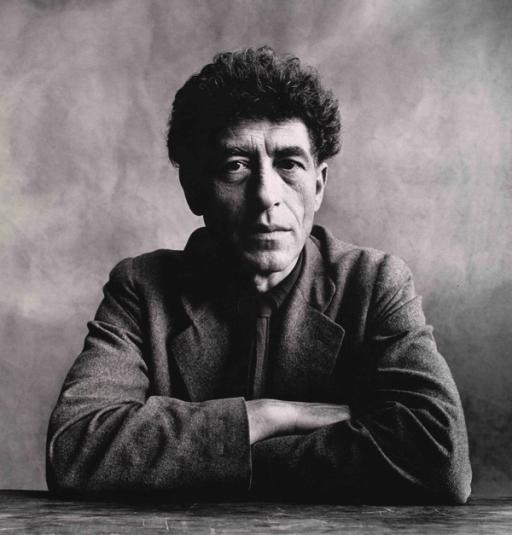
Alberto Giacometti
Swiss, 1901–1966 86 works onlineIn the winter of 1947, Alberto Giacometti wrote a letter to Pierre Matisse, a gallerist in New York who was organizing an exhibition of his works.
Learn more →

From MoMA Design Store


Installation views
We have identified this work in the following photos from our exhibition history.
Licensing
Artwork or archival images
If you would like to reproduce an image of a work of art in MoMA's collection, or an image of a MoMA publication or archival material (including installation views, checklists, and press releases), please contact Art Resource (publication in North America) or Scala Archives (publication in all other geographic locations).
Audio and film clips
MoMA licenses archival audio and select out of copyright film clips from our film collection. At this time, MoMA produced video cannot be licensed by MoMA/Scala. All requests to license archival audio or out of copyright film clips should be addressed to Scala Archives at [email protected]. Motion picture film stills cannot be licensed by MoMA/Scala. For access to motion picture film stills for research purposes, please contact the Film Study Center at [email protected]. For more information about film loans and our Circulating Film and Video Library, please visit Circulating Film and Video Library.
Text from a publication or the archives
If you would like to reproduce text from a MoMA publication, please email [email protected]. If you would like to publish text from MoMA's archival materials, please fill out this permission form and send to [email protected].
Feedback
This record is a work in progress. If you have additional information or spotted an error, please fill out this feedback form.