Not on view
Sometime during the year, Picasso created the plaster Head of a Warrior (pl. 68), a sculpture that conveys the infinite variety of materials and creative processes he used in making his sculptures. For this work he used the so-called imprint technique, in which materials are pressed into fresh plaster to create indexical impressions, and objects are sometimes embedded in the work itself. Picasso also cast certain forms, such as the triangular base, for which he poured plaster inside a vessel made of corrugated cardboard-possibly a simple box he had cut into shape beforehand for use as a mold. The artist probably used keyed segments from a discarded plaster mold to indicate the plume of the Spartan-style helmet, while two tennis balls form the warrior's eyes. Other materials, such as a sculptor's stand, chicken wire, nails, wire, and a crowbar, are revealed in an x-radiograph taken of the original plaster in the Conservation Laboratory of The Museum of Modern Art.
Picasso Sculpture, 2015. Edited by Ann Temkin and Anne Umland. Essays by Virginie Perdrisot, Luise Mahler and Nancy Lim, p. 144-145.
Explore more
Pablo Picasso
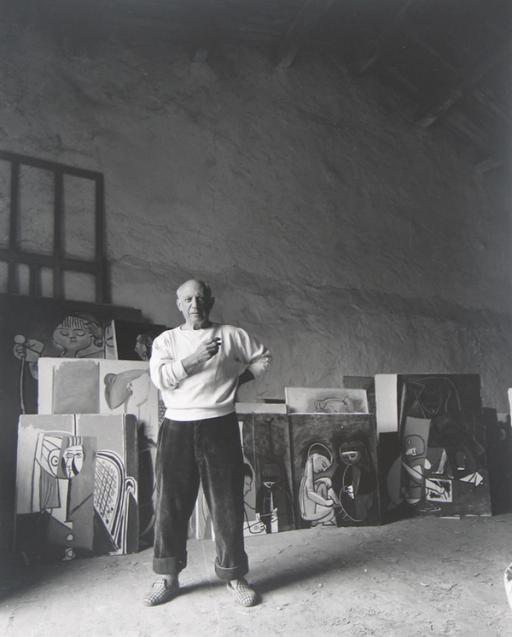
Spanish, 1881–1973 1257 works onlineWith these words, Picasso shed light on two central principles of his artistic production over nearly 80 years: his openness to a diverse range of styles, subject matters, and mediums, and his resistance to the notion that change in art necessarily corresponds to improvement or progress.
Learn more →
Audio
Audio from the playlist 1880–1950: Works from the Collection
From MoMA Design Store


Installation views
We have identified this work in the following photos from our exhibition history.
Provenance Research Project
This work is included in the Provenance Research Project, which investigates the ownership history of works in MoMA's collection.
Jacqueline Picasso
The Museum of Modern Art, New York. Gift of Jacqueline Picasso, 1984
Provenance research is a work in progress, and is frequently updated with new information. If you have any questions or information to provide about the listed works, please email [email protected] or write to:
Provenance Research Project
The Museum of Modern Art
11 West 53 Street
New York, NY 10019
Licensing
Artwork or archival images
If you would like to reproduce an image of a work of art in MoMA's collection, or an image of a MoMA publication or archival material (including installation views, checklists, and press releases), please contact Art Resource (publication in North America) or Scala Archives (publication in all other geographic locations).
Audio and film clips
MoMA licenses archival audio and select out of copyright film clips from our film collection. At this time, MoMA produced video cannot be licensed by MoMA/Scala. All requests to license archival audio or out of copyright film clips should be addressed to Scala Archives at [email protected]. Motion picture film stills cannot be licensed by MoMA/Scala. For access to motion picture film stills for research purposes, please contact the Film Study Center at [email protected]. For more information about film loans and our Circulating Film and Video Library, please visit Circulating Film and Video Library.
Text from a publication or the archives
If you would like to reproduce text from a MoMA publication, please email [email protected]. If you would like to publish text from MoMA's archival materials, please fill out this permission form and send to [email protected].
Feedback
This record is a work in progress. If you have additional information or spotted an error, please fill out this feedback form.