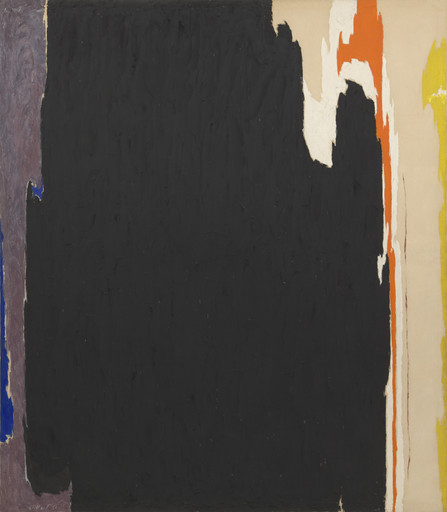
Painting 1944-N is a powerful early example of Still's mature style. The surface is a black impasto, enlivened with knife marks. A jagged red line cuts high on the canvas, and is intersected by two vertical, irregular, pointed shapes before plunging downward to the bottom edge. The size of paintings like this one, its largely empty expanse, and the lightning-bolt quality of Still's line have led some to see in his work a vision of the broad spaces of the Western prairies, where he grew up. But he himself believed that such associations only diminished his work.
Still commanded a new kind of abstraction, free from decipherable symbols. The tarry surface of Painting 1944-N concentrates attention on itself, denying the illusion of depth, and the intensely saturated hue carries emotional force without relying on associative imagery. More programmatically than any of the other Abstract Expressionists, Still consciously tried to erase any traces of modern European art from his painting, and to develop a new art appropriate to the New World. "Pigment on canvas," he believed, "has a way of initiating conventional reactions. . . . Behind these reactions is a body of history matured into dogma, authority, tradition. The totalitarian hegemony of this tradition I despise, its presumptions I reject."
The Museum of Modern Art, MoMA Highlights, New York: The Museum of Modern Art, revised 2004, originally published 1999, p. 193.
Explore more
From MoMA Design Store


Installation views
We have identified this work in the following photos from our exhibition history.
Licensing
Artwork or archival images
If you would like to reproduce an image of a work of art in MoMA's collection, or an image of a MoMA publication or archival material (including installation views, checklists, and press releases), please contact Art Resource (publication in North America) or Scala Archives (publication in all other geographic locations).
Audio and film clips
MoMA licenses archival audio and select out of copyright film clips from our film collection. At this time, MoMA produced video cannot be licensed by MoMA/Scala. All requests to license archival audio or out of copyright film clips should be addressed to Scala Archives at [email protected]. Motion picture film stills cannot be licensed by MoMA/Scala. For access to motion picture film stills for research purposes, please contact the Film Study Center at [email protected]. For more information about film loans and our Circulating Film and Video Library, please visit Circulating Film and Video Library.
Text from a publication or the archives
If you would like to reproduce text from a MoMA publication, please email [email protected]. If you would like to publish text from MoMA's archival materials, please fill out this permission form and send to [email protected].
Feedback
This record is a work in progress. If you have additional information or spotted an error, please fill out this feedback form.