Paul Signac
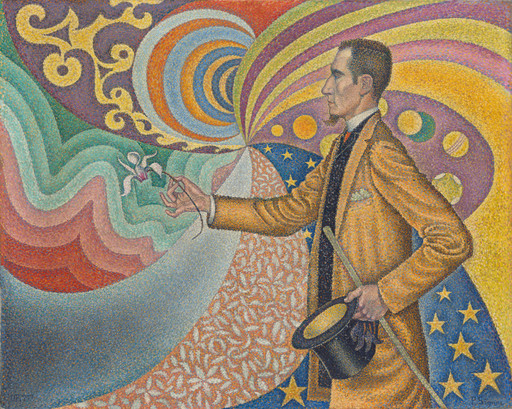
Opus 217. Against the Enamel of a Background Rhythmic with Beats and Angles, Tones, and Tints, Portrait of M. Félix Fénéon in 1890
1890
Oil on canvas
Félix Fénéon was an editor, translator, art dealer, and anarchist activist and the critic who coined the term Neo-Impressionism to describe the works of Signac and Georges Seurat in the late 1880s. In this portrait, Signac depicted Fénéon in left profile. The lines of the subject’s nose, elbow, and cane descend in a zigzag pattern, like the rhythmic “beats and angles” of the title, and the flower he holds rhymes with the upturned curl of his goatee. Attention to abstract patterns continues in the kaleidoscopic pinwheel of the backdrop, likely an allusion to the aesthetic theory of Charles Henry, the Frenchman whose books on color theory and the “algebra” of visual rhythm Signac had recently illustrated.
Fénéon’s relation to the decorative background may be symbolic. In 1887 he had defended the Neo-Impressionists against criticism that their application of paint in uniform dots resembled mosaics or tapestries. “Take a few steps back,” Fénéon urged, and “the technique . . . vanishes; the eye is no longer attracted by anything but that which is essentially painting.” But what was painting’s essence at that historical moment? Was it a means of relaying nature’s ephemeral bloom to the viewer, or the craft of composing paint on canvas? In this portrait, the answer is both, and neither. As Fénéon saw it, painting was the creation of a superior and purified reality transfused with the artist’s personality.
MoMA Highlights: 375 Works from The Museum of Modern Art, New York (New York: The Museum of Modern Art, 2019)
Explore more

Neo-Impressionism
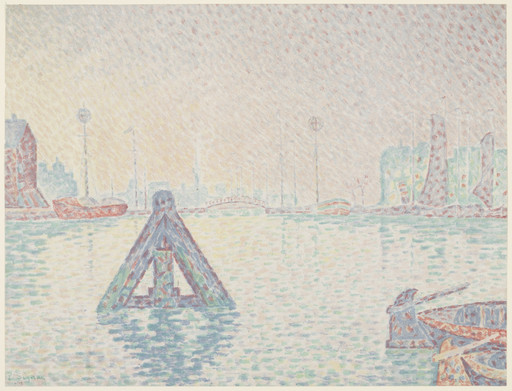
A term coined by French art critic Fénéon in 1886, applied to an avant-garde art movement that flourished principally in France from 1886 to 1906.
Learn more →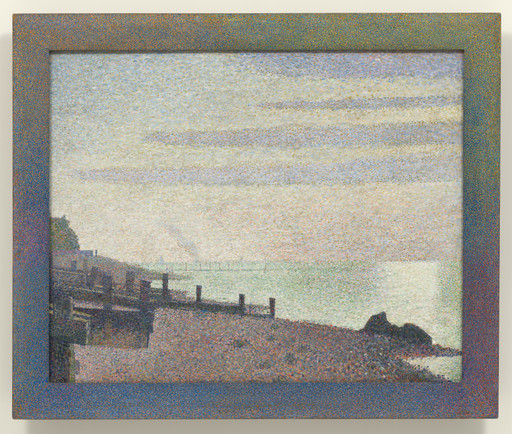
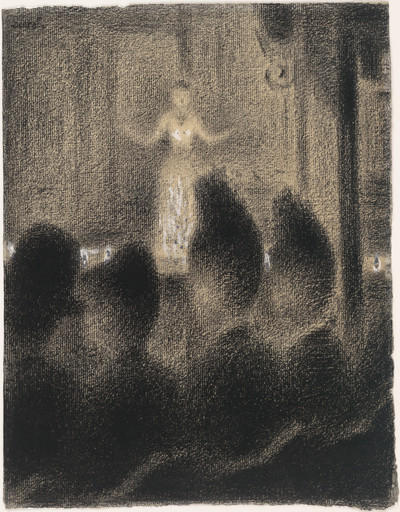
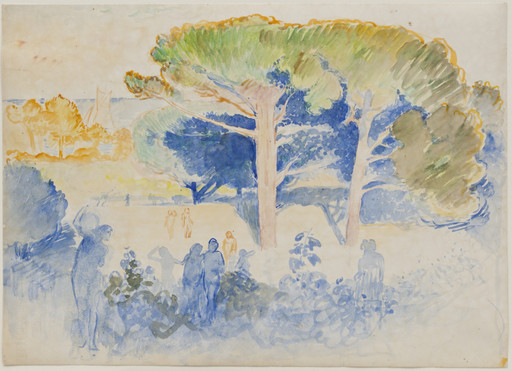
Pointillism
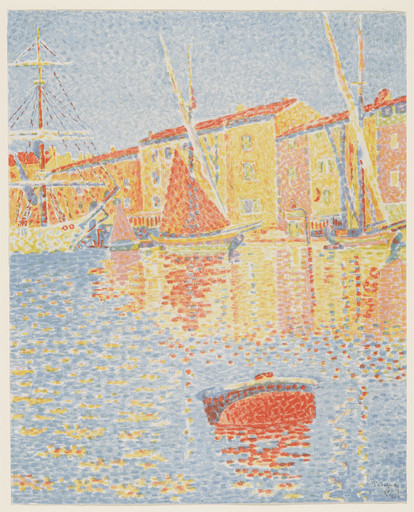
A painting technique developed by French artists Georges-Pierre Seurat and Paul Signac in which small, distinct points of unmixed color are applied in patterns to form an image.
Learn more →

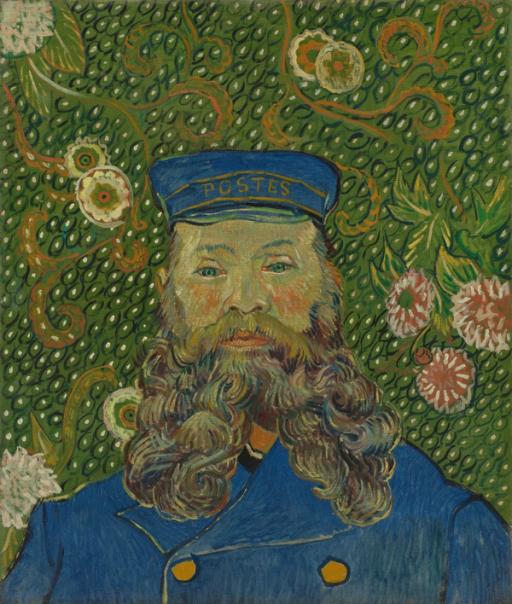
Portrait
A representation of a particular individual, usually intended to capture their likeness or personality.
Learn more →
French Landscapes and Interiors
Gallery 501The late 19th century in France was an era of rapid change: the emergence of mass media, new and faster forms of transportation, urban expansion of cities like Paris, and developments in industry.
Learn more →
Audio
Audio from the playlist Collection 1880s–1940s
From MoMA Design Store


Installation views
We have identified this work in the following photos from our exhibition history.
Licensing
Artwork or archival images
If you would like to reproduce an image of a work of art in MoMA's collection, or an image of a MoMA publication or archival material (including installation views, checklists, and press releases), please contact Art Resource (publication in North America) or Scala Archives (publication in all other geographic locations).
Audio and film clips
MoMA licenses archival audio and select out of copyright film clips from our film collection. At this time, MoMA produced video cannot be licensed by MoMA/Scala. All requests to license archival audio or out of copyright film clips should be addressed to Scala Archives at [email protected]. Motion picture film stills cannot be licensed by MoMA/Scala. For access to motion picture film stills for research purposes, please contact the Film Study Center at [email protected]. For more information about film loans and our Circulating Film and Video Library, please visit Circulating Film and Video Library.
Text from a publication or the archives
If you would like to reproduce text from a MoMA publication, please email [email protected]. If you would like to publish text from MoMA's archival materials, please fill out this permission form and send to [email protected].
Feedback
This record is a work in progress. If you have additional information or spotted an error, please fill out this feedback form.