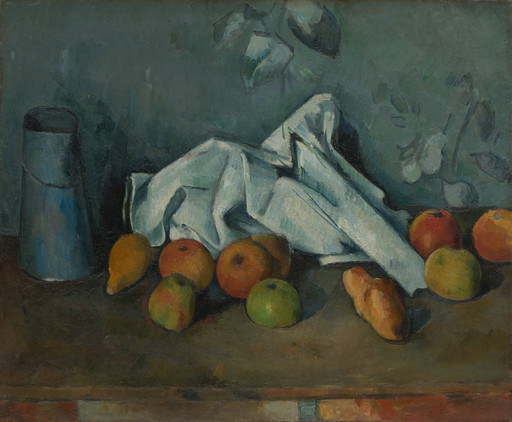
Bliss purchased Still Life with Apples in 1922 at an auction of work owned by Dikran G. Kelekian, the dealer who introduced her to modern art. She purchased it for $21,000, the auction’s highest price. The New York Times reported, “There was applause when it was shown,” which increased when the price rose “in an incredibly short time.” Though Bliss was not identified as the buyer at the auction, other collectors present heard the work was purchased by a “prominent woman collector” and suspected it was she.
When Bliss moved to her new home in 1929, this painting took pride of place over the piano in her music room. It’s importance to Bliss is also reflected in a rare exception in her will, which stipulated that once in MoMA’s collection it could not be sold.
[Lillie P. Bliss and the Birth of the Modern](/calendar/exhibitions/5737), November 17, 2024–March 29, 2025
Gallery label from 2022
“Painting from nature is not copying the object,” Cézanne wrote, “it is realizing one’s sensations.” In this work the artist demonstrates that a still life can be more than an imitation of life—it can be an exploration of seeing and of the very nature of painting. Never aiming for mere illusion, Cézanne consistently drew attention to the quality of the paint and canvas. Here, for example, some areas of canvas are left bare, and others, like the drape of the tablecloth, appear unfinished. Rules of perspective, too, are broken: the right corner of the table tilts forward and is not aligned with the left side.
2022
Gallery label from 2012.
Still Life with Apples demonstrates that the genre of still life can be a vehicle for faithfully representing not only objects but also the appearance of light and space. Painting from nature is not copying the object, Cézanne wrote, it is realizing ones sensations. He consistently drew attention to the quality of the paint and canvasnever aiming for illusion. For example, the edges of the fruit in the bowl are undefined and appear to shift. Rules of perspective, too, are broken; the right corner of the table tilts forward and is not aligned with the left side. Some areas of canvas are left bare, and others, like the drape of the tablecloth, appear unfinished. Still Life with Apples is more than an imitation of lifeit is an exploration of seeing and the very nature of painting.
2012.
Explore more
Paul Cézanne
French, 1839–1906 25 works onlineThroughout his decades-long career, he dedicated himself to this task, continuously experimenting with his materials and techniques in an effort to record his sensations on paper and canvas.
Learn more →
Post-Impressionism
A term coined in 1910 by the English art critic and painter Roger Fry and applied to the reaction against the naturalistic depiction of light and color in Impressionism.
Learn more →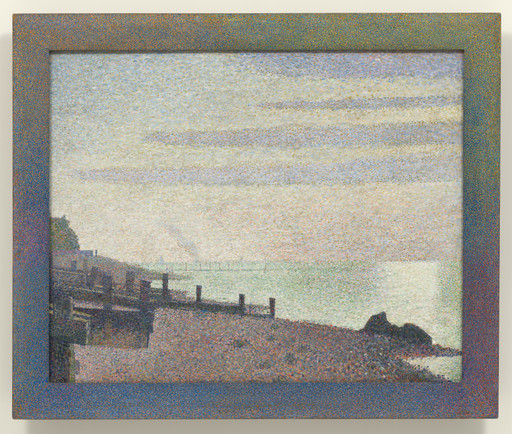
Audio
Audio from the playlist Lillie P. Bliss and the Birth of the Modern
From MoMA Design Store


Installation views
We have identified this work in the following photos from our exhibition history.
Provenance Research Project
This work is included in the Provenance Research Project, which investigates the ownership history of works in MoMA's collection.
Paul Cézanne
Ambroise Vollard, Paris (stock no. 3489), purchased from Paul Cézanne
Maurice Gangnat, Paris
c. 1913, Paul Rosenberg, Paris
Galerie Durand-Ruel, Paris and New York
c. 1916 – 1922, Dikran K. Kelekian, Paris
1922 – 1931, Lillie P. Bliss (1864–1931), New York, purchased from the above at the Kelekian Collection sale at the American Art Association, New York, Jan. 30–31, 1922, no. 156
1931/1934, The Museum of Modern Art, New York, acquired by bequest from Lillie P. Bliss
Provenance research is a work in progress, and is frequently updated with new information. If you have any questions or information to provide about the listed works, please email [email protected] or write to:
Provenance Research Project
The Museum of Modern Art
11 West 53 Street
New York, NY 10019
Licensing
Artwork or archival images
If you would like to reproduce an image of a work of art in MoMA's collection, or an image of a MoMA publication or archival material (including installation views, checklists, and press releases), please contact Art Resource (publication in North America) or Scala Archives (publication in all other geographic locations).
Audio and film clips
MoMA licenses archival audio and select out of copyright film clips from our film collection. At this time, MoMA produced video cannot be licensed by MoMA/Scala. All requests to license archival audio or out of copyright film clips should be addressed to Scala Archives at [email protected]. Motion picture film stills cannot be licensed by MoMA/Scala. For access to motion picture film stills for research purposes, please contact the Film Study Center at [email protected]. For more information about film loans and our Circulating Film and Video Library, please visit Circulating Film and Video Library.
Text from a publication or the archives
If you would like to reproduce text from a MoMA publication, please email [email protected]. If you would like to publish text from MoMA's archival materials, please fill out this permission form and send to [email protected].
Feedback
This record is a work in progress. If you have additional information or spotted an error, please fill out this feedback form.