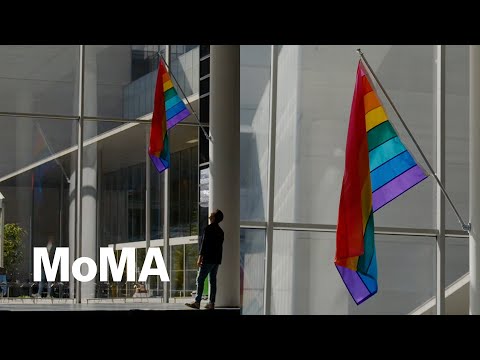
Some symbols can move the whole world. The Rainbow Flag, first unfurled at the San Francisco Gay and Lesbian Freedom Day Parade on June 25, 1978, is a gleaming example. Led by Baker, a political activist and designer, thirty volunteers hand-dyed and stitched rainbow flags for the event. Baker, who called the rainbow a “natural flag in the sky,” was inspired by the proliferation of the US flag in popular culture as a symbol of commemoration, power, and festivity. MoMA first displayed the contemporary, mass-produced version of the flag on June 26, 2015, the day the US Supreme Court made the historic decision to legalize same-sex marriage. The rainbow flag continues to symbolize pride, acceptance, community, diversity, and, above all, love.
Pirouette: Turning Points in Design, January 26, 2025–November 15, 2025
Publication excerpt from MoMA Highlights: 375 Works from The Museum of Modern Art, New York (New York: The Museum of Modern Art, 2019)
The rainbow flag is a symbol of pride and community that was first unfurled at the San Francisco Gay and Lesbian Freedom Day Parade on June 25, 1978. Led by Baker, the flag’s designer, thirty volunteers gathered at the Gay Community Center in San Francisco to hand-dye and stitch rainbow flags for the parade, two of which were later hung in the United Nations Plaza in San Francisco to highlight the acceptance and equality of sexual and gender minorities as both a global struggle and a matter of civil rights. The contemporary, mass-produced version of the flag in MoMA’s collection celebrates the accessibility and worldwide adoption of this humble masterpiece of design.
Baker admired the universality of the rainbow, which he called a “natural flag in the sky.” He also was inspired by the way in which American flags had proliferated in popular culture as symbols of commemoration, power, and festivity during the United States’ bicentennial celebrations of 1976. Since its inception, Baker’s flag has undergone numerous revisions, but all variations maintain the rainbow scheme.
Two weeks after its formal entry into MoMA’s collection, the rainbow flag was hung for the first time in the Museum’s galleries on June 26, 2015, the day the US Supreme Court made its historic decision to legalize same-sex marriage in all states. The rainbow flag continues to stand as a powerful and evocative symbol of acceptance, community, diversity, and, above all, love.
MoMA Highlights: 375 Works from The Museum of Modern Art, New York (New York: The Museum of Modern Art, 2019)
Explore more
Textile
A work consisting of natural or artificial fibers, often woven. Can refer to artist-created sculptures, hand-woven works, and industrially produced fabrics.
Learn more →


Audio
Audio from the playlist 1980–Today: Works from the Collection
Audio from the playlist Queer Highlights
Audio from the playlist Pirouette: Turning Points in Design
Articles and videos
From MoMA Design Store


Installation views
We have identified this work in the following photos from our exhibition history.
Licensing
Artwork or archival images
If you would like to reproduce an image of a work of art in MoMA's collection, or an image of a MoMA publication or archival material (including installation views, checklists, and press releases), please contact Art Resource (publication in North America) or Scala Archives (publication in all other geographic locations).
Audio and film clips
MoMA licenses archival audio and select out of copyright film clips from our film collection. At this time, MoMA produced video cannot be licensed by MoMA/Scala. All requests to license archival audio or out of copyright film clips should be addressed to Scala Archives at [email protected]. Motion picture film stills cannot be licensed by MoMA/Scala. For access to motion picture film stills for research purposes, please contact the Film Study Center at [email protected]. For more information about film loans and our Circulating Film and Video Library, please visit Circulating Film and Video Library.
Text from a publication or the archives
If you would like to reproduce text from a MoMA publication, please email [email protected]. If you would like to publish text from MoMA's archival materials, please fill out this permission form and send to [email protected].
Feedback
This record is a work in progress. If you have additional information or spotted an error, please fill out this feedback form.