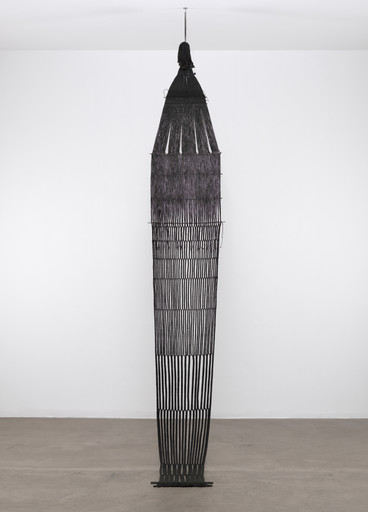
Hicks's weavings often make reference to surfaces, landscapes, and built environments. The parabolic shape delineated by Prayer Rug’s tassels mimics arch forms common to the Islamic architecture Hicks encountered in North Africa during extensive travel throughout the world. The vertical display of the piece upends the notion of the rug as a textile trodden underfoot, while bound tassels projecting from the plane emphasize the tactile quality of the wool fibers. During the 1960s and 1970s, Hicks made many soft fiber pieces for modernist corporate offices and public spaces that offered a foil to the severity of their interiors.
Brute Material: Fiber into Form, April 5, 2013–September 8, 2013.
Gallery label from Making Space: Women Artists and Postwar Abstraction , April 19 - August 13, 2017.
Of the genesis of her sculptural textiles, Hicks said, "I became absorbed into the story of what is a tapestry, what is not a tapestry, what is the new tapestry, what is a tapestry that leaves the wall and jumps into space." The vertical display of Prayer Rug upends the notion of the rug as a textile trodden underfoot, and the dangling, voluminous tassels highlight the tactile quality of the wool fibers. Hicks—who studied with Josef and Anni Albers at Yale, and later drew inspiration from fiber-working techniques she encountered during her travels throughout Latin America, North Africa, and India—makes work that bridges art, architecture, design, and craft. Her architectural sensibility extends to the many large-scale soft fiber pieces she developed for modernist corporate office buildings and public spaces, which provide a foil to the severity of these environments.
Making Space: Women Artists and Postwar Abstraction, April 19 - August 13, 2017.
Explore more
Sheila Hicks
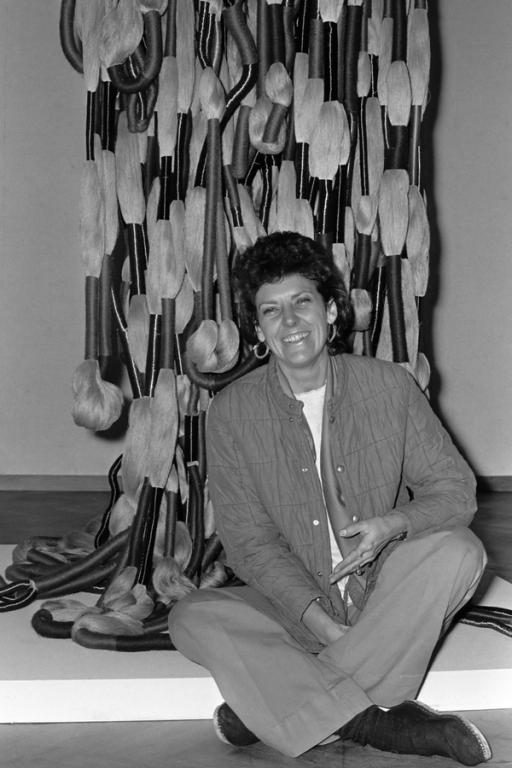
American, born 1934 21 works onlineBorn during the Great Depression in Hastings, Nebraska, Sheila Hicks spent much of her early life on the road, with her father seeking work where he found it.
Learn more →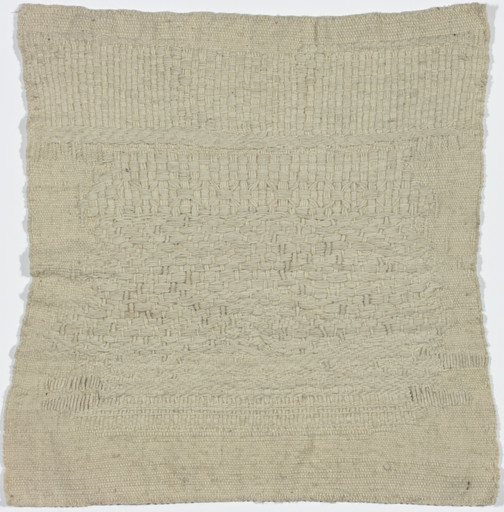

Textile
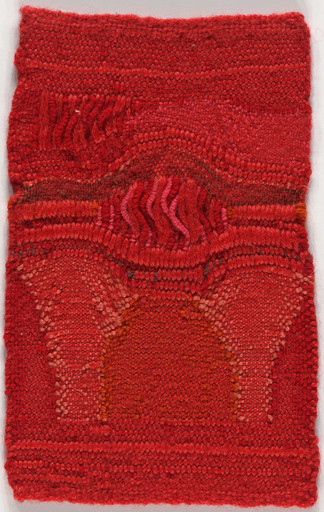
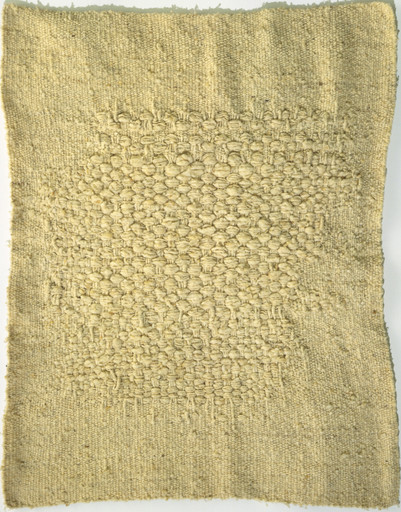
A work consisting of natural or artificial fibers, often woven. Can refer to artist-created sculptures, hand-woven works, and industrially produced fabrics.
Learn more →


Audio
Audio from the playlist Making Space: Women Artists and Postwar Abstraction
From MoMA Design Store


Installation views
We have identified this work in the following photos from our exhibition history.
Licensing
Artwork or archival images
If you would like to reproduce an image of a work of art in MoMA's collection, or an image of a MoMA publication or archival material (including installation views, checklists, and press releases), please contact Art Resource (publication in North America) or Scala Archives (publication in all other geographic locations).
Audio and film clips
MoMA licenses archival audio and select out of copyright film clips from our film collection. At this time, MoMA produced video cannot be licensed by MoMA/Scala. All requests to license archival audio or out of copyright film clips should be addressed to Scala Archives at [email protected]. Motion picture film stills cannot be licensed by MoMA/Scala. For access to motion picture film stills for research purposes, please contact the Film Study Center at [email protected]. For more information about film loans and our Circulating Film and Video Library, please visit Circulating Film and Video Library.
Text from a publication or the archives
If you would like to reproduce text from a MoMA publication, please email [email protected]. If you would like to publish text from MoMA's archival materials, please fill out this permission form and send to [email protected].
Feedback
This record is a work in progress. If you have additional information or spotted an error, please fill out this feedback form.