Collection 1880–1950

507

Kandinsky: The Spiritual in Art

New on view

Ongoing

MoMA

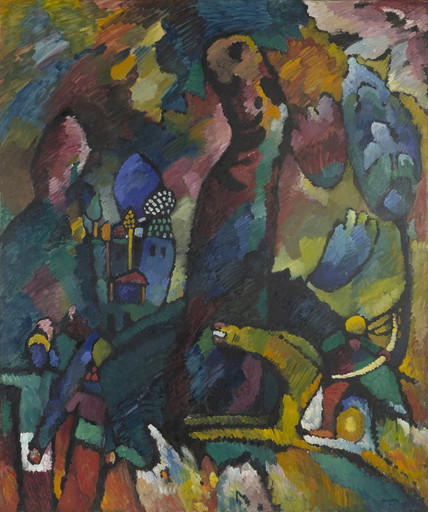
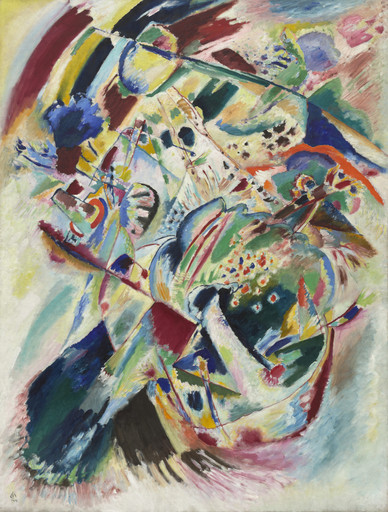
Vasily Kandinsky. Panel for Edwin R. Campbell No. 4. 1914. Oil on canvas, 64 1/4 × 48 1/4" (163 × 122.5 cm). The Museum of Modern Art, New York. Nelson A. Rockefeller Fund (by exchange). © 2026 Artists Rights Society (ARS), New York/ADAGP, Paris
  • MoMA, Floor 5, 507 The Alfred H. Barr, Jr. Galleries

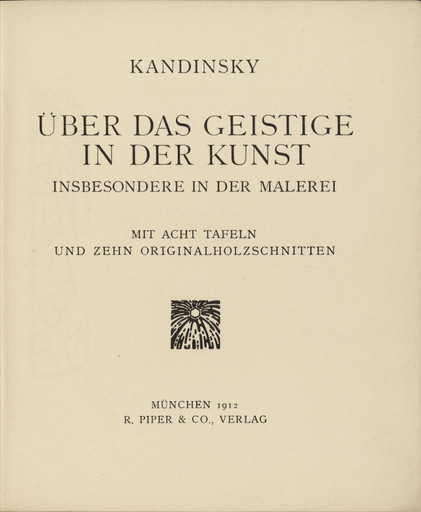
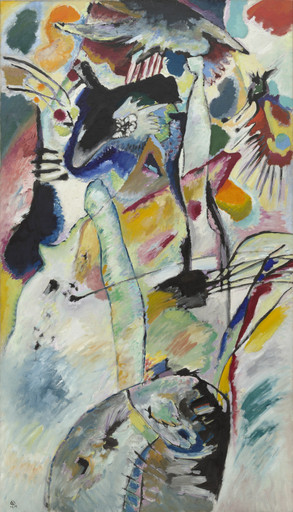
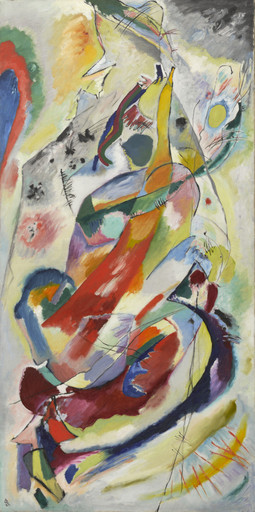
“Must we not renounce the object altogether, throw it to the winds and instead lay bare the purely abstract?” In his 1911 book Concerning the Spiritual in Art, Vasily Kandinsky championed expression and spirituality over naturalistic depiction. Earlier that year, he had publicly exhibited an abstract painting for the first time.

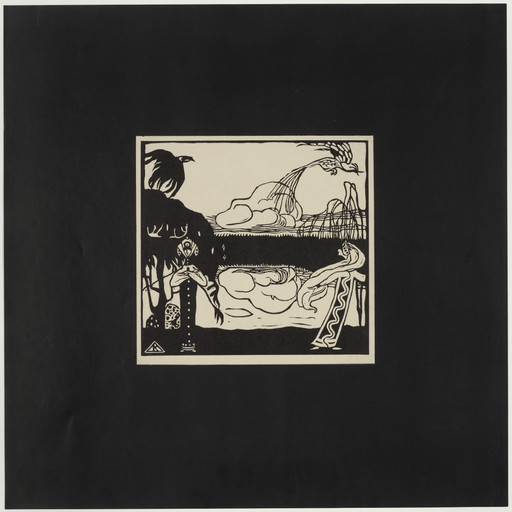
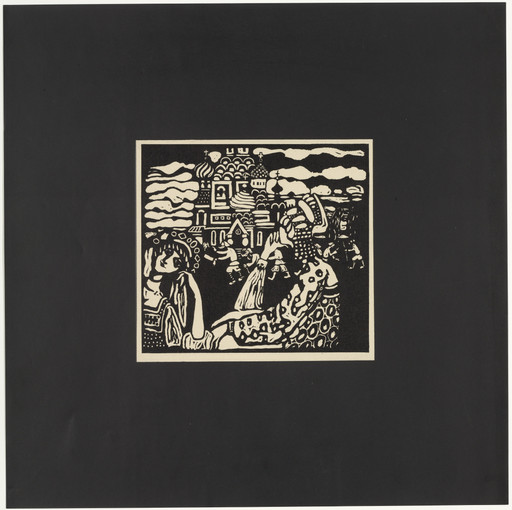
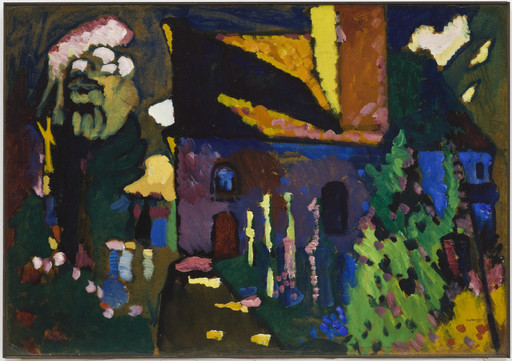
Kandinsky made the works on view here in the years immediately before and after this watershed moment. Early examples feature recognizable motifs—for instance, a hunter with a bow in a vibrant patchwork landscape—but by 1914, he largely released form and color from representation. Instead, he produced dynamic arrangements of shapes and lines that evoke a sense of motion. He also looked to music as a model for visual composition. Using its language of melodies and harmonies, he imagined new pictorial categories, such as “impressions” and “improvisations,” to elicit emotional and sensorial responses from viewers. “Color is a keyboard,” he declared. “The eye is the hammer. The soul is the piano, with its many strings.”

Organized by Jodi Hauptman, The Robert Lehman Foundation Chief Curator of Drawings and Prints, and Lydia Mullin, Manager, Collection Galleries, with Rachel Remick, Curatorial Associate, Department of Curatorial Affairs and Department of Painting and Sculpture.
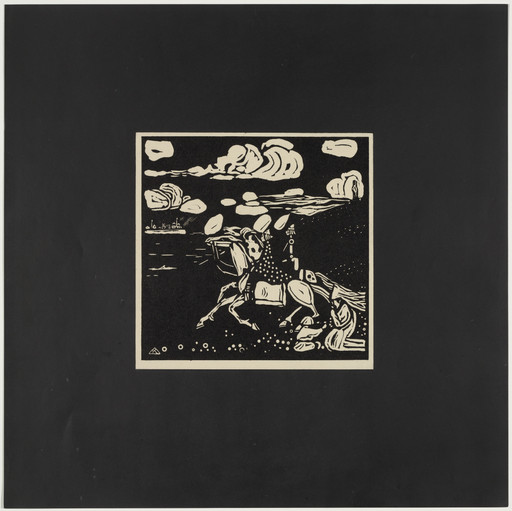
11 works online

Artist

Licensing

If you would like to reproduce an image of a work of art in MoMA’s collection, or an image of a MoMA publication or archival material (including installation views, checklists, and press releases), please contact Art Resource (publication in North America) or Scala Archives (publication in all other geographic locations).

MoMA licenses archival audio and select out of copyright film clips from our film collection. At this time, MoMA produced video cannot be licensed by MoMA/Scala. All requests to license archival audio or out of copyright film clips should be addressed to Scala Archives at [email protected]. Motion picture film stills cannot be licensed by MoMA/Scala. For access to motion picture film stills for research purposes, please contact the Film Study Center at [email protected]. For more information about film loans and our Circulating Film and Video Library, please visit https://www.moma.org/research/circulating-film.

If you would like to reproduce text from a MoMA publication, please email [email protected]. If you would like to publish text from MoMA’s archival materials, please fill out this permission form and send to [email protected].

Feedback

This record is a work in progress. If you have additional information or spotted an error, please send feedback to [email protected].