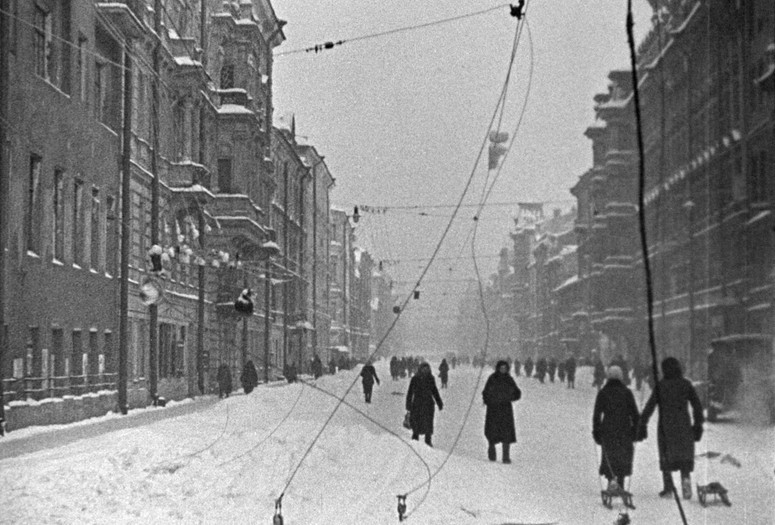
Blockade (БЛОКАДА). 2005. Russia. Written and directed by Sergei Loznitsa. DCP courtesy Atoms & Void. No dialogue. 52 min.
The Siege of Leningrad was the most devastating military blockade in world history. Between 1941 and 1944, over the span of 872 days, Axis powers caused the deaths of an estimated 1.5 million Soviet civilians, nearly half of the city’s population, through artillery shelling, starvation, disease, cold, and failed evacuation attempts. Sergei Loznitsa draws on footage shot by frontline cameramen—some of it incorporated into the wartime and postwar films Leningrad in Fight, 900 Unforgettable Days, The Feat of Leningrad, and The Sentence of the People—to create a devastating record of suffering and bravery. Its soundtrack reduced to a few spare, haunting Foley effects, Blockade is bracketed by different types of looking: the reconnaissance scouting for antiaircraft batteries and dirigible surveillance at the start of the siege, and the crowds gathered for public lynchings of enemy captives and traitors in its aftermath.
Blockade also depicts the nighttime rituals of blackout shades and klieg lights scanning the sky, bronze equestrian monuments dismantled for safekeeping, and Nazi soldiers paraded through the streets at gunpoint. Then, scenes of carnage and conflagration unfold. Baroque churches, stately government buildings, and apartments are bombed into rubble. Ordinary citizens join fire brigades to salvage whatever remains. Propaganda posters are pasted alongside hastily handwritten bulletins. The city freezes over. Drinking and cooking water is drawn from dirty blocks of ice, scraps of firewood from detritus. While some people attempt to flee the city on trains, others die of pestilence, hypothermia, or hunger, their bodies littering the city boulevards before they can be carted off and buried in mass pits.
Artel (АРТЕЛЬ). 2006. Russia. Written and directed by Sergei Loznitsa. DCP courtesy Atoms & Void. No dialogue. 30 min.
Ice fishing in the White Sea is not for the faint of heart, as revealed in Sergei Loznitsa’s observant film study. Lying along the Arctic Circle in northwestern Russia and reaching average depths of 180 feet, the Sea is an unyielding frozen mass requiring hours of chainsawing and digging to breach, and yet even after three centuries it remains an important shipping route. The film’s title, Artel, refers to a cooperative of artisans and laborers involved with seasonal industries like fishing, logging, and farming. Loznitsa’s interest is in the traditions and customs of disparate Russian peoples, a subject to which he returns in Northern Light and his most recent film, Imperium.