Saute ma ville. 1968. Belgium. Written and directed by Chantal Akerman. Restored from the original 35mm camera negative by Royal Film Archive of Belgium — CINEMATEK and Fondation Chantal Akerman; DCP courtesy Janus Films. No dialogue. 13 min.
In this manic, Beckettian (or Chaplinesque) tragicomedy, a decisive early work inspired by Jean-Luc Godard’s Pierrot le fou, 18-year-old Chantal Akerman enacts a kind of semiotics of her cramped kitchen. Like some confined zoo creature or clumsy Dionesian reveler, she cooks, scrubs, wolfs down pasta, polishes her shoes, reads the newspaper, dances before the mirror, frees the cat…and duct tapes the doorjamb (an act that can suggest only one grim thing). Then, striking the pose of an ancient Greek funerary figure—perhaps Oizys, the goddess of despair, or an angel of grief—she’s last seen holding a bouquet of freshly cut flowers while resting her mournful head on the gas-lit stove. “In my opinion,” Akerman would later contend, “Saute ma ville is the opposite of Jeanne Dielman: the story of a girl who answers back to her mother, who shatters the norms confining women to feminine tasks, who breaks everything in the kitchen and who does everything in a twisted way, off the mark, and nevertheless it is a love story.”
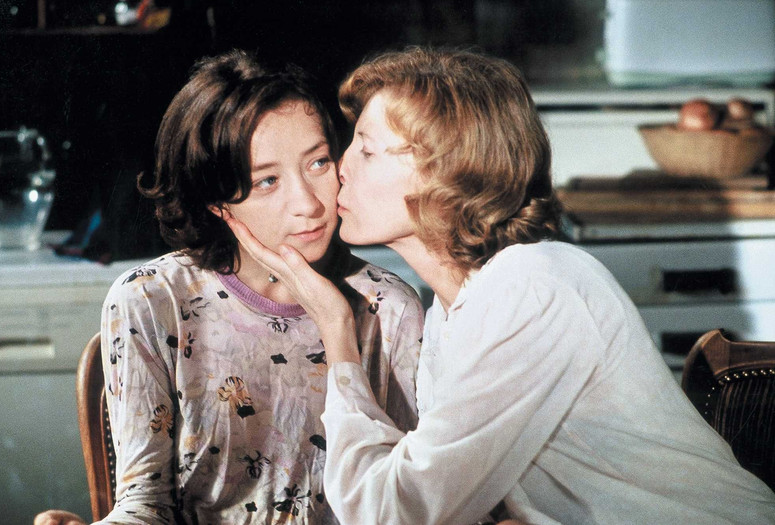
Demain on déménage (Tomorrow We Move). 2004. Belgium/France. Directed by Chantal Akerman. Screenplay by Akerman, Eric de Kuyper. With Sylvie Testud, Aurore Clément, Jean-Pierre Marielle, Natacha Régnier. Restored in 4K by Royal Film Archive of Belgium — CINEMATEK and Fondation Chantal Akerman in collaboration The Bureau Sales; DCP courtesy The Bureau Sales. In French; English subtitles. 110 min.
What makes Chantal Akerman’s screwball comedy so subversive is its dark undercurrent of survivor’s guilt. The film puts in mind something Billy Wilder once wrote in a German newspaper: “If the concentration camps and the gas chambers were all imaginary, then please tell me—where is my mother?” Charlotte (Sylvie Testud) is a ditsy, chain-smoking writer who pays the bills by writing bad erotic literature, seeking (but not finding) inspiration in everything from vacuum cleaning to eavesdropping on café conversations. Her oversensitive, recently widowed mother Catherine (Aurore Clément), who’s given to playing rapturous Romantic piano sonatas, settles in with her, cluttering their bohemian duplex with family heirlooms that are a constant reminder of the dead—her husband’s suitcase, with its dull razor and oversized underwear, her Polish grandmother’s diary from 1924—and driving her batty with maudlin ruminations on chicken smells. As Charlotte resolves to move out, various neurotic apartment-hunters traipse in. “This film will have something in it of my very first short film, Saute ma ville, made in 1968,” Akerman notes. “A tragicomedy, almost Chaplinesque.”