Wood folding chair, mounted photograph of a chair, and mounted photographic enlargement of the dictionary definition of "chair"
Not on view
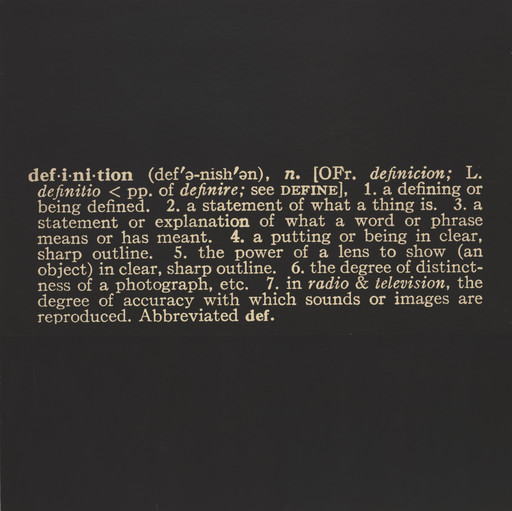
In One and Three Chairs, Joseph Kosuth represents one chair three ways: as a manufactured chair, as a photograph, and as a copy of a dictionary entry for the word “chair.” The installation is thus composed of an object, an image, and words.
Kosuth didn’t make the chair, take the photograph, or write the definition; he selected and assembled them together. But is this art? And which representation of the chair is most “accurate”? These open-ended questions are exactly what Kosuth wanted us to think about when he said that “art is making meaning.” By assembling these three alternative representations, Kosuth turns a simple wooden chair into an object of debate and even consternation, a platform for exploring new meanings.
Publication excerpt from The Museum of Modern Art, MoMA Highlights , New York: The Museum of Modern Art, revised 2004, originally published 1999, p. 257.
A chair sits alongside a photograph of a chair and a dictionary definition of the word chair. Perhaps all three are chairs, or codes for one: a visual code, a verbal code, and a code in the language of objects, that is, a chair of wood. But isn't this last chair simply . . . a chair? Or, as Marcel Duchamp asked in his Bicycle Wheel of 1913, does the inclusion of an object in an artwork somehow change it? If both photograph and words describe a chair, how is their functioning different from that of the real chair, and what is Kosuth's artwork doing by adding these functions together? Prodded to ask such questions, the viewer embarks on the basic processes demanded by Conceptual art.
"The art I call conceptual is such because it is based on an inquiry into the nature of art," Kosuth has written. "Thus, it is . . . a working out, a thinking out, of all the implications of all aspects of the concept 'art,' . . . Fundamental to this idea of art is the understanding of the linguistic nature of all art propositions, be they past or present, and regardless of the elements used in their construction." Chasing a chair through three different registers, Kosuth asks us to try to decipher the subliminal sentences in which we phrase our experience of art.
The Museum of Modern Art, MoMA Highlights, New York: The Museum of Modern Art, revised 2004, originally published 1999, p. 257.
Explore more
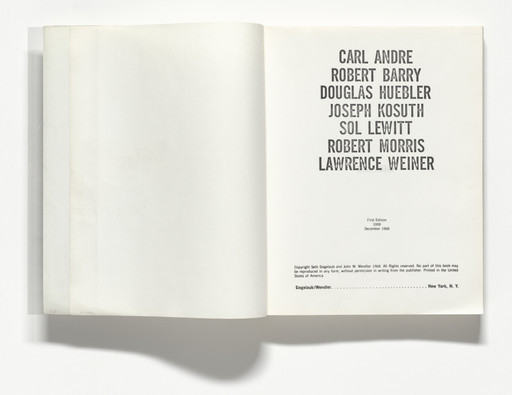
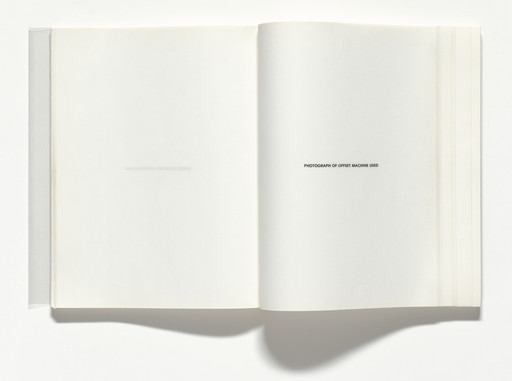
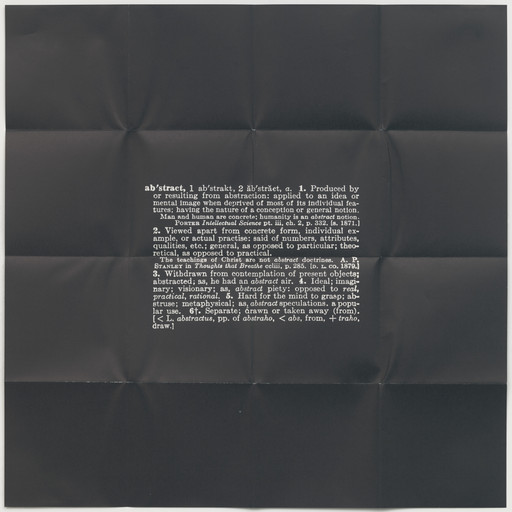
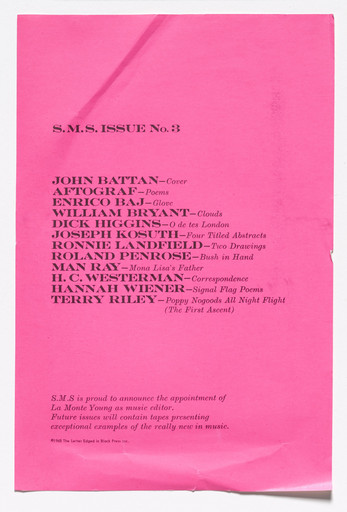
Conceptual art
In the 1960s, many artists experimented with art that emphasized ideas over objects and materials traditionally associated with art making.
Learn more →



Audio
Audio from the playlist 1950–1980: Works from the Collection
From MoMA Design Store


Installation views
We have identified this work in the following photos from our exhibition history.
Licensing
Artwork or archival images
If you would like to reproduce an image of a work of art in MoMA's collection, or an image of a MoMA publication or archival material (including installation views, checklists, and press releases), please contact Art Resource (publication in North America) or Scala Archives (publication in all other geographic locations).
Audio and film clips
MoMA licenses archival audio and select out of copyright film clips from our film collection. At this time, MoMA produced video cannot be licensed by MoMA/Scala. All requests to license archival audio or out of copyright film clips should be addressed to Scala Archives at [email protected]. Motion picture film stills cannot be licensed by MoMA/Scala. For access to motion picture film stills for research purposes, please contact the Film Study Center at [email protected]. For more information about film loans and our Circulating Film and Video Library, please visit Circulating Film and Video Library.
Text from a publication or the archives
If you would like to reproduce text from a MoMA publication, please email [email protected]. If you would like to publish text from MoMA's archival materials, please fill out this permission form and send to [email protected].
Feedback
This record is a work in progress. If you have additional information or spotted an error, please fill out this feedback form.