MoMA
Posts tagged ‘Architecture’
September 1, 2010  |  Rising Currents
Rising Currents Boat Tour: Understanding the Present and Imagining a Possible Future

Photo (and all subsequent photos) by Ben Prosky

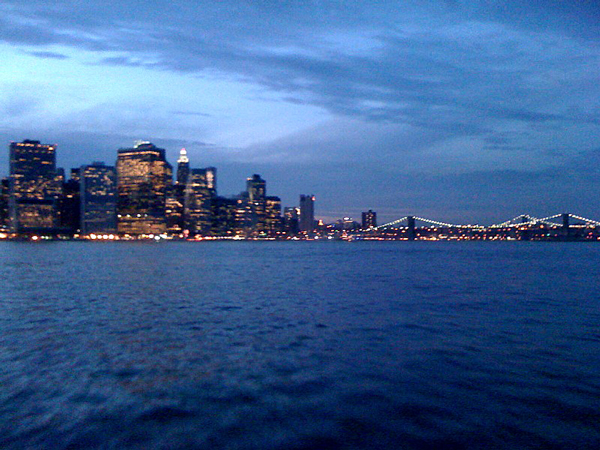
“YES,” I replied, without delay, to the e-mail announcing MoMA and the AIA Center for Architecture’s last boat tour of the New York harbor in August. Having missed several tours earlier in the summer, I could not let this opportunity pass. Through Rising Currents, MoMA had not only invited architects and landscape designers into their galleries to present works responding to a real-world dilemma, but was now taking the public out of its galleries and into the areas examined as well.

March 26, 2010  |  Rising Currents
Rising Currents: Opening of the Exhibition

Documentation of the P.S.1 workshop phase of the exhibition

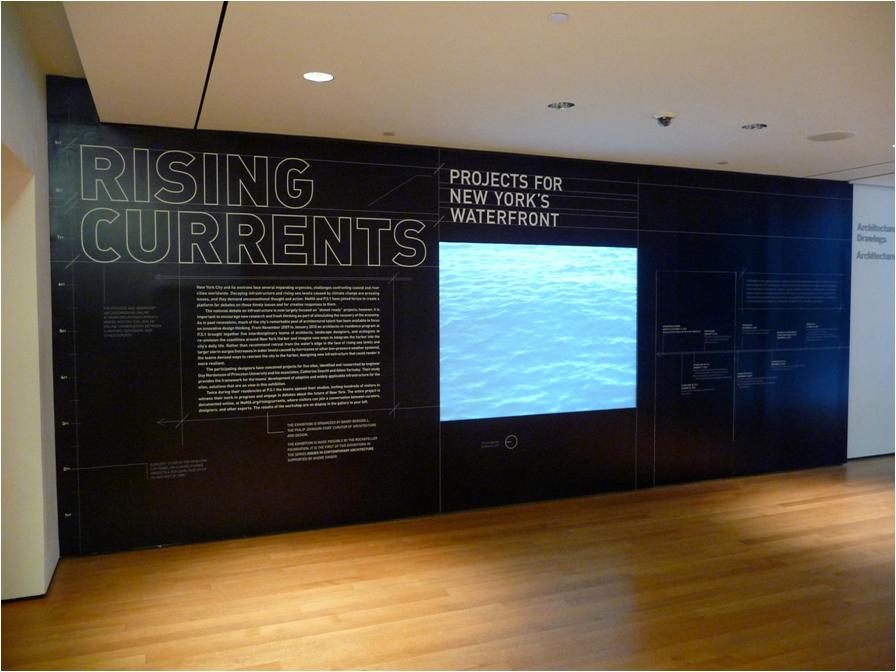
Rising Currents opened to the public yesterday. One of the premises of the exhibition is the value of creative collaboration, and in that spirit we encourage visitors to respond to the exhibition by posting comments on the project website at the kiosk inside the gallery.     

The team leaders participated in a panel discussion moderated by myself and Guy Nordenson on Tuesday evening. We posed several questions to the teams, focusing on the unique format of the workshop phase at P.S.1. Specifically, we asked if the teams gained any valuable insights during the Open Houses, when the public was invited to see work in progress. 

February 16, 2010  |  Rising Currents
Rising Currents: Optimistic Innovation

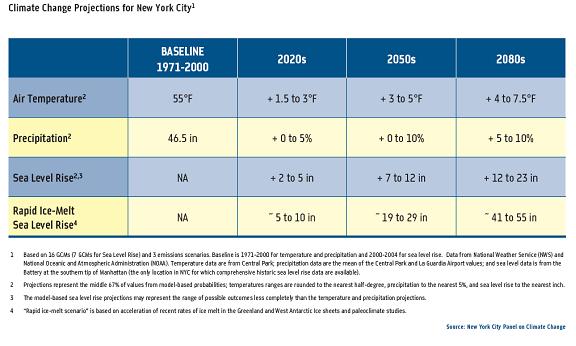
Climate change and sea-level projections developed by the New York City Panel on Climate Change

The Rising Currents exhibition and studio work at P.S.1 demonstrated the challenges that New York City faces from climate change, as well as the opportunities we have to rethink how we interact with the built and natural environment. 

New York City already faces real and significant climate risks. We currently experience hot, humid summers and severe weather events, including heat waves, torrential downpours, snow and ice storms, and nor’easters. These weather events affect every New Yorker. As our climate changes, increasing our resilience to these events will become even more necessary.

February 2, 2010  |  Rising Currents
Rising Currents: Governors Island

A few days after visiting the five teams at their open studios at P.S.1, I went for a walk on Governors Island to view the zones from the island’s waterfront promenade. Governors Island sits in the heart of New York Harbor, and the promenade provides the perfect vantage point from which to take in the harbor as a singular force and view the zones as they are today. Climate change and rising sea levels no longer seem abstract when you look out from the island and contemplate the potential impact of the one-hundred-year flood on different locations, including the island itself. I walked around the island clockwise from Soissons Dock:

January 26, 2010  |  Rising Currents
Rising Currents: High Stakes

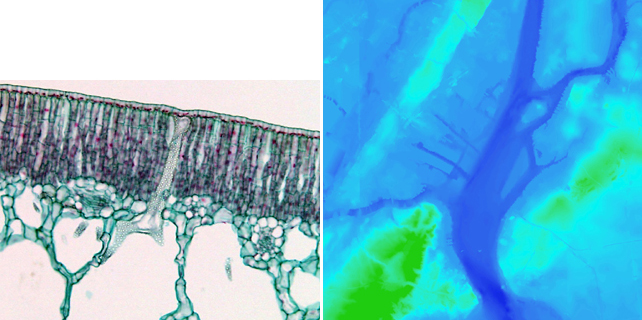
Left: Long cylindrical palisade cells, the primary site of light absorption and photosynthesis, are found just below the upper surface of a leaf. Image courtesy University of Nevada, Las Vegas School of Life Sciences; Right: A merged GIS-based model of the New York-New Jersey Upper Bay, emphasizing the fluid continuity of topography and bathymetry. Deepest areas are indicated in dark blue, highest elevations in green. © Palisade Bay Team: Guy Nordenson and Associates, Catherine Seavitt Studio, and Architecture Research Office

Catherine Seavitt, AIA LEED AP, is the Principal of Catherine Seavitt Studio in New York and co-author, with Guy Nordenson and Adam Yarinsky, of the book On the Water: Palisade Bay.

As one of the authors of the 2007 Latrobe Prize study On the Water: Palisade Bay, the backstory project that led to the development of the MoMA Rising Currents workshop and exhibition, I often get asked the question, “How did you come up with the title Palisade Bay?”  It’s a three-part answer.

January 19, 2010  |  Rising Currents
From a Grand Finale to the Next Phase

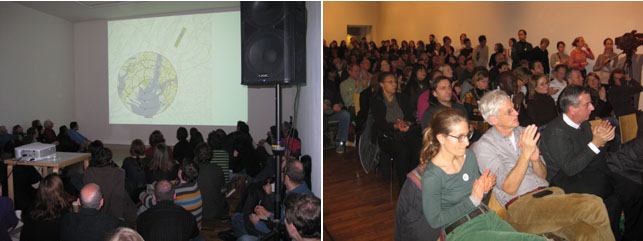
Open House presentations at P.S.1 on January 9, 2010

With a grand finale—attendees filled the room and spilled out into the hall—the five teams presented their final designs to the public at P.S.1 on January 9. As the teams now begin producing materials for the upcoming exhibition at MoMA (and the MoMA team begins preparing the space and the explanatory glue around the project), Rising Currents enters a new phase. Over the next few weeks a number of expert guest bloggers will add their perspectives on an experiment that challenges both the city as we have inherited it and the format of an architectural exhibition in an art museum. The quality of design, innovation, and intense teamwork that has characterized the last two months at P.S.1 has been nothing short of remarkable. The level of interest from city, state, and federal officials has been deeply encouraging and the surge of interest from the public has been spectacular. This week a jury will convene at P.S.1 to pick the finalists for the eleventh annual Young Architects Program (YAP). YAP is an integral part of our department’s programming and while the Rising Currents project is similar in some ways, it is worth noting that it is a true innovation for MoMA and P.S.1, and we believe in some respects, for architecture museums in general.

December 8, 2009  |  Rising Currents
Rising Currents Sneak Preview! Visit the Teams at P.S.1 on December 12

This Saturday, December 12 (2:00–6:00 p.m.), is the first opportunity for the public to visit the Rising Currents architect-in-residence studios at P.S.1. As part of P.S.1’s Saturday Sessions, the five teams will open their studios to the public and be available to discuss their work. Two rounds of presentations will be given. The first round of presentations will begin at 2:15 p.m. and be repeated at 4:30 p.m. Below, the teams offer a preview of their site work to date.

Eric Bunge and Mimi Hoang, nARCHITECTS
ZONE 3:

After two engineering workshops with Arup, we are pursuing four temporal strategies that unite the disparate scales of our site, and extend the domains of water and land across each other: 1) ferries and mobile programs on barges powered by methane gas collected from the Owl’s Head Wastewater Treatment Plant interconnect a network of hybrid stations/storm surge deflectors; 2) islands combine the infrastructural with the ecological, and are interconnected with inflatable storm surge barriers: “airbag urbanism”; 3) housing on stilts, off the sewage grid, is combined with floating treatment wetlands; 4) a pervious network of infiltration basins, swales, and culverts opportunistically appropriates underutilized plots of land, and when dry, functions as a decentralized network of parks.

Bauhaus Lounge: When the Couch Matches the Art
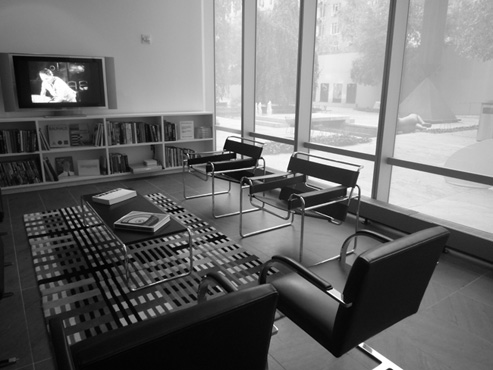
Bauhaus Lounge, The Lewis B. and Dorothy Cullman Education and Research Center

Bauhaus Lounge, The Lewis B. and Dorothy Cullman Education and Research Center

Matching the artwork with the living room couch is one of the perennial concerns of any collector. But when it comes to the Bauhaus, which was as much about designing couches as it was about artworks, finding the right furniture piece shouldn’t be a problem. Or so it seemed to us at the Education Department. During the exhibition Bauhaus 1919–1933: Workshops for Modernity, we imagined turning the reading room space in MoMA’s Cullman building into a Bauhaus Lounge, equipped with Bauhaus furniture for visitors to relax on while they watch a video of a reconstruction of Oskar Schlemmer’s Triadic Ballet or browse through Bauhaus literature. We thought we had enough original Bauhaus-designed chairs lying around MoMA’s buildings that it couldn’t be too hard to put such a lounge together. We do have a Wassily chair (no one remembers where it came from) that sits in the Education offices; we also snatched away a few other chairs from a conference room and two Mies van der Rohe Barcelona chairs from outside of Glenn Lowry’s office waiting area (his office wants them back after the show).

November 3, 2009  |  Rising Currents
Rising Currents: Projects for New York’s Waterfront
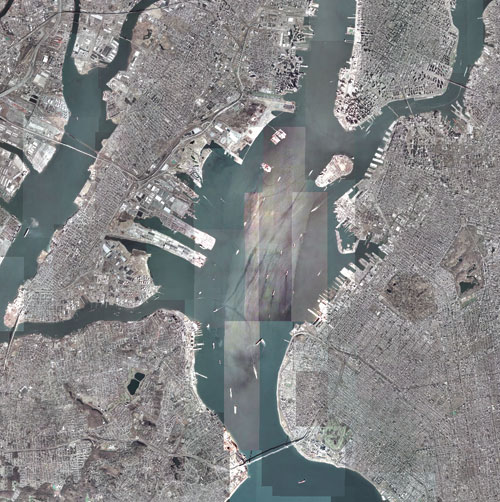
Aerial view of Palisade Bay. Image courtesy of Palisade Bay Team: Guy Nordenson and Associates, Catherine Seavitt Studio, Architecture Research Office

Aerial view of Palisade Bay. Image courtesy of Palisade Bay Team: Guy Nordenson and Associates, Catherine Seavitt Studio, Architecture Research Office

When I joined the Museum two-and-a-half years ago, I wanted to find innovative ways for the Museum to engage with contemporary practice in architecture, landscape, and design-related engineering, techniques that could complement the reactive mode of an exhibition where we show what has been done already, what we admire and is deserving of contextualization and wider publicity. There seem to be many compelling and timely issues that MoMA should be able to respond to quickly, while they are still relevant topics of dialogue and debate, issues that may require that we take the risk of committing to works and outcomes that remain to be seen.

Now we are launching a research laboratory on immediate, pressing issues. This new project is an invitation to undertake original interdisciplinary design research on “glocal” problems: global in implication but local in application and design. With the joint Rising Currents workshop and exhibition, MoMA serves in an almost unprecedented way as the incubator—rather than the mirror—of new ideas.