MoMA
Posts in ‘Learning and Engagement’
October 17, 2013  |  Events & Programs, Learning and Engagement
(FAQ) Frequently Asked Questions
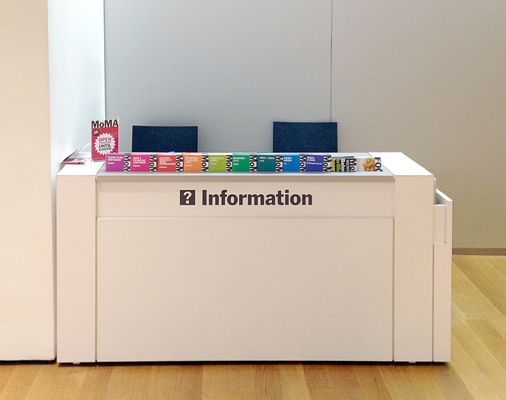
Info_Desk

Photograph courtesy of Paul Ramirez Jonas

As part of my research for Artists Experiment, I went to MoMA to sit side by side with the volunteers that staff the information desks. I was not 100% sure what I would find, but my instincts told me that there was something interesting about the situation

October 16, 2013  |  Learning and Engagement
Combining Poetry with Visual Art to See (and Feel) in a New Way

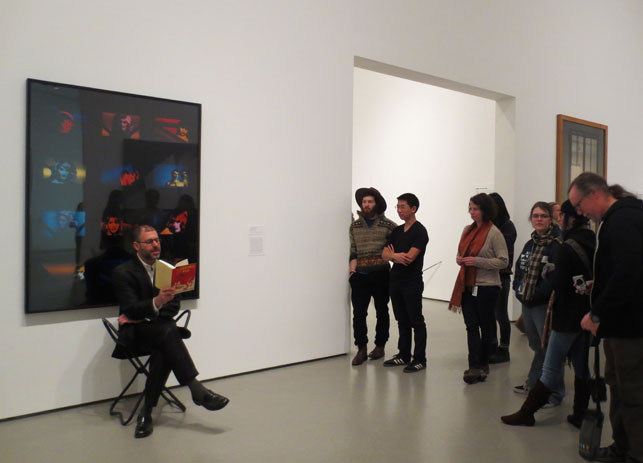
Kenneth Goldsmith performs a guerilla reading in the MoMA galleries.

Kenneth Goldsmith performs a guerilla reading in the MoMA galleries. Photo: Jackie Armstrong

“Painting is poetry that is seen rather than felt, and poetry is painting that is felt rather than seen.” – Leonardo da Vinci

When visiting a museum, especially in New York City, it’s easy to wander around without pausing to look at specific works of art. After all, there’s so much to see and crowds to contend with.

Games Artists Play, at MoMA
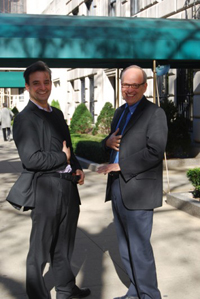
Pablo Helguera (left) and the author (right)

Pablo Helguera (left) and the author (right)

Teaching a workshop on art and game theory is the second cooperative venture Pablo Helguera and I have undertaken in the last couple of years. The first was a diet. Bear with me; the two are not unrelated. Frustrated with our personal efforts to shed a couple of pounds, we were ready for an experiment. A website offered a new set of motivations: We were required to report our weight to one another on a weekly basis, to allow our wives to monitor our progress, and (here is the kicker) we gave them our credit card information with the understanding that if we failed to lose the specified weight, we would automatically donate money to the National Rifle Association (NRA). How is this related? Game theory studies how and why people make decisions. Pablo and I wanted to lose weight but we also enjoyed eating —and the latter was prevailing, one dessert at a time. The structure of the diet added new elements to our decisions—our weight became public, our competitive natures were activated, and given our feelings about the NRA, our political and moral sense was now at stake in our menu decisions. No donations were made. The pounds melted away. It would have been a considerably different situation if the rules had been changed—for example if there were a slim and happy winner and a loser who ignominiously and publicly contributed to the NRA. Had we entered a diet with those rules we might have emerged even thinner, but as friends, we most likely would not have joined in the first place.

Game theory opens a set tools to think about rational and irrational decisions. These decisions are always conceived in terms of pairs and groups—otherwise they are not games—so we can begin to understand how we decide what to do in relation to other people. If we are interested in art that is relational, interactive, cooperative, or participatory perhaps we should look at this theory of relations. Pablo and I are not experts in game theory. But we both think games like the Prisoner’s Dilemma, the Dictator Game, the Ultimatum Game, and others are interesting starting points for a discussion of interpersonal behavior. When played in public—as we intend to do in the class—the games have an interesting performative quality that can lead to a rich conversation on a topic we are quite conversant in—participatory, cooperative art. Quite frankly, as much as we have written about social practice art, this is a new field, and we are all still struggling to get a handle on how to think about it.

I’m looking forward to the workshop as an experiment in this emerging discussion and hope you will join us on October 22 and 24 at MoMA for Games Artists Play: The Game as a Socially Engaged Art Form.




MoMA Class: The Market Is the Medium
caption TK

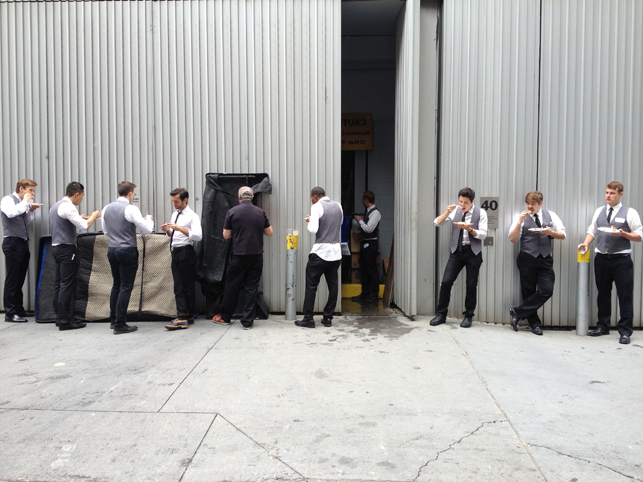
Workers dining outside the Museum on 54 Street before an exhibition opening. Photo: Amy Whitaker

I first started teaching business as a creative practice when I landed at the Slade School of Fine Art in London to study for an MFA in painting—MBA already in hand. 

September 23, 2013  |  Events & Programs, Learning and Engagement
The Real History of Multimedia
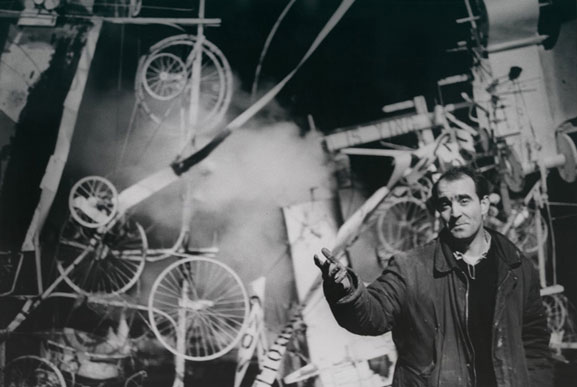
Homage to New York: a Self-Constructing & Self-Destroying Work of Art Conceived and Built by Jean Tinguely. Exhibition Date: March 17, 1960. Photographer: David Gahr

Homage to New York: a Self-Constructing and Self-Destroying Work of Art Conceived and Built by Jean Tinguely. The Museum of Modern Art, March 17, 1960. Photo: David Gahr

I began my scholarly work on the history of multimedia when I discovered, much to my surprise and dismay, that most people thought it all started in the 1980s with the personal computer and the CD-ROM.

September 20, 2013  |  Learning and Engagement
MoMA Studio: Exchange Café—What Do You Exchange?

Organized in collaboration with Caroline Woolard, a Brooklyn-based artist who participated in MoMA’s inaugural Artists Experiment initiative, MoMA Studio: Exchange Café was designed to be a social space focused on exchanged-based practices. Taking the form of a café, the Studio encouraged visitors to question notions of reciprocity, value, and property through shared experiences.

September 16, 2013  |  Learning and Engagement
MOOCS and Museums: Not Such Strange Bedfellows After All

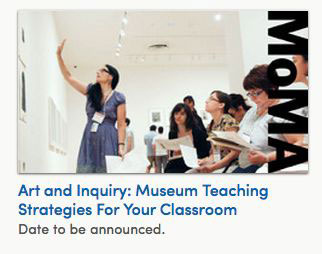
artinquiry-squareThis past spring MoMA decided to team up with the MOOC (Massive Open Online Course) provider Coursera to offer professional development for K–12 teachers all over the world. As the assistant director of School and Teacher Programs at MoMA, the MOOC ball landed in my court.

August 8, 2013  |  Learning and Engagement
Learning to Debate Art, One Puzzle at a Time
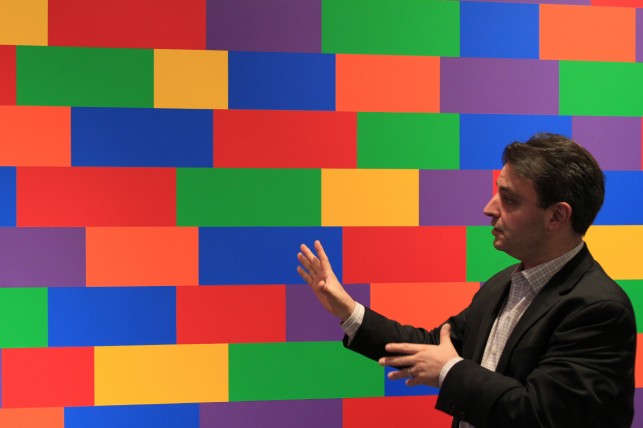
Instructor Pablo Helguera in MoMA's galleries. Art featured: Sol LeWitt. Wall Drawing #1144, Broken Bands of Color in Four Directions. 2004. Synthetic polymer paint. Given anonymously. © 2013 Sol LeWitt/Artists Rights Society (ARS), New York

Instructor Pablo Helguera in MoMA’s galleries. Art featured: Sol LeWitt. Wall Drawing #1144, Broken Bands of Color in Four Directions. 2004. Synthetic polymer paint. Given anonymously. © 2013 Sol LeWitt/Artists Rights Society (ARS), New York

One of the strongest memories I have of my student days at the School of the Art Institute of Chicago are the long nights of study alongside a coffeepot and the tome Art Through the Ages by Helen Gardner. My goal was to memorize practically every caption of the 2,000 or so images in that book,

Asking the Big Questions: Agora Conversations in MoMA’s Sculpture Garden
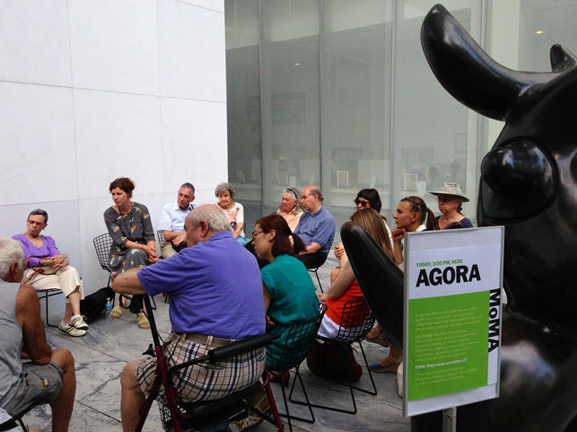
Agora: What makes something art?, facilitated by Petra Pankow. The Abby Aldrich Rockefeller Sculpture Garden, July 9, 2013

Agora: What makes something art?, facilitated by Petra Pankow. The Abby Aldrich Rockefeller Sculpture Garden, July 9, 2013

“What do we want from museums?” As the topic for the final meeting of this summer’s educator-facilitated, public discussion series, Agora, this question fittingly articulated the line of thinking that motivated the program’s unique format and approach. While Agora (named after the ancient Greek tradition of philosophical inquiry)

Introducing Teens.MoMA.org
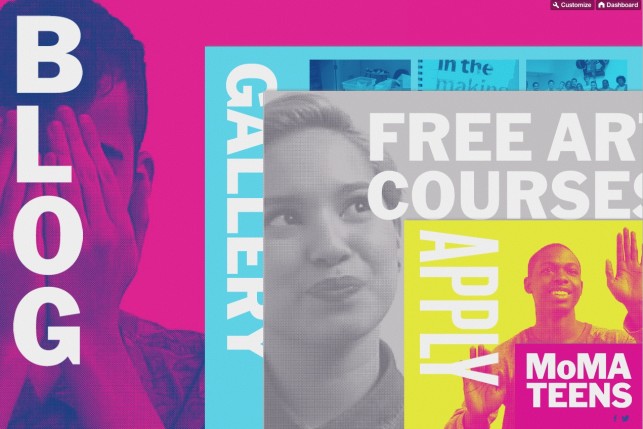
Teens.MoMA.org, the new site for everything MoMA Teens-related

Teens.MoMA.org, the new site for everything MoMA Teens-related

Every year, we bring hundreds of NYC teens through our studio doors to take part in dozens of free hands-on art-making programs. From In the Making to the MoMA + MoMA PS1 Cross-Museum Collective to our recently created Digital Advisory Board, we are constantly looking to find new ways of engaging young audiences