MoMA
Posts in ‘Learning and Engagement’
Are You Inspired to Go Beyond the Cut-Out?
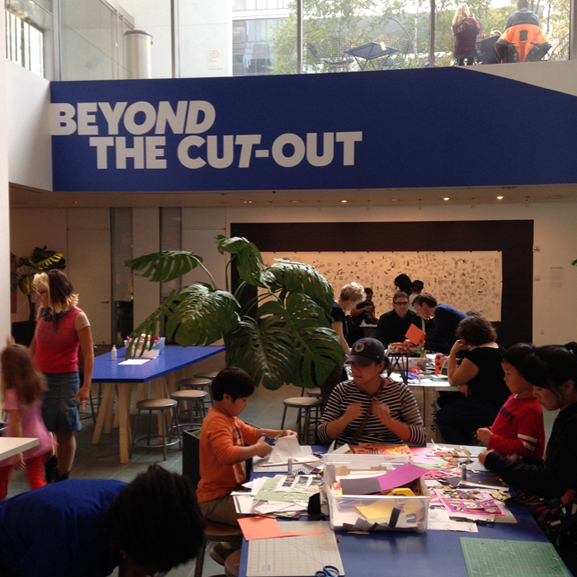
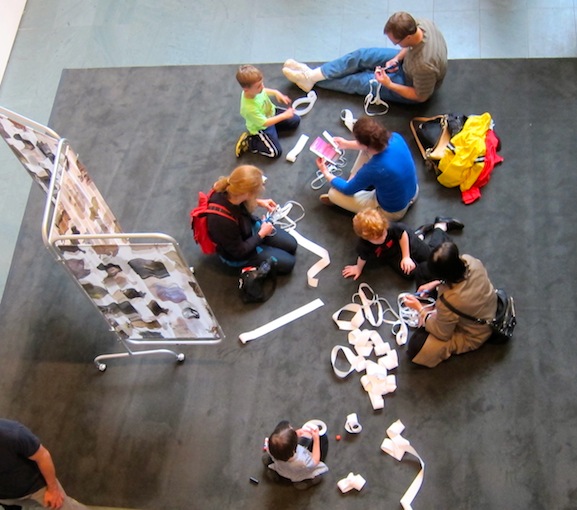
Installation view of MoMA Studio: Beyond the Cut-Out. Installation view. Photo: Sarah Kennedy, 2014

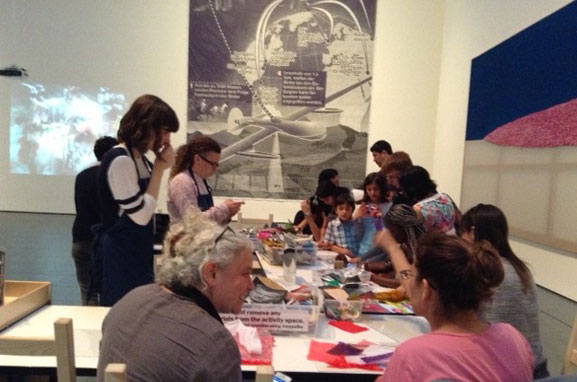
Installation view of MoMA Studio: Beyond the Cut-Out. Photo: Sarah Kennedy, 2014

There has been a lot of excitement around the opening of the exhibition Henri Matisse: The Cut-Outs. The Museum has been teeming with energetic visitors who see it and walk away feeling buoyed and inspired. We anticipated that this would be a common response to the exhibition, so over the past few months, in dialogue with the exhibition curators—Karl Buchberg, Jodi Hauptman, and Samantha Friedman—we have been designing educational programming that can complement a visitor’s experience in the galleries and provide an outlet for the creative energy that Matisse’s cut-outs generate.

October 1, 2014  |  Learning and Engagement
Mind Games: In Search of Artistic Inspiration
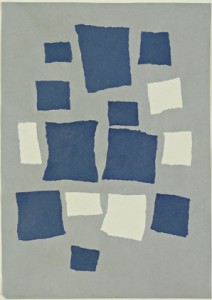
Jean (Hans) Arp. Untitled (Collage with Squares Arranged according to the Laws of Chance). 1916–17. Torn-and-pasted paper and colored paper on colored paper, 19 1/8 x 13 5/8" (48.5 x 34.6 cm). The Museum of Modern Art, New York. Purchase. © 2014 Artists Rights Society (ARS), New York/VG Bild-Kunst, Bonn

Jean (Hans) Arp. Untitled (Collage with Squares Arranged according to the Laws of Chance). 1916–17. Torn-and-pasted paper and colored paper on colored paper, 19 1/8 x 13 5/8″ (48.5 x 34.6 cm). The Museum of Modern Art, New York. Purchase. © 2014 Artists Rights Society (ARS), New York/VG Bild-Kunst, Bonn

How do artists seek, find, or create inspiration?

As an artist/educator, I often find myself gathering inspiration for my own work from my experiences teaching in the galleries. Recently I have been thinking a lot about the nature of collaboration, and looking back to art historical examples to inform my own thinking.

Thinking back, I realized that the exhibition Dada at MoMA in 2006 was one of the first times this idea clicked for me. I remember being intrigued by how many of the exercises these artists were playing with over 100 years ago are still so relevant to the kind of teaching experiences I develop today. And after putting those techniques to use in my classes, I was also struck by how inspired I was as an adult to replicate and try out some of those same devices that had brought artists like Jean Arp, Man Ray, and Duchamp such a wealth of creative potential. I was impressed by how human these games made these distant “Artist” figures seem; by humanizing them their work became easier to understand and allowed me to layer some of their creative thinking and processes onto my own.

In my own work, I find it most inspiring to create constraints—mostly with materials, some self-imposed, some borne out of necessity —and work within them. How can I use what I have at hand, or can find for cheap, to realize a vision? Or when I find myself without vision, sometimes just playing with materials and making something– anything– in the studio can generate an exciting idea that then grows into larger concept and artwork later on.
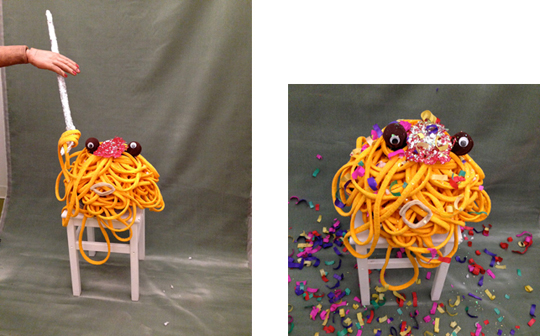
A work in progress by the author

A work in progress by the author made in collaboration on with Alison Kuo, based solely on random materials in the studio and the product of an afternoon of experimenting/messing around


When I was asked to come up with a Studio Immersion course for MoMA, I knew I wanted to explore these ideas with other adults, and experiment with how these forced collaborations, set criteria, and new materials might create an interesting dynamic within the class and inspire participants to expand their own practice outside the classroom. For one example, I love the Niki de Saint Phalle piece that was recently on view, Shooting Painting American Embassy (1961)—which the artist created by arranging packets of paint and food on a canvas, covering them with layers of plaster, and then asking collaborators to shoot at the canvas and release the paint—and that work prompted me to research other forms of playful, performative processes artists before and after her have employed.
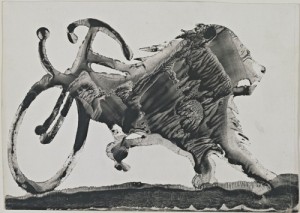
Oscar Domínguez. Untitled. 1936–37. Decalcomania (gouache transfer) on paper, 6 1/16 x 8 5/8" (15.4 x 21.9 cm). The Museum of Modern Art, New York. The Joan and Lester Avnet Collection. © 2014 Oscar Domínguez/Artists Rights Society (ARS), New York/ADAGP, Paris

Oscar Domínguez. Untitled. 1936–37. Decalcomania (gouache transfer) on paper, 6 1/16 x 8 5/8″ (15.4 x 21.9 cm). The Museum of Modern Art, New York. The Joan and Lester Avnet Collection. © 2014 Oscar Domínguez/Artists Rights Society (ARS), New York/ADAGP, Paris


The Dadaists and Surrealists fit in exactly with this theme of playful processes. Of course I knew about exquisite corpse drawings and automatic poetry, but, as I researched more, I was pleasantly surprised by the range of materials and techniques they implemented. Paint-based techniques were also used, such as Bulletism—a technique where ink is shot at a blank piece of paper and the artist then develops images based on the marks left behind. I can’t wait to get some willing experimenters involved with this!

This is just one example of many historical processes I’ve dug up for this course, and a few that I’ve created for us to play around with. So for those of you who might be thinking, “I’m not an artist,” or “I can’t draw,” or any other number of doubting thoughts, Mind Games will give you the chance to think like a Surrealist and let your subconscious be your guide. Break some rules and come draw outside the lines with me!

Class starts October 22. For more information, please visit MoMA.org/courses.

August 27, 2014  |  Family & Kids, Learning and Engagement
Psychedelic Acceptance Hotel and the Rainbow on Pluto: MoMA Teens x Babycastles

This summer’s In the Making program brought an incredibly diverse group of over 85 NYC teens into contact with a range of artists and arts organizations, for a series of six-week intensive art programs. Perhaps our most ambitious project ever, this summer’s collaboration with  Babycastles, a non-profit video game-based gallery and arts collective, saw 23 teens working together on the creation of a fully-functional arcade, mural, and sculptural art installation.

August 21, 2014  |  Family & Kids, Learning and Engagement
Trance-scendence: MoMA Teens Explore Hypnotism and Performance Art

Even after years of creating weird and off-kilter art courses for teens, one of the darkest and strangest teen art courses we’ve ever offered might very well be last season’s Under the Spell of Mysterious Forces: Magic, Illusion, and Performance Based Art. Taking the young participants deep into a realm where magic, trance, and extrasensory perception mingle with performance art, the course attracted a range of curious open-minded teens, all wiling to take the plunge into the artistic unknown.

Looking Back at MoMA Studio: Breathe with Me…and Beyond

This past May and June, MoMA’s Education and Research Building mezzanine was the site of MoMA Studio: Breathe with Me, an interactive space that explored the intersections between art, therapeutic practice, and the ways in which we relate to objects and people through physical encounters.

Polke Pop-Up Activity Space
MoMA visitors participate in a Polke Pop-Up Activity

MoMA visitors participate in a Polke Pop-Up Activity

If you happen to visit the exhibition Alibis: Sigmar Polke 1963–2010 on Tuesday afternoons you will notice something different: the sight of Museum visitors making art inspired by Sigmar Polke’s processes, in close proximity to his works of art. This shift toward more hands-on learning experiences is not something that happened overnight.

July 2, 2014  |  Learning and Engagement, Tech
Five Steps to Making the Art & Activity MOOC
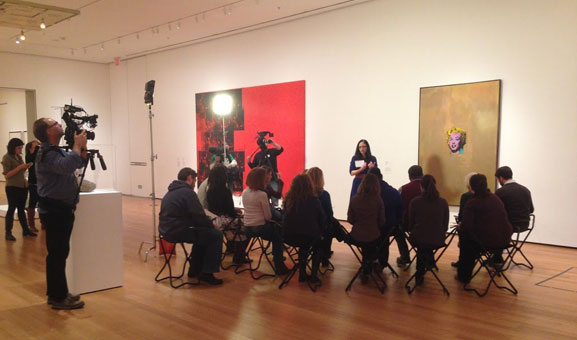
The video crew captures Lisa leading a teacher professional development session in MoMA's fourth-floor Painting and Sculpture Galleries. Photo: Stephanie Pau

The video crew captures Lisa leading a teacher professional development session in MoMA’s fourth-floor Painting and Sculpture Galleries. Photo: Stephanie Pau

On July 7, we launch Art & Activity: Interactive Strategies for Engaging with Art, a new Massive Open Online Course (MOOC). The course is part of an ongoing partnership with MOOC provider Coursera, to provide free professional development opportunities for K–12 teachers worldwide.

Playing Games at MoMA Studio: Won’t You Breathe with Me?
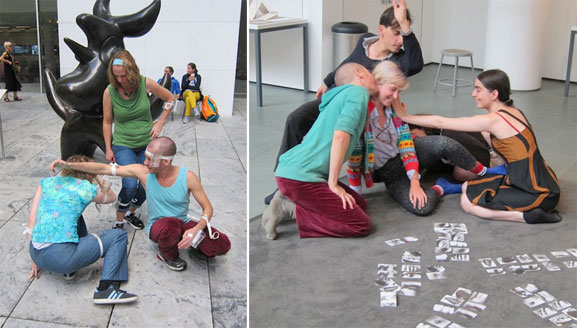
From left: Playing Polvo with Michel Groisman at MoMA Studio: Breathe with Me; Playing Sirva-Se in MoMA's Sculpture Garden with Michel Groisman. Photos by Sarah Kennedy

From left: Playing Polvo with Michel Groisman at MoMA Studio: Breathe with Me; Playing Sirva-Se in MoMA’s Sculpture Garden with Michel Groisman. Photos by Sarah Kennedy

We are entering the fourth week of MoMA Studio: Breathe with Me and want to share some of the highlights of the artist-led workshops that have activated the space so far. Each one revealed the ways in which Lygia Clark’s work continues to resonate with contemporary artists and their hopes to engage the public in experiences of art that are physical and social in nature.

Would You Like to Come Breathe with Me at MoMA Studio?
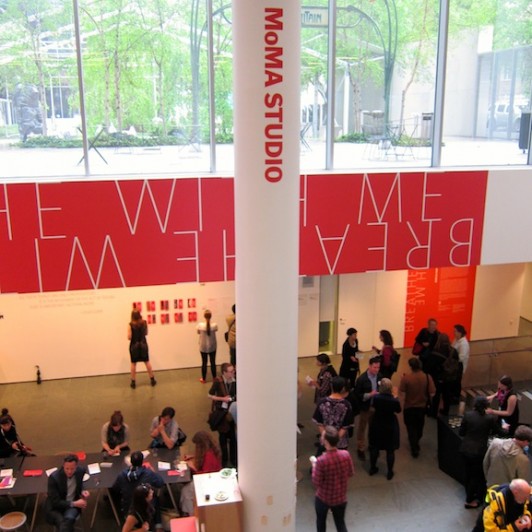
MoMA Studio: Breathe with Me Opening event on Friday, May 16, 2014. Photo by Sarah Kennedy, MoMA staff member.

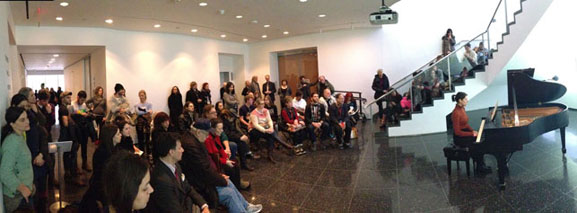
MoMA Studio: Breathe with Me Opening event on Friday, May 16, 2014. Photo: Sarah Kennedy

Last Friday, May 16, we celebrated the opening of MoMA Studio: Breathe with Me, an interactive space that has been organized in conjunction with the exhibition Lygia Clark: The Abandonment of Art, 1948–1988, on view in the sixth-floor galleries through August 24, 2014. Taking Clark’s art as a reference point, the Studio presents a series of drop-in programs, participatory experiences, and artist-led workshops that explore the intersections between art, therapeutic practice, and the ways in which we relate to objects and people through physical encounters.

Like all previous MoMA Studios, MoMA Studio: Breathe with Me is a free, interactive space open to visitors of all ages, and offers experiential learning experiences that complement looking and talking about works of art in the galleries, allowing for engagement with art in hands-on, creative ways. Visitors can experiment, learn, play, and create as they make connections between their lives, their own creativity, and the processes and materials of modern and contemporary art.

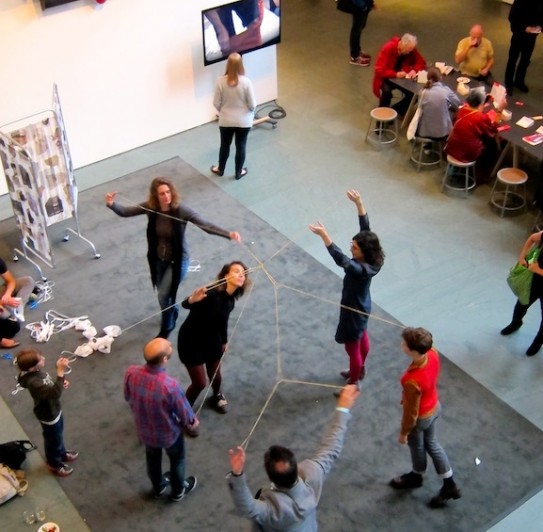
Visitors using Lygia Clark's sensorial object called Living Structures, made up of elastic bands connecting participants in a giant flexible web. Photo by Sarah Kennedy

Visitors using Lygia Clark’s sensorial object called Living Structures, made up of elastic bands connecting participants in a giant flexible web. Photo: Sarah Kennedy

The process of putting this particular MoMA Studio together has been a unique experience due to the nature of Lygia Clark’s work, which is often dynamic and sensorial in nature—a quality that is highlighted in the exhibition itself, which has a central component that is about engaging the public in participatory ways within the galleries. This aspect of the exhibition parallels the planning of our Studio programming and has allowed for a fruitful collaboration with the curatorial team and the exhibition facilitators.

In developing the focus and scope of MoMA Studio: Breathe with Me, and in the hopes of revealing the profound resonance Clark’s work has had with contemporary artists, we have collaborated with a talented group of artists from near and far, to present an exciting series of programs for this MoMA Studio. These artists include Ricardo Basbaum, Carlito Carvalhosa, Stephanie Diamond and Tamara Vanderwal, Michel Groisman, Jeanine Oleson, and Allison Smith.

Visitors trying Lygia Clark's proposition, Caminhando on the rug at MoMA Studio: Breathe with Me with Allison Smith's Joining Screens project as a backdrop. Photo by Sarah Kennedy

Visitors trying Lygia Clark’s proposition, Caminhando, on the rug at MoMA Studio: Breathe with Me with Allison Smith’s Joining Screens project as a backdrop. Photo: Sarah Kennedy

Perhaps more than previous Studios, this one is conceived as a space that comes alive most with the activation of the workshops and events by willing participants, in collaboration with artists. This week the workshops kicked off with Carlito Carvalhosa’s public action in the The Abby Aldrich Rockefeller Sculpture Garden and MoMA Studio on May 20 and 21, followed by Michel Groisman’s Polvo and Sirva-Se workshops, which begin tomorrow, May 22 and run through the Memorial Day weekend. We are following Clark’s philosophy, “the work is in the act,” and we invite you all to join us! Visit MoMA.org/MoMAstudio for details.

“Is This a Social Experiment?” Performing John Cage
Serra Sabuncuoglu and Robert Barry participate in Performing John Cage, The Museum of Modern Art, February 18, 2014. Photo by Sarah Kennedy

Serra Sabuncuoglu and Robert Barry participate in Performing John Cage, The Museum of Modern Art, February 18, 2014. Photo by Sarah Kennedy

Twice daily, from February 7 to 20, MoMA staff and invited artists performed John Cage’s score 4’33” in an area just outside the exhibition There Will Never Be Silence: Scoring John Cage’s 4’33”. Over the course of those two weeks, 28 renditions of 4’33” were performed by 20 staff members and eight guest artists.