
MoMA
Posts in ‘Collection & Exhibitions’
May 4, 2010  |  Artists, Collection & Exhibitions
Bodies in the Galleries: Thoughts from an Ex-Dancer on Marina Abramović

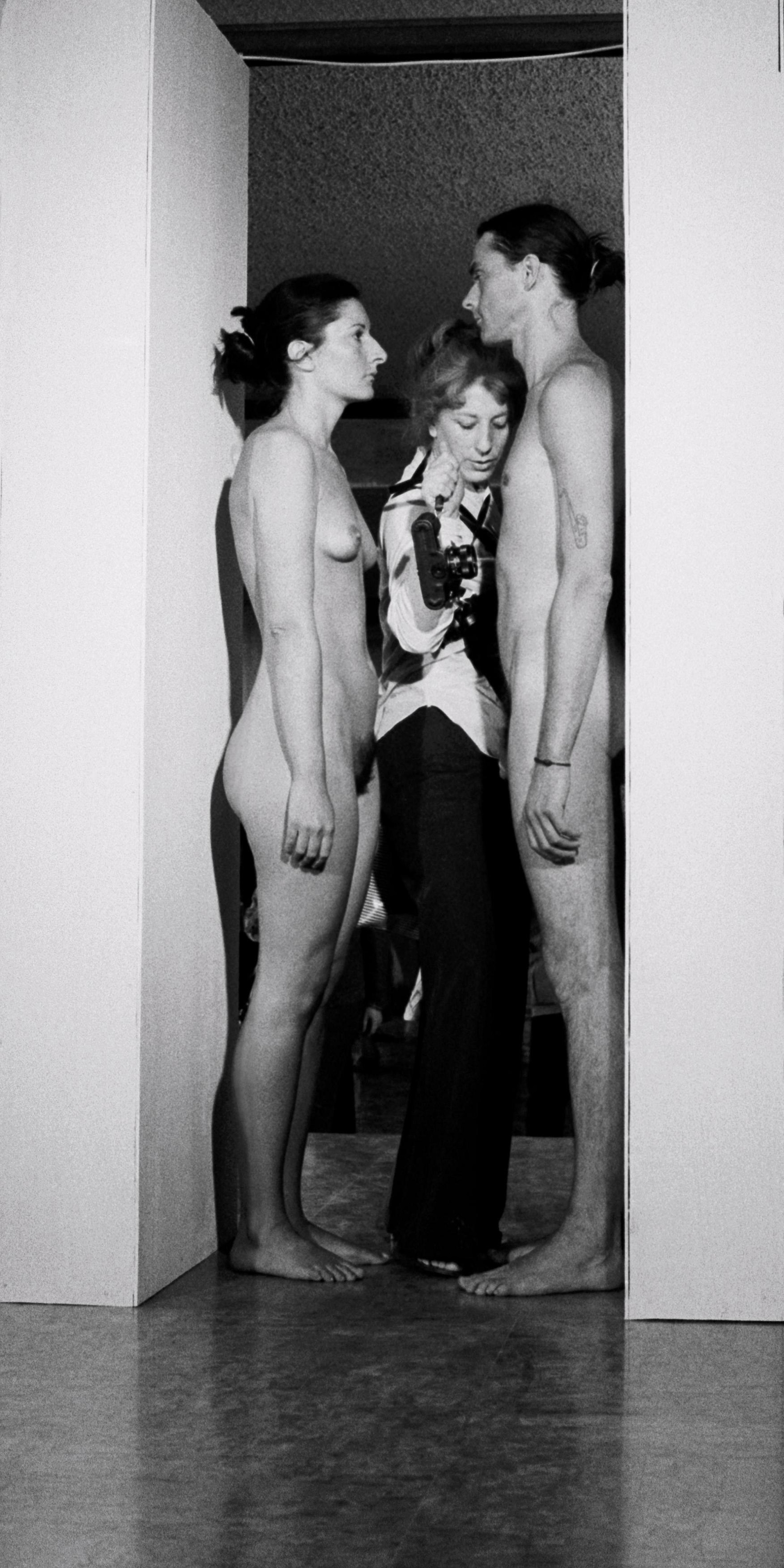
Marina Abramović and Ulay in Imponderabilia, 1977. © 2010 Marina Abramović. Courtesy Marina Abramović and Sean Kelly Gallery/Artists Rights Society (ARS), New York

Friends and family keep asking me recently, “What do you think of the Marina Abramović show?” The exhibition has sparked a lot of conversation, especially one aspect of it—yes, the “naked people.”

Some viewers have been shocked by the bodies in our galleries, but I didn’t expect to be one of them. Beyond the occasional cartwheel, there hasn’t been much call at MoMA for my performing skills… but before I was a MoMA wordsmith, I was a modern dancer, performing for several years mostly with the Regina Nejman Dance Company.

Dancers become comfortable with the body to an unusual degree. There’s the co-ed quick costume-changing backstage, the impolite contact of dance partnering, not to mention you spend a lot of your life wearing spandex. And yet I discovered that Abramović’s reperformers—clothed and unclothed—ruffled my composure, too.

Imponderabilia (1977), the Abramović piece in which two nude performers flank a doorway, has gotten a lot of press. Brushing past the genitalia of strangers in a crowded, public place—could anything be more nightmarish for a New Yorker? Recently, playing hooky from my desk, I breathed in, to be thinner, and slipped between the man and woman performing that afternoon. Safely through, I realized my heart was pounding. Other visitors hurried through nonchalantly, pretending they were going that way anyway; the performers, standing with knees slightly bent, never broke their bubble of concentration. (A good trick for the endurance stander, to avoid wobbling or fainting: don’t lock your knees.)

May 3, 2010  |  Artists, Collection & Exhibitions
At Home Everywhere: The Travels of Henri Cartier-Bresson

Henri Cartier-Bresson. Shanghai. 1948. Gelatin silver print, printed 1971. The Museum of Modern Art. Acquired through the generosity of Robert B. Menschel. © 2010 Henri Cartier-Bresson/Magnum Photos, courtesy Fondation Henri Cartier-Bresson, Paris

I tracked Henri Cartier-Bresson (1908–2004) from England to India to Indonesia and back. He was in England for the coronation of King George VI; he was in India when Gandhi was assassinated; he was in Indonesia as the nation gained independence from the Dutch. He was seemingly everywhere.

I know because it was my job to compile all of Cartier-Bresson’s photo captions, notes, datebooks, and correspondence from his travels, which covered the better part of the 50 years he was actively working as a photographer. I then had to transform this into a comprehensive yet comprehensible chronology that would appear in the catalogue of the exhibition Henri Cartier-Bresson: The Modern Century.

April 30, 2010  |  Artists, Collection & Exhibitions, Tech
Marina Abramović: A Gallery of Portraits

If you happen to witness—or, for the intrepid, participate in—Marina Abramović‘s new work The Artist Is Present, you may notice a well-equipped photographer quietly documenting each daily performance. The artist has asked photographer Marco Anelli to take portraits of every visitor who participates in the piece. The results, as you can see below and on the exhibition website, are captivating.

Check back frequently, as the images are updated regularly. At this point there are over eight hundred portraits!

</embed>

Burton Farewell: Installing the Exhibition

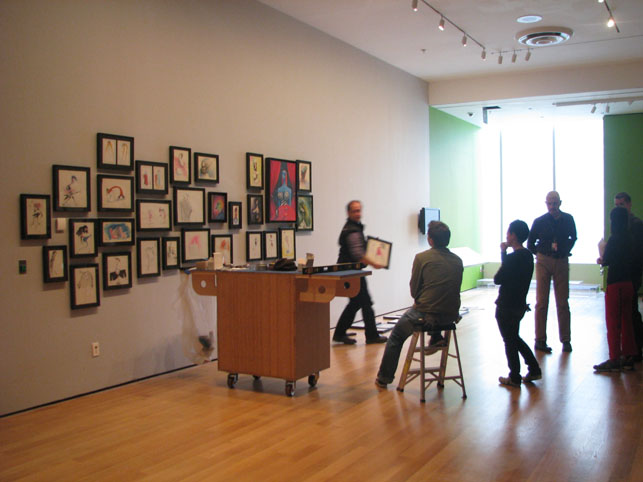
Curator Ron Magliozzi and the exhibitions team install Tim Burton

The installation of the Tim Burton show took thirteen days, beginning on October 28, 2009, and ending (save some inevitable last-minute tweaking) on Friday, November 13. As the first institution given the opportunity to exhibit Burton’s unseen work, the urge to present a comprehensive selection was hard to resist. With 716 pieces of framed art, objects, and media to put in place, the pressure was on—especially since we knew that a series of special openings had been scheduled before the general public arrived: Tim’s private opening on November 16 for his friends and collaborators, a Department of Film benefit honoring Tim on November 17, and the opening reception on November 18. The realization that we would soon be hosting Johnny Depp, Danny Elfman, Helena Bonham Carter, Catherine O’Hara, Bo Welch, Glenn Shadix, Diane Wiest, Colleen Atwood, Danny DeVito, Jeffrey Jones, Crispin Glover, and others—not to mention Tim himself—added to the sense of excitement shared by everyone on the MoMA installation team.

April 19, 2010  |  Collection & Exhibitions, Design, Film
3D Burton: Shadows and Reflections

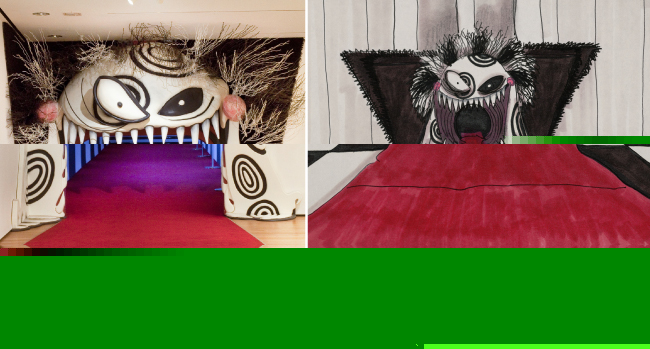
Three-dimensional rendering of the entrance to Tim Burton (left) by TwoSeven, Inc., based on an untitled drawing (right) by Tim Burton for the unrealized project Trick or Treat (1980)

Tim Burton was one of the most challenging exhibitions our graphic design department has had the pleasure of fully developing. It explores a wide spectrum of Tim Burton’s creative work, including drawings, paintings, photographs, moving images, concept art, storyboards, puppets, maquettes, costumes, and cinematic ephemera. For the exhibition graphic design, our goal was to take all these diverse visual references and distill them into a simple graphic treatment that celebrated Burton’s work.

April 15, 2010  |  Artists, Collection & Exhibitions
New at MoMA: Sanja Iveković’s Double Life

I first made a studio visit with Sanja Iveković about ten years ago, when I was invited to organize a large-scale exhibition at the Museum of Contemporary Art in Zagreb, Croatia. She impressed me instantly. I recall thinking, “This is an inspiring artist with whom I will forge a long-lasting relationship.” A feminist, activist, and video pioneer, Iveković came of age in the early 1970s, when artists broke free from mainstream institutional settings, laying the ground for a form of praxis antipodal to official art. Part of the generation known as the Nova Umjetnička Praksa (New Art Practice), she has produced works of cross-cultural resonance that range from conceptual photomontages to video and performance. Last month I visited Iveković again in Zagreb, this time to discuss her first survey exhibition in the U.S., which is scheduled to open at MoMA at the end of 2011.

April 13, 2010  |  Artists, Collection & Exhibitions
Marina Abramović: What Is Performance?

This past August, I visited Marina Abramović at her home in upstate New York, where she was running a workshop with the re-performers of the exhibition Marina Abramović: The Artist Is Present. In a series of five videos that show excerpts of my conversation with the artist, she talks about her work, her exhibition at MoMA, and performance art. As an artist who uses her body as a medium, it is fascinating to hear Abramović’s feelings on fear and limitations. In this video, the artist offers her thoughts on the meaning and definition of performance art.

April 8, 2010  |  Collection & Exhibitions
9 Screens: Frolic and Detour

Commissioned by MoMA in conjunction with the 9 Screens exhibition series, Frolic and Detour takes its title from a legal term referring to “employee conduct that is outside the scope of employment and is undertaken purely for the employee’s own benefit.” The video employs both documentary and hallucinatory observations to describe one man’s daily routines and departures as punctuated by a kaleidoscopic mixture of painting, sculpture, cinema, and architecture. Shifting atmospheres ranging from offices, bedrooms, tennis courts, psychiatrist couches, forests, nightclubs, and hospitals provide the backdrops for days in the life of its “lion-in-winter” protagonist, native New Yorker and Attorney-at-Law Arnold Mandell.

April 7, 2010  |  Collection & Exhibitions, Film
Crude Elegance: Stop-motion Animation and Tim Burton

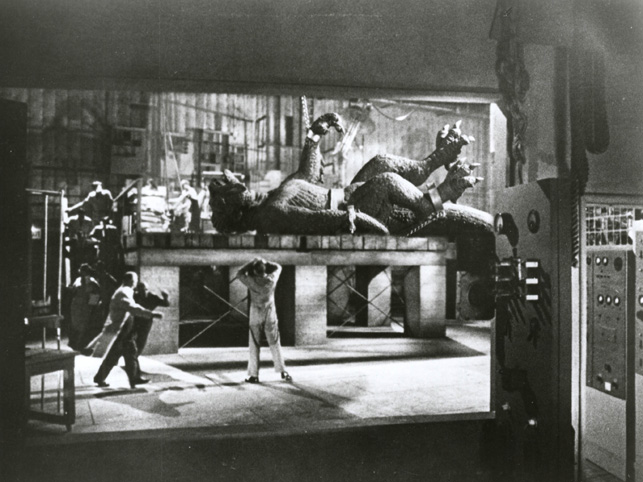
20 Million Miles to Earth. 1957. USA. Directed by Nathan Juran. Film Stills Archive, The Museum of Modern Art, New York

It was love at first sight for Tim Burton and stop-motion animation. At an early age, Burton was drawn to films such as Nathan Juran’s 20 Million Miles to Earth (1957) and Don Chaffey’s Jason and the Argonauts (1963), which featured innovative animation by special effects master Ray Harryhausen. Burton responded to the sense of wonder the technique conjured in its audiences and was inspired to create his own stop-motion animated films, such as a 1971 super-8mm short featuring cavemen and dinosaur figures (on view in the MoMA gallery exhibition) that invokes When Dinosaurs Ruled the Earth (1970, directed by Val Guest, and animated by Jim Danforth).

Listening to Marina Abramović: Art Must Be Beautiful, Artist Must Be Beautiful

In this clip from the CD (as discussed in a previous post) that accompanies the catalogue of Marina Abramović’s current retrospective, The Artist Is Present, Marina discusses her performance Art Must Be Beautiful, Artist Must Be Beautiful (1975) and shares with the reader her thoughts about the work and its creation. This is complemented by a discussion of the performance in one of the essays featured in the catalogue, “The Art of Marina Abramović: Leaving the Balkans, Entering the Other Side,” by art historian and critic Jovana Stokić.