Through examining four pieces in The Museum of Modern Art’s collection, one can better understand how John Cage’s embrace of indeterminacy can be traced in the period following 4’33” (1952) and in more recent years, and how these later works play with the concepts of chance and the ephemeral in different ways.


Posts in ‘Collection & Exhibitions’
February 19, 2014
|
Artists,
Collection & Exhibitions
Constructed Situations: Communicating the Influence of John Cage

February 14, 2014
|
Collection & Exhibitions
A Few Ideas from the MoMA Design Collection
To the visitor, a museum might appear as a collection of objects. And it certainly is, a collection painstakingly assembled by generations of curators. But intrinsic to MoMA’s curatorial approach is the museum as a collection of ideas, represented by the objects (which convey concepts like abstraction, organicism, and postmodernism) and also communicated though the curator’s selection and grouping of objects. As curators, we are constantly identifying timely concepts worth exploring and representing through MoMA’s collection. Because design is a field often directly engaged with the technology and issues of its time, it demands a contemporary approach and interpretation. Our upcoming exhibition A Collection of Ideas presents several lenses through which MoMA looks at design and the contemporary world—significant areas of research that examine the connection between design and violence; the increasingly important field of interaction design; and the relationship between nature and the built environment, which demands urgent attention and redefinition.
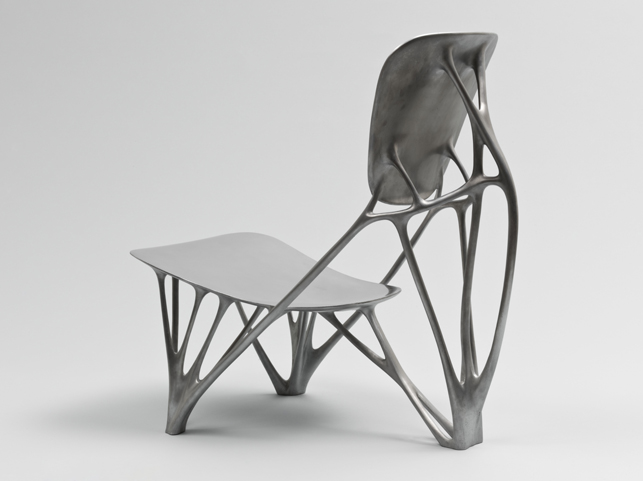
Joris Laarman. Bone Chair, 2006. Aluminum. Manufactured by Joris Laarman Studio (The Netherlands, est. 2006). Gift of the Fund for the Twenty-First Century, 2008. The Museum of Modern Art, New York
“Organic Design,” the first idea explored in this installation, presents the most recent manifestations of a centuries-old quest—learning from nature how to build elegantly, economically, and sustainably. Organic design, influenced by natural forms and processes, has advanced very rapidly in the 21st century. Computer-aided design and 3-D printing technologies have enabled designers to emulate nature’s economies and building methods. Joris Laarman’s 2006 Bone Chair, for example, was designed using three-dimensional optimization software that mimics the generative process of bones to concentrate the object’s mass and strength in the areas that bear the most stress.
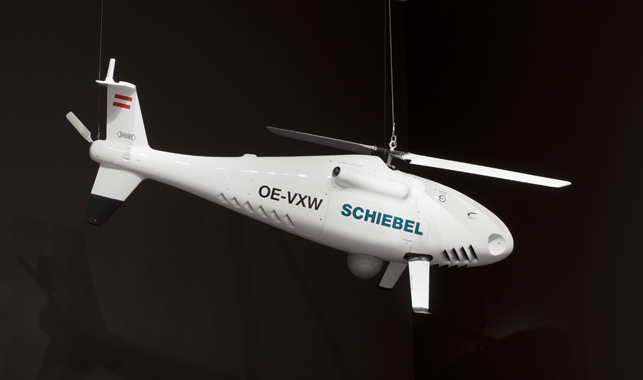
Gerhard Heufler and Hans Georg Shiebel. Camcopter S-100 Unmanned Aerial Vehicle. 2004. Carbon fiber and titanium. Manufactured by Schiebel Elektronische Geräte GmbH (Austria, est. 1951).
Gift of the manufacturer, 2006. The Museum of Modern Art, New York
“Design and Violence” (also an online curatorial experiment at designandviolence.MoMA.org) seeks to comprehend the complex impact of design on the built environment and on everyday life, as well as the manifestations of violence in contemporary society. Designers aim to change the world around them—often in fundamental ways—and the consequences can be drastic when they overstep, indulge temptations, adopt abhorrent goals, or even simply err. The Museum’s Camcopter S-100 Unmanned Aerial Vehicle, designed by Gerhard Heufler and Hans Georg Schiebel in 2004, is a drone originally intended for aerial landmine detection and eradication. Drones are design objects that have seen an upsurge in news coverage for applications that range from the hostile (as weapons of warfare) to the benign (as delivery vehicles for consumer products).
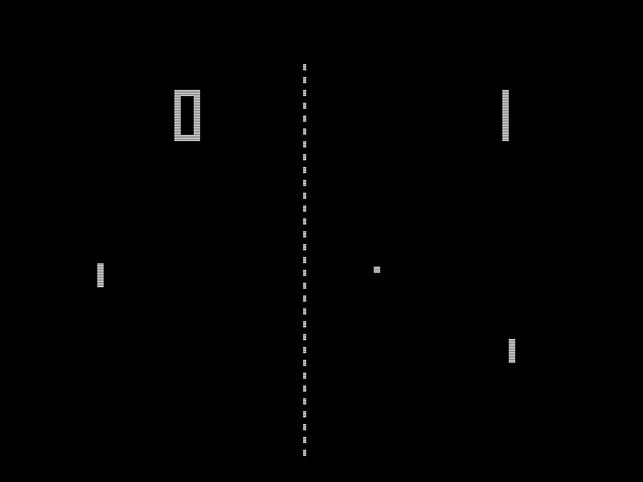
Allan Alcorn of Atari, Inc. (USA, est. 1972). Pong. 1972. Published by Atari, Inc. Gift of Atari Interactive, Inc., 2013. Image © 2014 Atari, Inc.
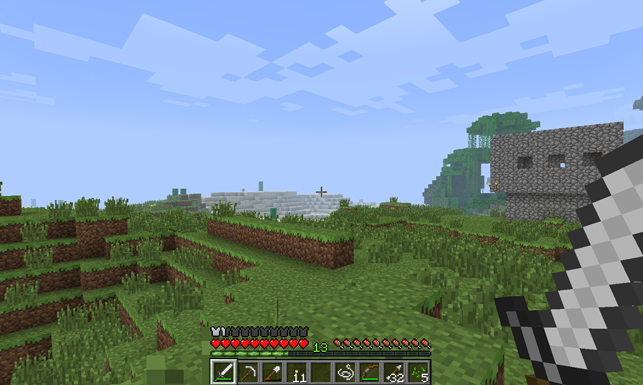
Markus “Notch” Persson of Mojang (Sweden, est. 2009). Minecraft. 2011. Published by Mojang. Gift of Mojang, 2013. Image © 2014 Mojang
“Interaction Design” is another idea represented in the display of eight newly acquired videogames (from 1972’s Pong to 2011’s Minecraft), and by digital icons such as the ubiquitous Google Map Pin. The exhibition’s curator, Paola Antonelli points out that,”Interaction designers build the digital dimension of our lives, choreographing everything from the way we tap the screens of our mobile devices to our exchanges with ATM machines.” Our ever more digital world calls for interaction design that is aesthetically appealing, functionally and structurally ingenious, and innovative in how it approaches technology and anticipates user behavior.
These clusters of objects showcase not only new acquisitions and highlights from MoMA’s collection, but also timely categories of investigation and their representative design forms—new ideas and new approaches for the contemporary age.
February 6, 2014
|
Collection & Exhibitions,
Film
Finding The Robot
Recently I was watching a 35mm print of a new film acquisition called Vincere (2009), directed by Marco Bellocchio. Vincere tells the story of the rise of Benito Mussolini and Ida Dalser, the woman he kept as his secret lover for decades. At one point in the film, Mussolini pays a visit to the Milan headquarters of the Futurists to view a multimedia art exhibition.
February 5, 2014
|
Artists,
Collection & Exhibitions
The Poetry of Silence: Jackson Mac Low’s Drawing-Asymmetry
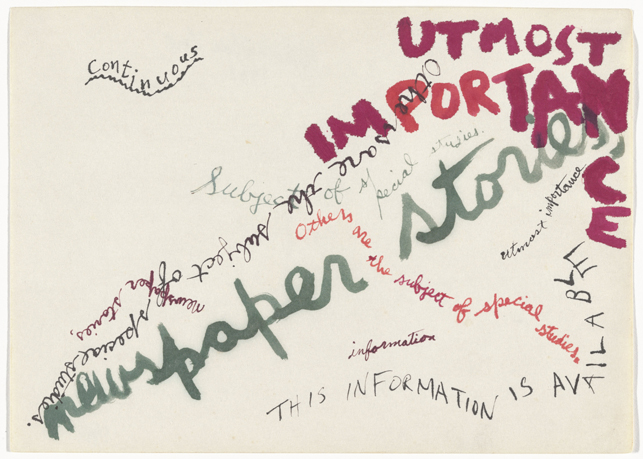
Jackson Mac Low. Drawing-Asymmetry #5. 1961. Ink and colored ink on paper, 8 9/16 x 11 7/8″ (21.7 x 30.2 cm). The Museum of Modern Art, New York. The Gilbert and Lila Silverman Fluxus Collection Gift, 2008. © 2014 The Estate of Jackson Mac Low
If you visit MoMA’s exhibition There Will Never Be Silence: Scoring John Cage’s 4’33”, you will encounter a suite of enigmatic drawings by Fluxus-affiliated poet Jackson Mac Low, comprising swirling letters and seemingly nonsensical combinations of words. Although they seem like meaningless scribbles, the words are actually legible and meant to be read aloud.
February 3, 2014
|
Behind the Scenes,
Collection & Exhibitions,
Conservation
Frank Lloyd Wright’s “Living City” Lives On: Conserving the Broadacre City Model
![Drawing of Broadacre City by Frank Lloyd Wright. From B. Pfeiffer, Frank Lloyd Wright 1943–1959: The Complete Works [Vol. 3], edited by Peter Gössel, published by Taschen, 2009](https://www.moma.org/wp/inside_out/wp-content/uploads/2014/01/Image-13-643x480.jpg)
Drawing of Broadacre City by Frank Lloyd Wright. From B. Pfeiffer, Frank Lloyd Wright 1943–1959: The Complete Works [Vol. 3], edited by Peter Gössel, published by Taschen, 2009
MoMA and Columbia University’s Avery Library recently made an acquisition sure to excite even the most casual architecture fans: the Frank Lloyd Wright Archive. In addition to many thousands of drawings, photographs, and ephemera, this collection includes over 60 models and building fragments. One of the largest and most expansive models is that of Broadacre City—Frank Lloyd Wright’s utopian reimagining of the city as open space and landscape rather than skyscraper and skyline.
January 30, 2014
|
Collection & Exhibitions
New in the Galleries: The Russian Avant-Garde
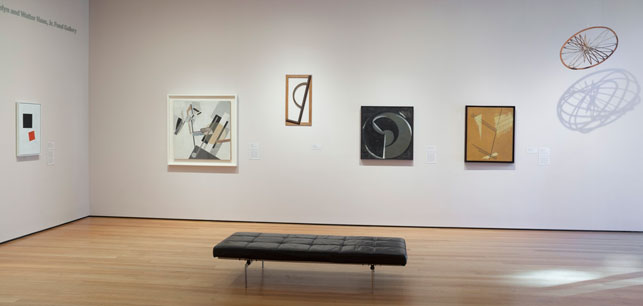
Installation view of the fifth-floor Alfred H. Barr Painting and Sculpture Galleries, The Museum of Modern Art, summer 2013. Pictured are works by from left to right Kazimir Malevich, [at far left], El Lissitzky, Vasily Ermilov, and Aleksandr Rodchenko. Photo: John Wronn]
MoMA’s collection galleries are always changing. When the Artist’s Choice: Trisha Donnelly exhibition closed this past summer in one of the fifth-floor galleries, the Department of Painting and Sculpture had a chance to use that space to conceive a new installation of Russian art from the Museum’s collection.
January 29, 2014
|
Collection & Exhibitions
Ileana Sonnabend: Ambassador for the New
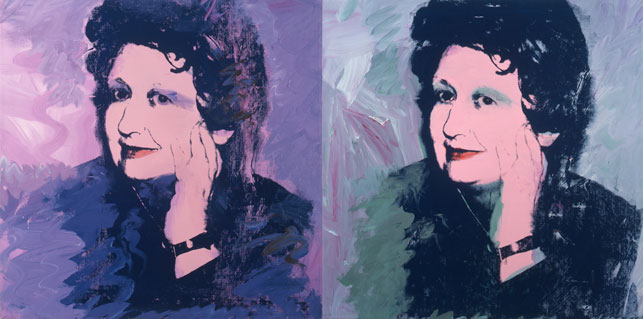
Andy Warhol (American, 1928–1987). Ileana Sonnabend. 1973. Acrylic and silkscreen ink on canvas, two panels, 40 x 80″ (101.6 x 203.2 cm). The Sonnabend Collection. © 2013 Andy Warhol Foundation for the Visual Arts/Artists Rights Society (ARS), New York
The important role played by women in 20th-century art history remains a fertile field of study. Many historians, curators, and critics have focused their attention on great artists—Frida Kahlo, Louise Bourgeois, Eva Hesse, for example—and on countless others who are lesser known but also fascinating.
January 24, 2014
|
Artists,
Collection & Exhibitions
Diving into Rauschenberg’s Canyon
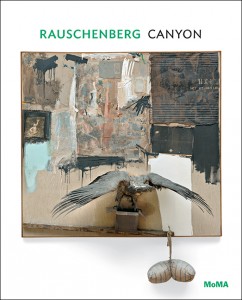
Cover of Raushenberg: Canyon by Leah Dickerman, published by The Museum of Modern Art
Rauschenberg affixed the bald eagle onto a canvas that would eventually become Canyon (1959), one in a series of radically experimental works he called Combines, which mixed paint and other art materials with things found in daily life. In Canyon, a seemingly incongruous variety of objects surround the eagle, including a photograph of Rauschenberg’s son, Christopher; a postcard of the Statue of Liberty; a man’s white shirt, cut and opened up; a crumpled tube of paint; fragments of printed words; and an industrial metal drum.
Rauschenberg: Canyon, the latest volume in the MoMA One on One series, sheds light on the genesis of this startling and enigmatic work by tracing the artist’s education, influences, and travels through Italy, Morocco, and Spain. Rauschenberg first started using found materials while attending Black Mountain College near Asheville, North Carolina, where every student was required to pitch in with community labor. Rauschenberg volunteered for garbage collection, and ended up incorporating the objects he found in his classmates’ trash into his art. The hybrid creations he began producing in the mid-1950 with recognizable, everyday items offered a defiant counterpoint to the quintessential American style of Abstract Expressionism that prevailed at the time. As he wrote in his earliest statement on the Combines, in 1956: “I consider the text of a newspaper, the detail of a photograph, the stitch in a baseball, and the filament in a light bulb as fundamental to the painting as brush stroke or enamel drip of paint. In the end, what one sees as my work is what I choose to make with no guarantee of enlightenment, humor, beauty or art.”
Canyon, currently on view at MoMA in Ileana Sonnabend: Ambassador for the New, had been in gallerist Ileana Sonnabend’s personal collection since she purchased it from the artist the year it was made. Sonnabend was one of Rauschenberg’s lifelong champions, and her support played a significant role in his becoming the first American artist to be awarded the grand prize at the Venice Biennale, in 1964. Following her death in 2007, her heirs entered a curious debate with the IRS regarding the work. The Migratory Bird Treaty Act of 1918 and the Bald Eagle Protection Act of 1940 made it illegal to buy, sell, barter, or possess a bald eagle in the U.S. Canyon was allowed to remain in Sonnabend’s collection because Rauschenberg had provided a notarized statement saying the bird had been stuffed by one of Roosevelt’s Rough Riders before the laws’ passage, but because it could not be sold, the family’s appraisers had valued it at zero. The IRS disagreed, ruling that it was worth far more, and assessed an estate tax and penalties on the heirs. The resolution they reached allowed the family to donate the work to a U.S. institution in exchange for dropping the tax claim. Thus, in 2012, Canyon was generously donated to The Museum of Modern Art, where it joins five other Combines, to provide an in-depth representation of this key aspect of Rauschenberg’s career.
To learn more, download a free preview of Rauschenberg: Canyon by Leah Dickerman.
January 22, 2014
|
Artists,
Collection & Exhibitions
Off the Record: Mike Kelley’s Extracurricular Activities
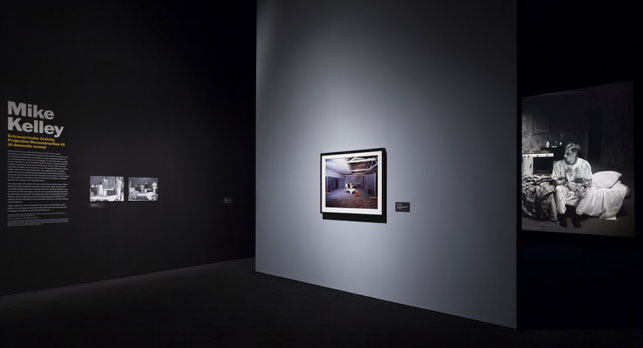
Installation view of Mike Kelley: Extracurricular Activity Projective Reconstruction #1 (A Domestic Scene), The Museum of Modern Art, October 13, 2013–February 2, 2014
In honor of Mike Kelley’s exceptional career and legacy, Extracurricular Activity Projective Reconstruction #1 (A Domestic Scene), a seminal work in his complex videography, is on view both at MoMA PS1—as part of the artist’s posthumous retrospective—and in MoMA’s second-floor Projects Gallery.
January 16, 2014
|
Collection & Exhibitions,
Design
Mine Kafon: Design Demines
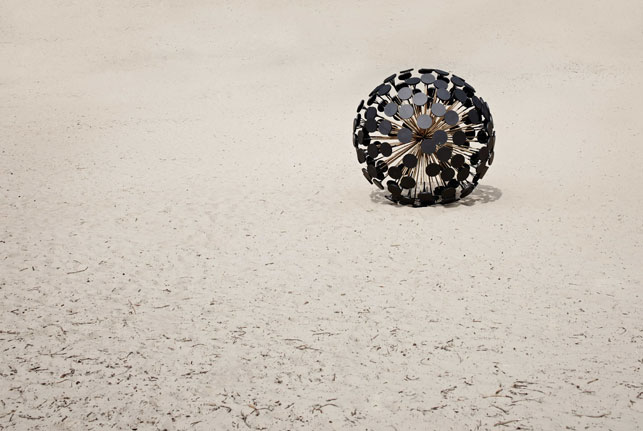
Massoud Hassani. Mine Kafon wind-powered deminer. 2011. Bamboo and biodegradable plastics, 87 x 87 x 87″ (221 x 221 x 221 cm). Gift of The Contemporary Arts Council of The Museum of Modern Art. Photo by Rene van der Hulst
Massoud Hassani’s wind-powered land minesweeper, the Mine Kafon, was inspired by the handmade toys from his childhood growing up in the desert north of Kabul, Afghanistan. As a boy, Hassani and his brother would fashion small paper toys to roll in the wind, racing them across the local fields.
If you are interested in reproducing images from The Museum of Modern Art web site, please visit the Image Permissions page (www.moma.org/permissions). For additional information about using content from MoMA.org, please visit About this Site (www.moma.org/site).
© Copyright 2016 The Museum of Modern Art
Welcome to MoMA.org. To take full advantage of all the site’s features, including the option to save works in the collection, please upgrade your browser to Firefox,
Google Chrome, Safari, or Internet Explorer 9.
See our help page for more information.
To take full advantage of all of the features on MoMA.org, please upgrade your browser to Firefox, Google Chrome,
Safari, or Internet Explorer 9.