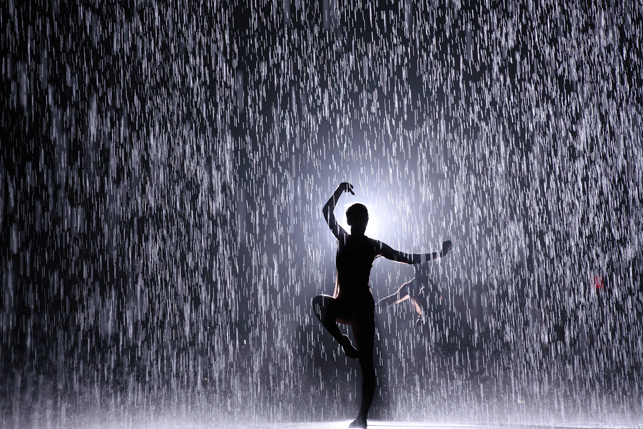
Rain Room‘s conception was swift. We were coming up with ideas for dropping an image from above, so each individual pixel would fall into place, using water on water-reactive ground.



Rain Room‘s conception was swift. We were coming up with ideas for dropping an image from above, so each individual pixel would fall into place, using water on water-reactive ground.

In the March of 2012, conservators in MoMA’s sculpture conservation lab undertook a yearlong treatment of an original kitchen by Charlotte Perriand and Le Corbusier from the seminal urban construction the Unite d’Habitation. All of the kitchen components (including the drain!) were transported from Marseilles, France, to our lab in New York City, and reassembled for research and treatment.

After exhaustive research prior to conserving Untitled (Piano), it was time for reflection. MoMA curators and conservators discussed the difficult decisions ahead. We knew that Nam June Paik playfully changed his works with each installation, and often incorporated new audio and video technologies into his older video sculptures. Should we continue this tradition, or freeze the existing technologies at the moment of his death?
I thought I knew about David Moreno’s work when I met with him in his “office,” tucked inside the storage facilities of the Department of Drawings.

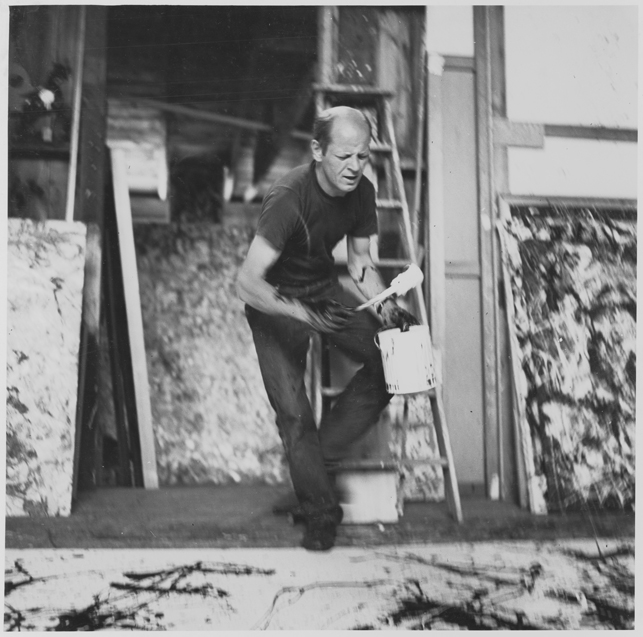
Jackson Pollock at work in his studio, 1950. Photo: Hans Namuth
In the May 1951 issue of ARTnews a selection of photographs by Hans Namuth appeared as illustrations for Robert Goodnough’s article, “Pollock Paints a Picture.” The images depict a focused Pollock energetically applying paint to a large canvas spread across his studio floor.
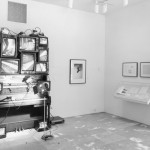
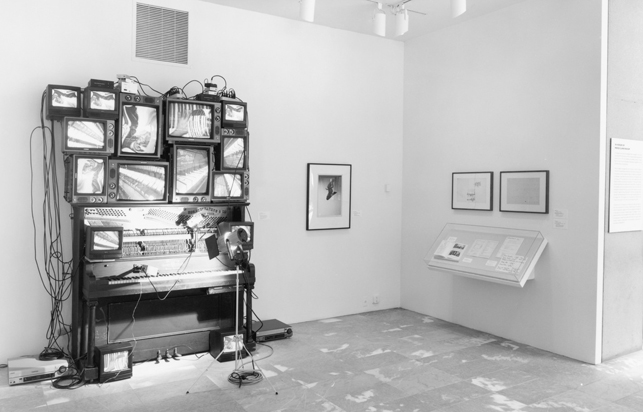
Nam June Paik. Untitled. 1993. Player piano, 15 televisions, two cameras, two laser disc players, one electric light and light bulb, and wires, overall approx. 8′ 4″ x 8′ 9″ x 48″ (254 x 266.7 x 121.9 cm), including laser disc player and lamp. Bernhill Fund, Gerald S. Elliot Fund, gift of Margot Paul Ernst, and purchase. © 2013 Estate of Nam June Paik
In 1993 MoMA acquired a piano modified with a floppy-disc drive player unit. In the gallery it plays jazz show tunes really loud. The piano also has 15 cathode ray tube (CRT) monitors stacked on it.

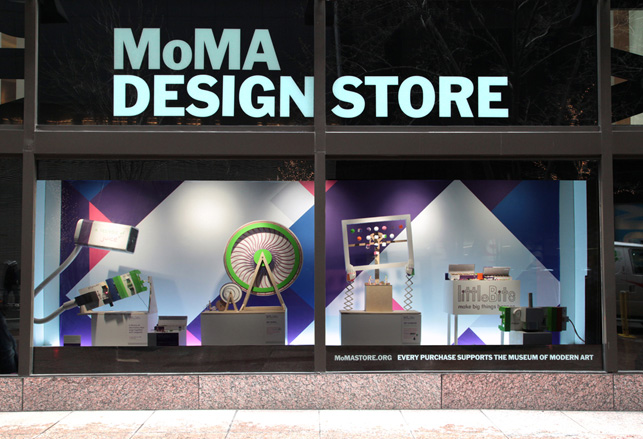
Completed window at the MoMA Design Store midtown Manhattan location
The MoMA Stores have devoted our New York retail windows to feature a very special little product, a product “big enough” to be included in the Museum’s own design collection. The windows include larger than life-size objects that flicker, move, and spin through the technology of littleBits, tiny circuit boards with specific functions engineered to snap together with magnets.
Although there are a million typefaces to choose from, MoMA Design Studio chose to only use one typeface for the majority of The Museum of Modern Art’s exhibition identities. Why?
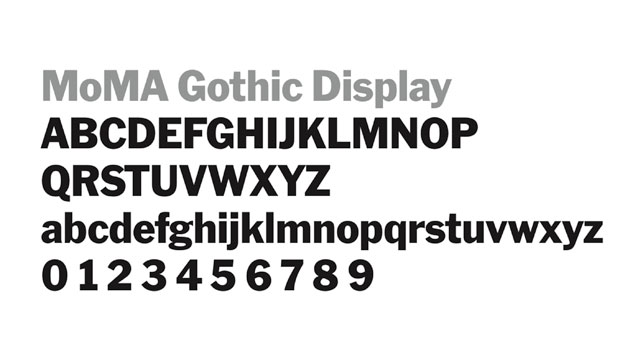
MoMA Gothic typeface. Typeface designed by Matthew Carter
At MoMA, we are tasked to design roughly 40 different title walls each year to accompany a wide variety of exhibitions. To manage workload, we made the decision four years ago to have two-thirds of the workload “templatized” by sticking to one typeface—our house font, MoMA Gothic (which is based on Franklin Gothic)—for all collection rotations.
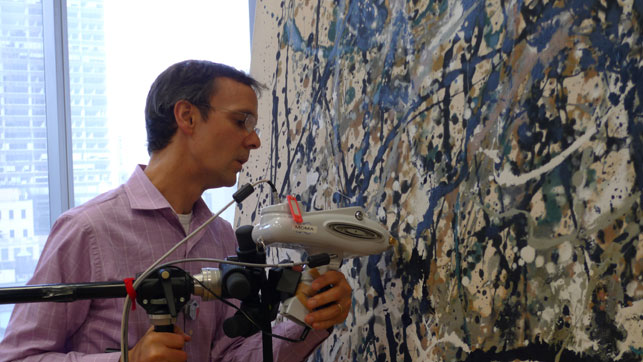
Conservation scientist Chris McGlinchey conducts elemental analysis using a handheld X-ray Fluorescence (XRF) analyzer
Empirical examination and scientific analysis are fundamental to conservation research and treatment; conservators frequently collaborate with scientists in order to clarify specific questions: to identify materials, elucidate degradation mechanisms, or test the efficacy of conservation methods.

The Unité d’Habitation was a landmark in modern architecture and design, and one of the first attempts to create highly designed spaces for low-income families. Along with apartments, the building included a half floor reserved for merchants, a pre-school, and a rooftop playground with wading pool and gymnasium. Le Corbusier was extremely efficient in the use of space, modeling his design on that of cruise ships,
If you are interested in reproducing images from The Museum of Modern Art web site, please visit the Image Permissions page (www.moma.org/permissions). For additional information about using content from MoMA.org, please visit About this Site (www.moma.org/site).
© Copyright 2016 The Museum of Modern Art