

Charles Silver, a curator in MoMA’s Department of Film, presents a series of writings to supplement the film exhibition An Auteurist History of Film. The following post accompanies the "D. W. Griffith at Biograph" program, which screens on October 15 in Theater 3 and on October 16 and 17 in Theater 2.
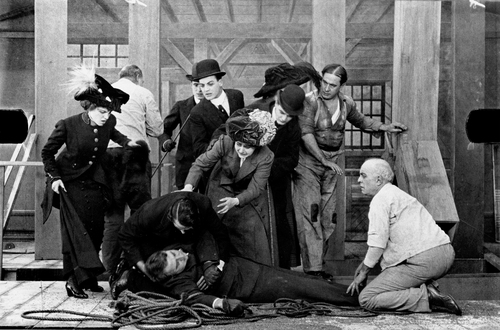
A Corner in Wheat. 1909. USA. Directed by D. W. Griffith. 35mm print, black and white, silent, approx. 15 min. Gift of Actinograph Corp. Preserved with funding from The Lillian Gish Trust for Film Preservation
Henri Matisse said, “My purpose is to render my emotion… I think only of rendering my emotion.”
Film history textbooks dutifully catalog the elements of cinematic grammar and expressiveness that D. W. Griffith invented or refined in his five years at Biograph (in collaboration with his cinematographer G. W. “Billy” Bitzer [1872–1944], who worked at the Museum Film Library late in his life, providing invaluable information on the Biograph films and preparing a posthumous autobiography)—a virtually endless list that includes close-ups, fades, masking, parallel editing, the moving camera or dolly shot, backlighting, changing camera angles, restrained histrionics through the cultivation of a stock company of professional film actors, “spectacle,” etc. Yet the salient point is that all of these essentially manipulative techniques served a larger purpose. Griffith’s great genius was his intuitive understanding of the inherent power of the movies to render emotion, to evoke feeling. No medium, before or since, has so thoroughly facilitated art’s capacity to touch that raw nerve, the primal and authentic human essence, and Griffith was the first filmmaker to fully grasp and exploit this fact. Fashions and conventions come and go, but at their best Griffith’s films—like all great art—are deeply felt expressions of what we are, of what it is like to be human.