

Charles Silver, a curator in MoMA’s Department of Film, presents a series of writings to supplement the film exhibition An Auteurist History of Film. The following post accompanies the “Actualities and Glimmerings of More”, which screens September 16, 17, and 18 in MoMA’s Celeste Bartos Theater (Theater 3).
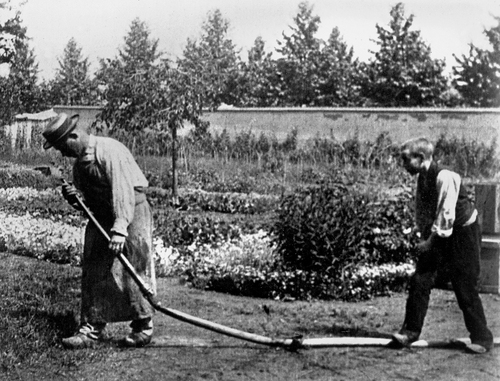
The Waterer Watered (aka The Sprinkler Sprinkled, or Watering the Flowers). 1895. France. Directed by Louis Lumière. 35mm print, black-and-white, silent, approx. 45 sec. Acquired from the artist
The Lumière brothers, Louis (1864–1948) and Auguste (1862–1954), are probably the closest we will ever come to identifying the first auteurs. Their role as “directors” largely consisted of finding a subject that interested them, plunking their camera (Cinematographe) down, and turning it on. This ultra-simple method was soon discarded by others as antiquated, although Andy Warhol brought it back (to considerable acclaim in some circles) some seventy years later. By sending film crews around the world to photograph the commonplace and the exotic, the Lumières effectively shrank the globe in ways never before deemed possible.
One of the things that intrigues me in seeing the people in these films—now 115 years removed from us—is that some of them, the middle-aged ones at least, may have shaken Abraham Lincoln’s hand; some of the elderly may have seen Napoleon marching through Paris. And yet, here they are, looking and moving much as we do, denizens of a world almost as strange to us as ours would be to them. They have achieved some level of immortality, and they embody one of the best arguments for film preservation: keeping our past alive.
The role played by Thomas Alva Edison (1847–1931) in the development of early cinema seems more in the realm of mystery than romance, more about profit and litigation than art. Edison’s focus on film was peripheral compared to many of his other endeavors, and he mostly left the field to associates like George Eastman (who invented the 35mm perforated celluloid film still used today) and William Kennedy Laurie Dickson (who built Edison’s Black Maria studio and more or less “directed” the first films Edison showed in his Kinetoscope peepshow parlors). Eastman went on to be a major philanthropist, and one of our sister film archives in Rochester is named after him. Dickson left Edison for the American Mutoscope and Biograph Company—Biograph, from whence sprang D. W. Griffith and the beginnings of modern cinema. Edison, “The Wizard of Menlo Park,” went on to sue everybody not under his control, and he finally left the film industry when antitrust action and the artistic inclinations of others made it no longer lucrative. For those who have never been there, the Edison Laboratory in Orange, New Jersey, is well worth a visit, and the Edison Tower now stands atop his original Menlo Park location.
Max Skladanowsky (1863–1939) was the German pretender to the Lumières’ throne. This graduate of Magic Lantern shows invented a cumbersome and not-very-efficacious projection system that provided Berliners with their first taste of the movies. These short films, whose existence in the Museum’s collection is a product of MoMA’s cofounding role—with the archive in Berlin under the Nazis and others—in the International Federation of Film Archives, were once classified as Skladanowsky Primitives, and they live up to the moniker.
Robert William Paul (1869–1943) and Cecil Hepworth (1874–1953), key figures in the early days of British cinema, are both exemplars of the inventor-turned-director route to auteur status. After a flurry of innovative experimentation, Paul gave up the movies in 1910. Hepworth, on the other hand, survived until the coming of talkies, making some thirty features along the way. Rescued by Rover contained plot elements that would serve D. W. Griffith three years later in his debut film, The Adventures of Dollie, and would inspire many subsequent animal-loving directors. (For an example, don’t miss two bravura performances by Shep the Thanhouser Collie in our Thanhouser: 100 Years film program, opening October 26.)