
MoMA
Posts in ‘An Auteurist History of Film’
December 22, 2009  |  An Auteurist History of Film
Send in the Clowns

These notes accompany the program Send in the Clowns, screening on December 23 and 24 in Theater 3.

While this is intended as a fun holiday program, a few comments might be in order. First, I should acknowledge my personal prejudice against slapstick. I have felt that Charles Chaplin and Buster Keaton rose to the heights of screen comedy by distancing themselves from their Sennett/Normand/Arbuckle roots. I know this hurts colleagues like our estimable pianist Ben Model and other friends, but the philosophy of “anything for a laugh” (evident also in most of Mel Brooks’s work and the early films of Woody Allen) seems incongruous to me, if we are talking about “ART.” I won’t even dignify The Three Stooges or Abbott and Costello (there go my other friends) with a mention. (So kindly disregard that mention.) Seriously, though, I have always sought out some logical structure, character development, or visual invention in determining the worthiness of a film. This doesn’t mean that I am incapable of laughing at silly antics, and I fully acknowledge that some of Keaton’s (The General, Steamboat Bill, Jr.) and Chaplin’s (Monsieur Verdoux, Limelight) greatest works can sometimes be painfully unfunny, but there is an imaginary line in what’s left of my brain that makes me distinguish between entertainment for its own sake and art. However, I don’t wish to rain on your parade or your holiday spirit. If nothing else, this program attempts to establish a lineage that eventually leads to greatness.
December 15, 2009  |  An Auteurist History of Film
And Yet More Competition: Walsh and Tourneur
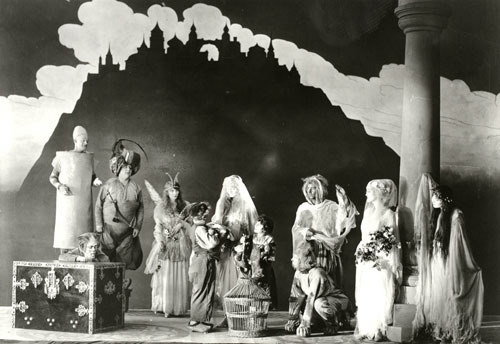
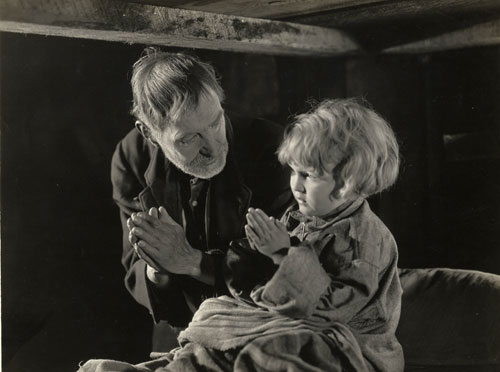
<i>The Blue Bird.</i> 1918. USA. Directed by Maurice Tourneur

The Blue Bird. 1918. USA. Directed by Maurice Tourneur

These notes accompany the program And Yet More Competition: Walsh and Tourneur on December 16, 17, and 18 in Theater 3.

The career of Raoul Walsh (1887–1980) represents the flip side of that of Mickey Neilan (see last week’s post). Both were rakish protégés of D. W. Griffith, but Walsh found the self-discipline and instinctive artfulness to manage a fifty-year directorial career. Although he worked in all genres, Regeneration speaks to his special facility with “gangster” films and the tragic destinies of their heroes. Some of his best films, including The Roaring Twenties (1939), High Sierra (1941), and White Heat (1949), fall into this category. Happy endings were not requisite, but he could still wax lyrical over the massacre of Custer in They Died with Their Boots On (1941). His auteurist personality was not always universally appealing. He occasionally had a penchant for sophomoric humor, as in his sequels to What Price Glory (his fine 1926 film adaptation of Laurence Stallings’s Broadway hit), which continued to pair Victor McLaglen and Edmund Lowe. Although not so important as John Ford or Howard Hawks, Walsh has an honored place in the history of Westerns. In Old Arizona (1928) is the first talkie shot largely on location, and The Big Trail (1930) is spectacularly inventive in its use of an experimental widescreen process. He worked productively with virtually everyone, from Humphrey Bogart to Mae West, and he discovered—and named—John Wayne. Walsh was an archetypal example of a studio director (Fox in the 1920s, Warner Brothers later) who accepted divergent assignments and managed to mold them into personal statements. Hollywood filmmaking would have been much poorer without him.

December 8, 2009  |  An Auteurist History of Film
More Competition: Neilan and Vidor
<i>The Jackknife Man.</i> 1920. USA. Directed by King Vidor

The Jackknife Man. 1920. USA. Directed by King Vidor

These notes accompany the screening of More Competition: Neilan and Vidor on December 9, 10, and 11 in Theater 3.

Marshall “Mickey” Neilan (1891–1958) was an archetypal example of a squandered talent, managing to cling to a twenty-plus-year directorial career before finally giving in to the allures of alcohol. (Many of the great directors suffered from this problem, but only John Ford seemed to control it by generally restricting his benders to between-film breaks.) Blanche Sweet, who had the “honor” of being married to Neilan, and whom he directed in The Sporting Venus (1925), told me a horror story about coming home to her brand new house and finding Mickey, John Barrymore, and other pals competing to see who could spit the most tobacco onto the ceiling. The “boy wonder” was essentially unemployable for the last twenty years of his life.

December 1, 2009  |  An Auteurist History of Film
D. W. Griffith’s Competitors: Ince and DeMille

These notes accompany the screening of D. W. Griffith’s Competitors: Ince and DeMille on December 2, 3, and 4 in Theater 3.

By the early 1910s there was a general awareness among film people that D. W. Griffith had brought something new to the medium and broadened the playing field. Rather than be intimidated, many ambitious young men who aspired to be directors followed Griffith’s lead—but also set out on their own path toward success. Thomas Ince (1882–1924) was one of the least intimidated. He shared Griffith’s experience as a not-very-successful stage actor who accidentally stumbled into the medium from which he would make his fortune. Unlike Griffith, however, Ince was highly organized and had a strong business sense. Twice he constructed his own studio, and he gradually fudged the lines between directing and producing, although he seems to have been highly adept at both. The early French film critic Louis Delluc made the distinction succinctly: “Griffith is cinema’s first director. Ince is its first prophet.”

November 24, 2009  |  An Auteurist History of Film
D. W. Griffith’s Intolerance
<i>Intolerance.</i> 1916. USA. Directed by D. W. Griffith. Acquired from the artist. Preserved with funding from the Celeste Bartos Film Preservation Fund

Intolerance. 1916. USA. Directed by D. W. Griffith. Acquired from the artist. Preserved with funding from the Celeste Bartos Film Preservation Fund

These notes accompany the screening of D. W. Griffith’s Intolerance on November 25 in Theater 2 and November 27 in Theater 3.

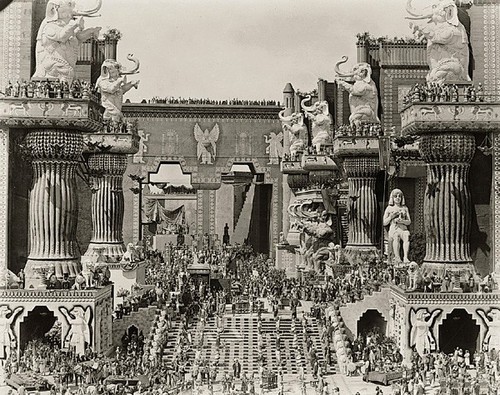
The humdrum life of a film archivist can occasionally be ameliorated by privileged moments. One of these was related to Intolerance (1916). Joseph Henabery (1888–1976) played Abraham Lincoln in The Birth of a Nation and had a small part in the French story of Intolerance. In 1916, under D. W. Griffith’s tutelage, he began a career as a director. Unlike some Griffith protégés (John Ford, Erich von Stroheim, Raoul Walsh), he never rose above the status of journeyman, although he did get to work with Douglas Fairbanks, Dorothy Gish, and Rudolph Valentino; he wound up making training films for the U.S. Army Signal Corps. Due to happy accident, Henabery’s real legacy lay elsewhere. When Griffith set out to recreate Babylon for Intolerance, he took a leaf from the book of Giovanni Pastrone, director of Cabiria (1914), doing serious research to ensure the authenticity of his recreation. Henabery was assigned to gather together photos and drawings of Babylonian buildings and art and compile them in a scrapbook for Griffith’s use. When Griffith’s papers were acquired by the museum by Iris Barry, the scrapbook was included. Henabery visited the Museum shortly before his death, and my colleagues and I had the pleasure of looking through his work of nearly sixty years earlier with him. The Babylonian set and the introductory crane shot that Griffith and cinematographer “Billy” Bitzer devised remain stunning. The movies had offered nothing like it before, and seldom had since.

November 17, 2009  |  An Auteurist History of Film
D. W. Griffith’s The Birth of a Nation

These notes accompany the screening of D. W. Griffith’s</em> The Birth of a Nation</a> on November 18 and 19 in Theater 3, and on November 20 in Theater 2.</p>


I have been struggling with The Birth of a Nation for nearly a half-century, since I first saw it as a teenager. On the one hand, it reaches the highest artistic plateau film had attained in its time, and it is probably, on balance, the most influential movie, in terms of technique, ever. On the other hand, it reeks of the conjugal evils of slavery and lethal white supremacy. How does one reconcile D. W. Griffith’s Leonardo-like genius with his sleazy acceptance of a worldview that is so shameful and repulsive? Can the excuses of slightly tempering the racism of Thomas Dixon’s The Clansman in his adaptation or of a nostalgic Confederate-soaked childhood be fully acceptable? How tolerable was this “blind spot”—as Atticus Finch termed racism in To Kill a Mockingbird—when it condoned the nineteenth-century Ku Klux Klan and helped start a new one in the twentieth century? And, does the film still matter as a social document? I would like to try to approach answers to these questions by begging your indulgence and recounting my personal journey (or journeys) as it relates to the film. Much of this will lie outside the scope of standard film history and criticism, but this is no ordinary film.

November 10, 2009  |  An Auteurist History of Film
Giovanni Pastrone’s Cabiria

These notes accompany the screening of Giovanni Pastrone’s Cabiria on November 11, 12, and 13 in Theater 3.

H. G. Wells published The Time Machine in 1895, simultaneous with the birth of the movies. By sending out their cadre of globetrotting cameramen, the Lumière brothers quickly opened up the world of the present (replete with all its regional oddities and exoticism) to film audiences. Wells mastered the speculative future in the tradition of Jules Verne, but perhaps even more intriguing for filmgoers was the possibility film offered to travel back in time and retrieve the distant past.

D. W. Griffith had dabbled in this (with his In Prehistoric Days, 1913, for example), but the real heavy lifting was done by the Italians. This is appropriate, since the thousand-year history of the Roman Republic and Empire was unrivaled in its impact on the contemporary world; Italy practically owned history. This was accentuated for visual artists by the poignant beauty of surviving ruins and statuary, both in Rome and spread over three continents. Italy’s heritage contributed mightily to the seeming authenticity of its celluloid spectacles.

November 3, 2009  |  An Auteurist History of Film
D. W. Griffith Leaves Biograph
Blanche Sweet in <i>Judith of Bethulia.</i> 1914. USA. Directed by D. W. Griffith. Acquired from the artist

Blanche Sweet in Judith of Bethulia. 1914. USA. Directed by D. W. Griffith. Acquired from the artist

These notes accompany the D. W. Griffith Leaves Biograph program, which screens on November 4, 5, and 6 in Theater 3 as part of the two-year </em>An Auteurist History of Film</a> exhibition.</span></p>

1915 marked the publication of poet Vachel Lindsay’s The Art of the Moving Picture, the first serious attempt in English to come to grips with the medium that had outgrown penny arcades and nickelodeons and was now threatening to appear in venues that would rival cathedrals. In the preceding year, as extraordinary European films like Benjamin Christensen’s The Mysterious X (released as Sealed Orders in the U.S.) and Giovanni Pastrone’s Cabiria were arriving on American shores, D. W. Griffith had been tearing at the seams of his constraining Biograph contract. As with so many early commentaries on the movies, Lindsay struggled to find the language that would do justice to his thoughts. (One thinks of a young Eugene O’Neill groping for words, or of Griffith himself, trying to articulate something previously undefined and unrecognized.) In fact, in his enthusiasm for film, indicative of the heady atmosphere of the times, Lindsay waxed positively Biblical, informing filmmakers:

“All of you who are taking the work as a sacred trust, I bid you God-speed…. You will be God’s thoroughbreds…. It has come then, this new weapon of men, and the face of the whole earth changes. In after centuries its beginning will be indeed remembered. It has come, this new weapon of men, and by faith and a study of the signs we proclaim that it will go on and on in immemorial wonder.”

October 28, 2009  |  An Auteurist History of Film
An Auteurist History of Film: "Two Danish Innovators"

Charles Silver, a curator in MoMA’s Department of Film, presents a series of writings to supplement the film exhibition An Auteurist History of Film. The following post accompanies the “Two Danish Innovators” program, which screens on October 28, 29, and 30 in Theater 3.

Der Student von Prag (The Student of Prague) has been called “the first real auteur film.” Actually, it appears now to have been a collaborative effort between director Stellan Rye (1880–1914), cameraman Guido Seeber (1879–1940), and star Paul Wegener (1874–1948), whom the same critic (Klaus Kreimeier) dubbed “the first modern German film actor.” Although the Danish Rye died fighting for Germany early in the First World War I, Seeber went on to photograph the 1914 version of The Golem and G. W. Pabst’s The Joyless Street and Secrets of a Soul. Wegener, a Max Reinhardt protégé, acted in or directed (or both) The Golem and its more famous 1920 remake, along with several Ernst Lubitsch films, Rex Ingram’s The Magician, and numerous films for the Nazis. In 1926, Henrik Galeen took Hanns Heinz Ewers’s story for The Student of Prague and remade it with the great Conrad Veidt as Der Student. Ewers was later the chronicler of Nazi icon Horst Wessel, who was made famous by Wegener’s 1933 film performance.

Rye’s film was a clear forerunner of the German Expressionist style and psyche, making it all the more a pity that he died so young, a tragedy that perhaps rivals Jean Vigo’s death at twenty-nine. Although shot in naturalistic locations in Prague, Rye’s imaginative facility with the camera evoked the Faust legend, E. T. A. Hoffman, and Edgar Allan Poe. If Rye had lived a normal lifespan, he might have been confronted with the choice between his native Denmark and his proto-Nazi compatriots and collaborators.

October 21, 2009  |  An Auteurist History of Film
An Auteurist History of Film: "The Scandinavian Connection"

Charles Silver, a curator in MoMA’s Department of Film, presents a series of writings to supplement the film exhibition An Auteurist History of Film. The following post accompanies the "The Scandinavian Connection" program, which screens on October 21, 22, and 23 in Theater 3.

Although Urban Gad (1879–1947) made a few films in Germany in the 1920s, during the golden age of Expressionism, his career had petered out by 1927. He clearly was not playing in the same league as Murnau, Lang, Pabst, Leni, Wiene, etc., and though an argument could be made that he anticipated some trends in Expressionism and that his use of eroticism was ahead of his time, his most significant contribution was the discovery of Asta Nielsen (1883–1972). Working in Germany, mostly with her then-husband Gad, Die Asta developed a restrained style of film acting, comparable to American counterparts like Lillian Gish and Mae Marsh. (To fully appreciate the achievement of these women, one should check out the staginess of Sarah Bernhardt’s film appearances from this period, although an elderly Eleanora Duse in Cenere managed quite well.) The actress performed Strindberg, Ibsen, Wedekind, and a cross-dressing Hamlet, but her most familiar role to Museum audiences would be in G. W. Pabst’s The Joyless Street (1925), the film that precipitated Greta Garbo’s coming to America. After appearing in just one talkie, she began a forty-year retirement (later to be topped by Garbo’s half-century “reclusion”), but it should be noted that at the age of seventy she undertook a second career, becoming a gifted collagist.