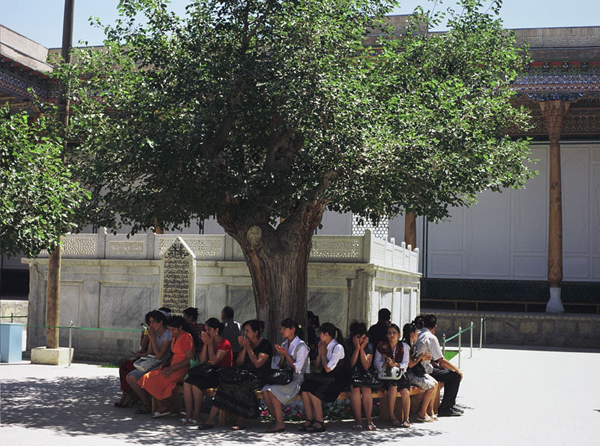
Female pilgrims at the tomb of Bahadur Al-Naqshband, Bukhara, Uzbekistan, 2011. Photo courtesy Slavs and Tatars



Female pilgrims at the tomb of Bahadur Al-Naqshband, Bukhara, Uzbekistan, 2011. Photo courtesy Slavs and Tatars
Sum of Days was initially exhibited at the Pinacoteca do Estado de São Paulo between August and November 2010. The invitation from MoMA to make a new version of the piece in the Marron Atrium was a great honor and a chance to reflect on the way the work exists independently of its setting, by seeing what would remain the same and what would be transformed in the new location.
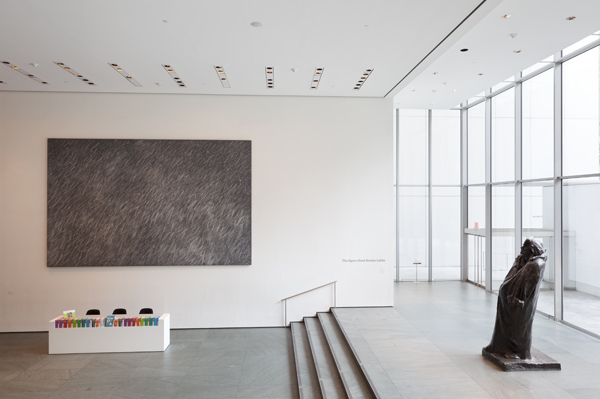
Installation view of The Agnes Gund Garden Lobby, The Museum of Modern Art, Fall, 2011. Photo: Jonathan Muzikar
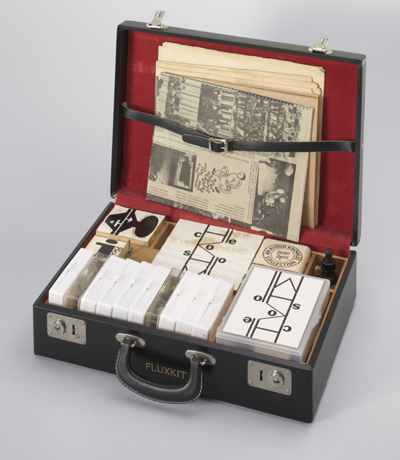
Fluxkit. 1965. Fluxus Edition announced 1964. The Museum of Modern Art. The Gilbert and Lila Silverman Fluxus Collection Gift
The opening of Thing/Thought: Fluxus Editions, 1962-1978 did not end on the evening of September 21, 2011. As part of the exhibition (on display in The Paul J Sachs Prints and Illustrated Books Galleries through January 16, 2012), six artists have been invited to participate in the exhibition’s organization by “unpacking” and arranging two Fluxkits—the signature compilation of objects by many Fluxus artists stored in black suitcases assembled by George Maciunas, a central organizer and participant. At different points throughout the run of the show, new artists will pull from the kits’ bounty—from posters to lentil beans—and have a hand in the making of this ever-evolving exhibition.
Of the line-up, which includes Alison Knowles, Dora Maurer, Anna Ostoya, Cory Arcangel, and William Pope.L, the first to put the kit to task is one who knows its form well: Mieko Shiomi. The Japanese-born composer and visual artist spent the early years of her career challenging her training as a classical musician. Exploring new possibilities of sound and composition, Shiomi famously made music with instruments’ unused parts. After rubbing shoulders with Tokyo-based artists who had spent time abroad in the early 1960s, including Nam June Paik, Yoko Ono, and Toshi Ichiyanagi, Shiomi left her native Japan, and joined the growing contingent of Fluxus artists in New York. Of the works that Shiomi created while working with Maciunas in New York, three (Endless Box, Events and Games, and Water Music) are components of the kits on display.
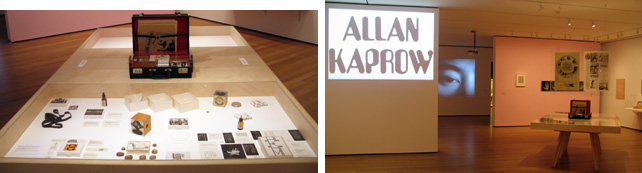
Although Shiomi’s stay with the Fluxus community in New York was short-lived, she has always overcome the limitations of her locality by embracing the mail service as a means for collaboration and artistic production. True to her ways, Shiomi sent the plans for her current arrangement for the Fluxkit to us from her home in Osaka via the U.S. postal service. Upon unfolding the long, scroll-like plan, my colleagues and I stood in admiration at the painstaking effort she put into the placement of each work. Shiomi’s masterful arrangement fills the cases entirely, and is ordered according to a system of grid-lines that distinguish each artist’s work from the next, while embedding them in a myriad of constellatory relations. While Shiomi certainly did not empty the Fluxkit suitcase entirely (and thus did prioritize certain works over others), the lyrical arrangement of the kit’s contents appears non-hierarchical—making one wonder what, in particular, Shiomi’s discerning hand adds to our understanding of the works before us.
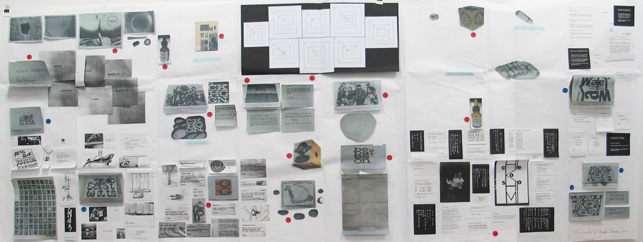
Mieko Shiomi's plan for her arrangement of Fluxkit. © 2011 Mieko Shiomi
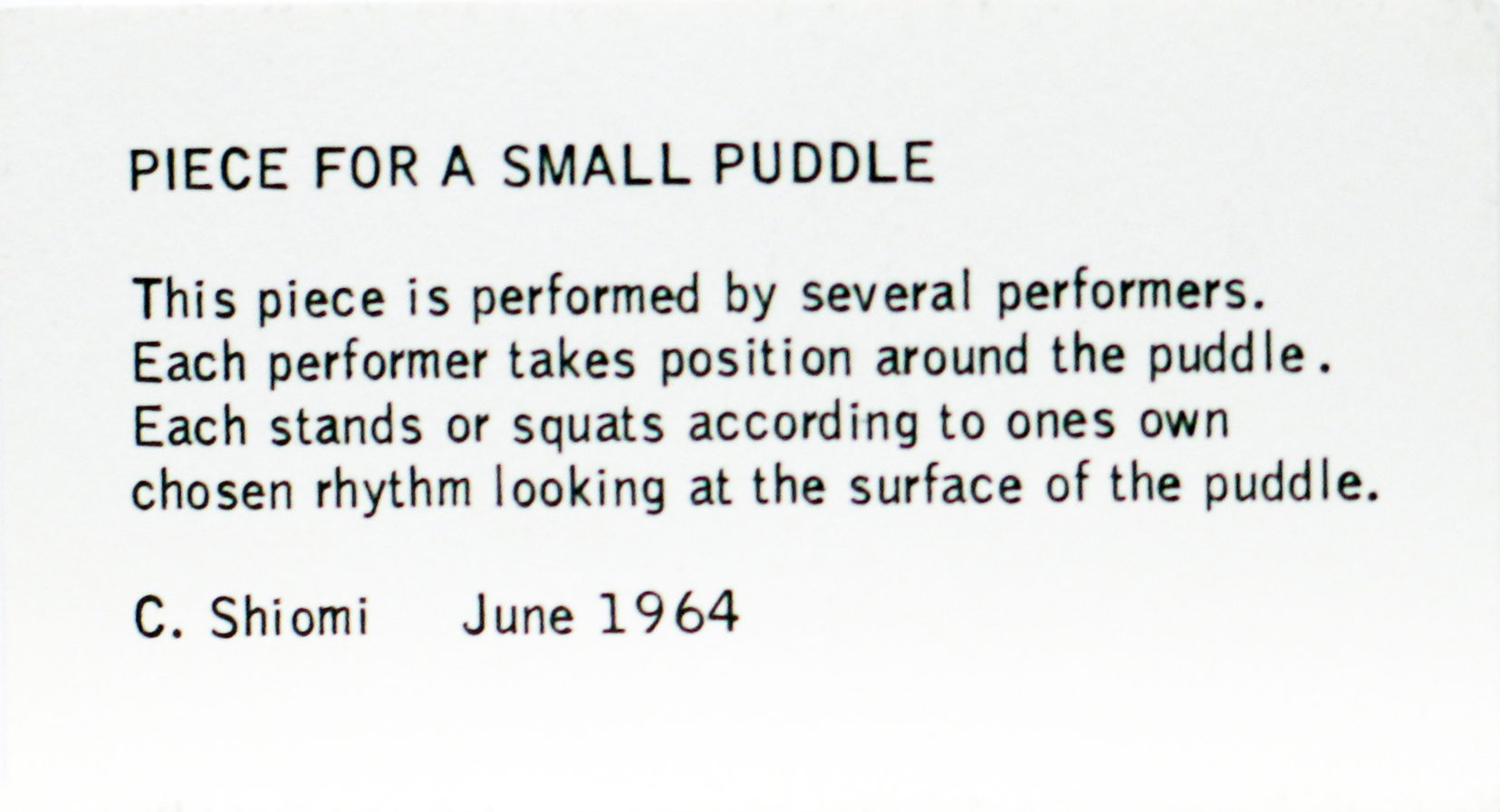
If meaning does not pop out blatantly before our eyes we may need to linger, look, and listen a little differently. We may even need to follow the artist’s lead. The instruction card shown on the right—from Shiomi’s Events and Games, which is on display in the kit—may shed some light on her approach to arranging the kit.
If nothing else, perhaps what we may glean from Shiomi’s display is the particular rhythm of its form—the way she peered upon the “puddle” of papers, cans, and cards. Like the event itself, Shiomi’s process concerns looking both intently and with multiple perspectives.
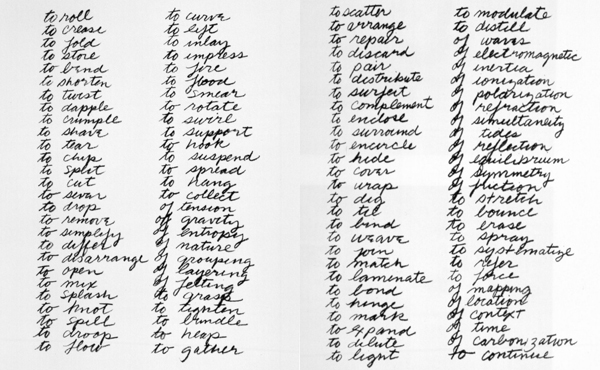
Richard Serra. Verb List. 1967–68. Graphite on paper, 2 sheets, each 10 x 8" (25.4 x 20.3 cm). The Museum of Modern Art, New York. Gift of the artist in honor of Wynn Kramarsky. © 2011 Richard Serra/Artists Rights Society (ARS), New York
A couple of weekends ago I walked around Manhattan’s Lower East Side in silence, holding a postcard with a rectangular hole cut out of it in front of me, seeing the city anew through a cardboard window. I was being led around by two artists on a “silent performative tour” of the area
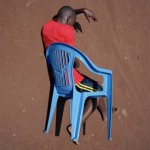
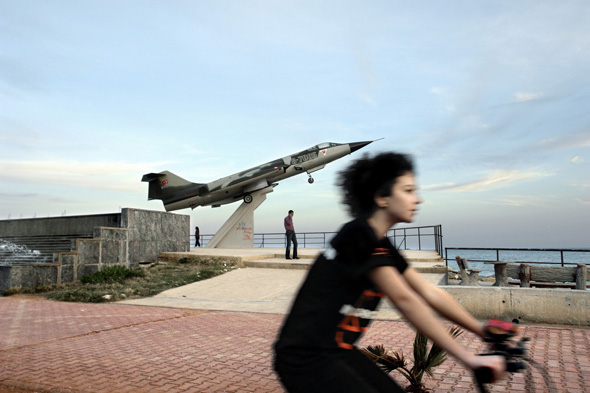
George Georgiou. Mersin. 2007. Pigmented inkjet print. Courtesy of the artist. © 2011 George Georgiou
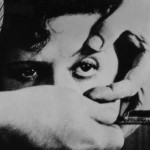

Luis Buñuel and Salvador Dalí. Un Chien andalou. 1928. France. 35mm print, black and white, silent, approx. 16 min. Gift of Luis Buñuel
Between 1964 and 1966 Andy Warhol commenced an ambitious project in which he would photograph, using 16mm motion picture film, his Factory superstars, art world luminaries, underground celebrities, fashionistas, rock and roll gods, bold-faced Hollywood names, drag queens, and aimless teenagers who gravitated to the avant garde, Pop art world of New York in the mid-1960s.


Raymond Pettibon. No Title (The bright flatness). 2003. Watercolor on paper. The Museum of Modern Art. The Judith Rothschild Foundation Contemporary Drawings Collection Gift, 2005
Recently my colleagues in MoMA’s Department of Film have blogged about their favorite summer films in tandem with the current film series Hot and Humid: Summer Films from the Archives and invited Inside/Out readers to suggest their own favorites.
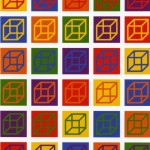
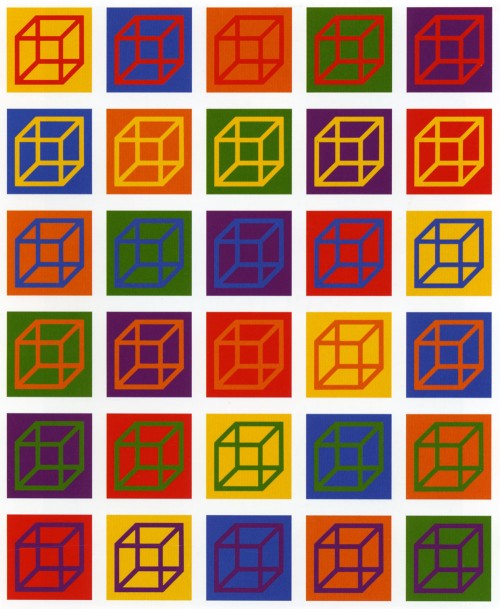
Sol LeWitt. Cubes in Color on Color. 2003. Portfolio of 30 linoleum cuts. Publisher: Arte y Naturaleza, Madrid. Printer: Watanabe Studio, Brooklyn, New York. Edition: 50. The Museum of Modern Art. Roxanne H. Frank Fund and General Print Fund
It must be the energy of summer that has thrown me into a general state of elation in which anything with a splash of color elevates my spirits. For instance, a recent trip to Dia:Beacon to see the exhibition Blinky Palermo: Retrospective 1964–1977 instantly brightened my experience there, in the same way that MoMA’s recently acquired work by Sol LeWitt, Cubes in Color on Color (2003) made my heart race with excitement.
If you are interested in reproducing images from The Museum of Modern Art web site, please visit the Image Permissions page (www.moma.org/permissions). For additional information about using content from MoMA.org, please visit About this Site (www.moma.org/site).
© Copyright 2016 The Museum of Modern Art