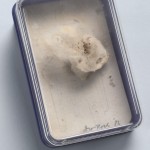
The title of the exhibition Wait Later This Will Be Nothing: Editions by Dieter Roth befits a number of the works on display that are slowly decomposing in front of spectators’ eyes. This post is dedicated to one particular pocket-sized perishable—Roth’s Pocket Room (Taschenzimmer) from MoMA’s Gilbert and Lila Silverman Fluxus Collection. In 1968, Dieter Roth—who challenged the boundaries of printmaking and publishing by integrating cheese, fruit, sausage, chocolate, and other organic materials into the process—released an unlimited edition comprising a banana slice on stamped paper tucked inside of a plastic container small enough to fit into the owner’s pocket.


Posts in ‘Artists’
March 28, 2013
|
Artists,
Collection & Exhibitions,
Fluxus
Exhibiting Fluxus: Decomposition Contained in Wait Later This Will Be Nothing: Editions by Dieter Roth
March 25, 2013
|
Artists,
Library and Archives
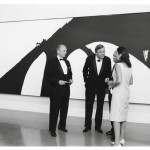
From the Archives: Robert Motherwell at MoMA, in His Own Words
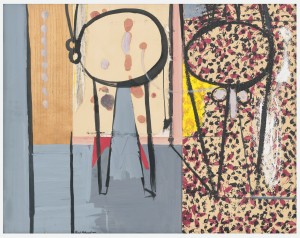
Robert Motherwell. Pancho Villa, Dead and Alive. 1943. Cut-and-pasted printed and painted papers, wood veneer, gouache, oil, and ink on board, 28 1/4 x 35 7/8″ (71.7 x 91.1 cm). Purchase. Art © Dedalus Foundation, Inc./Image permission granted by Dedalus Foundation, Inc.
One of the most fascinating aspects of working in the Museum Archives is uncovering how iconic artists engaged with MoMA beyond their artwork in the galleries. As one of the most celebrated Abstract Expressionist painters, Robert Motherwell has a rich exhibition history at the Museum that is traceable all the way back to 1944, when MoMA acquired its first work by Motherwell.
March 22, 2013
|
Artists,
Collection & Exhibitions,
Publications
Dieter Roth’s “Nothing” Is Really Quite Something
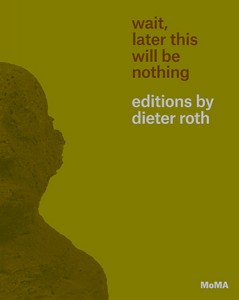
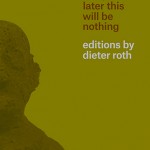
Cover of the exhibition catalogue Wait, Later This Will Be Nothing: Editions by Dieter Roth, published by The Museum of Modern Art
Pulled from Dieter Roth’s masterpiece, Snow (1964/69), the title of MoMA’s latest book initially reads as something of a dare to stick around: Wait, Later This Will Be Nothing: Editions by Dieter Roth. Whether from the curiosity to see how it ends or the desire to possess something fleeting, this call to action sparked our appetite to consume Roth’s editions slowly in order to savor what might not last.
March 20, 2013
|
Artists,
Collection & Exhibitions,
Videos
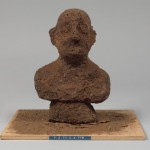
Wait, later this will be nothing. No really, I’ve seen it for myself.
Exhibition research often takes curators to archives, museums, private collections, and galleries. These are usually pristine spaces, where voices are hushed, light levels are low, and temperature and humidity are carefully controlled. But I experienced something very different as I investigated the work of Dieter Roth (Swiss, born Germany. 1930–1998), featured in the current exhibition Wait, Later This Will Be Nothing: Editions by Dieter Roth.
March 11, 2013
|
Artists,
Events & Programs,
Videos
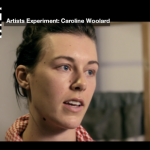
Artists Experiment: Meet Caroline Woolard
Artist, organizer, activist—these are only a few words to describe Caroline Woolard, one of our four collaborators for Artists Experiment. Collaboration and exchange are at the center of Woolard’s practice and this season, we’re bringing these ideas to MoMA’s education programs.
March 7, 2013
|
Artists,
Collection & Exhibitions
Dating Brandt
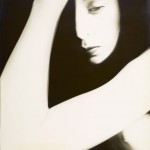
One of the underlying principles of Bill Brandt: Shadow and Light, currently on view in MoMA’s third-floor Photography Galleries, is the importance of vintage prints to understanding Brandt’s oeuvre—and by vintage print I mean a photographic print that was made around the same time as its negative. Anyone who visits the exhibition will surely be impressed by the fine quality of prints

March 4, 2013
|
Artists,
Events & Programs,
Videos
From Tijuana to New York: Raúl Cárdenas Osuna
New York City is the ultimate melting pot—from cuisine to culture, we have a little bit of everything here. What more could MoMA bring to this dynamic and exciting community? Artist, data expert, and all around amazing thinker Raúl Cárdenas Osuna of course!

February 25, 2013
|
Artists,
Events & Programs,
Videos
Archive as Impetus: Xaviera Simmons
What treasures do think you’d find if you spent months digging through MoMA’s Library collection? Just ask artist Xaviera Simmons! Xaviera is mining MoMA to trace the Museum’s history with political action through gesture. What does this mean?
February 22, 2013
|
Artists,
Conservation,
Jackson Pollock Project
MoMA’s Jackson Pollock Conservation Project: One: Number 31, 1950—Characterizing the Paint Surface Part 1
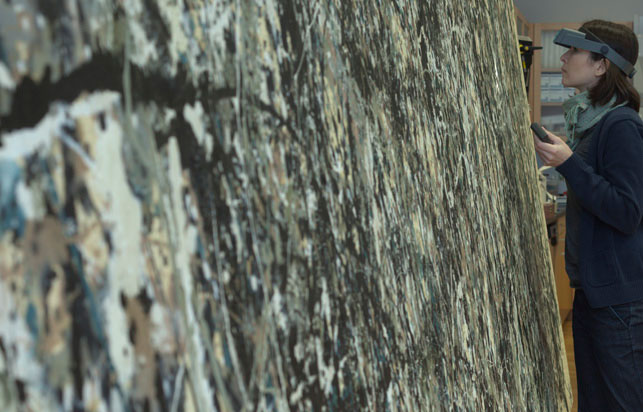
MoMA Assistant Conservator Jennifer Hickey inspects the paint surface of One: Number 31, 1950 under magnification
In our last post, we took a closer look at the variety of visual effects Pollock was able to achieve with his painting technique. We also observed some passages of paint that don’t appear to fit the typical characteristics of poured house paint. So we set out to investigate this seeming inconsistency.
February 18, 2013
|
Artists,
Behind the Scenes,
Collection & Exhibitions
Louise Bourgeois: A Flashback of Something that Never Existed
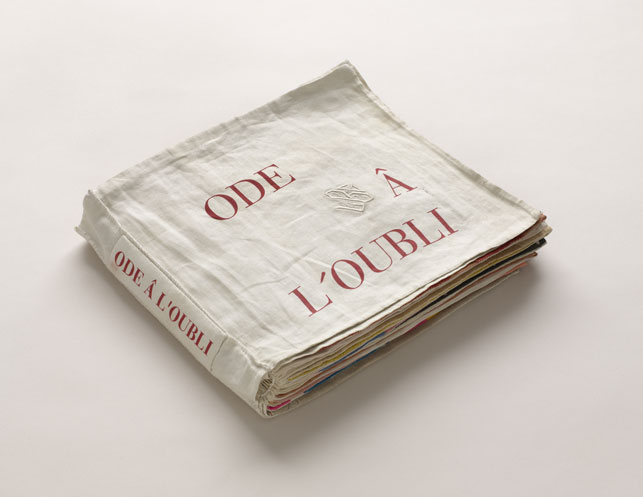
Louise Bourgeois. Ode à l’oubli. 2002. Fabric illustrated book with 35 compositions: 32 fabric collages, 2 with ink additions, and 3 lithographs (including cover), page (each approx.): 11 3/4 x 13” (29.8 x 33 cm); overall: 11 x 12 3/16 x 1 ¾” (28 x 31 x 4.5cm). © 2013 Louise Bourgeois Trust
The first installment of MoMA’s new online project Louise Bourgeois: The Complete Prints & Books includes Bourgeois’s fabric book Ode à l’oubli. In 2002, at the beginning of her 90th decade, Bourgeois constructed the book’s linen binding and pages out of 60-year-old, monogrammed hand towels from her 1938 wedding.
If you are interested in reproducing images from The Museum of Modern Art web site, please visit the Image Permissions page (www.moma.org/permissions). For additional information about using content from MoMA.org, please visit About this Site (www.moma.org/site).
© Copyright 2016 The Museum of Modern Art
Welcome to MoMA.org. To take full advantage of all the site’s features, including the option to save works in the collection, please upgrade your browser to Firefox,
Google Chrome, Safari, or Internet Explorer 9.
See our help page for more information.
To take full advantage of all of the features on MoMA.org, please upgrade your browser to Firefox, Google Chrome,
Safari, or Internet Explorer 9.