Not on view
In these x-rays of Pregnant Woman, hollow areas within the sculpture appear in black, while denser areas appear lighter. The white squiggly lines are pieces of sculptor's wire that Picasso used both to provide structural support for the plaster exterior, and to connect the different pieces of the assemblage. The dramatic profile view of the sculpture shows just a thin outline around the woman's breasts and distended abdomen; these parts are made from empty ceramic vessels. Another piece of ceramic material can be seen arching backwards from the top of the woman's forehead down to her shoulder. The silhouetted nails that appear to float throughout the sculpture are actually driven into pieces of wood, which do not appear clearly in the x-ray image.
Conservation Notes, X-Ray Analysis for Picasso's Pregnant Woman, August 2008.
Gallery label from Focus: Picasso Sculpture , July 3–November 3, 2008.
The potted jars and vase that compose this figure's breasts and distended womb are plainly visible and refer, perhaps, to Picasso's own ceramic work. Françoise Gilot, who lived with Picasso from 1946 until 1953, said that she believed the artist made Pregnant Woman as a type of wish fulfillment when she refused to have a third child.
Focus: Picasso Sculpture, July 3–November 3, 2008.
Explore more
Pablo Picasso
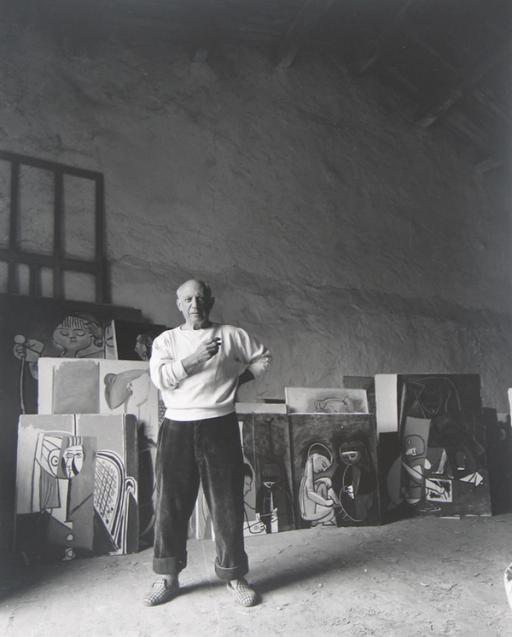
Spanish, 1881–1973 1257 works onlineWith these words, Picasso shed light on two central principles of his artistic production over nearly 80 years: his openness to a diverse range of styles, subject matters, and mediums, and his resistance to the notion that change in art necessarily corresponds to improvement or progress.
Learn more →

From MoMA Design Store


Installation views
We have identified this work in the following photos from our exhibition history.
Licensing
Artwork or archival images
If you would like to reproduce an image of a work of art in MoMA's collection, or an image of a MoMA publication or archival material (including installation views, checklists, and press releases), please contact Art Resource (publication in North America) or Scala Archives (publication in all other geographic locations).
Audio and film clips
MoMA licenses archival audio and select out of copyright film clips from our film collection. At this time, MoMA produced video cannot be licensed by MoMA/Scala. All requests to license archival audio or out of copyright film clips should be addressed to Scala Archives at [email protected]. Motion picture film stills cannot be licensed by MoMA/Scala. For access to motion picture film stills for research purposes, please contact the Film Study Center at [email protected]. For more information about film loans and our Circulating Film and Video Library, please visit Circulating Film and Video Library.
Text from a publication or the archives
If you would like to reproduce text from a MoMA publication, please email [email protected]. If you would like to publish text from MoMA's archival materials, please fill out this permission form and send to [email protected].
Feedback
This record is a work in progress. If you have additional information or spotted an error, please fill out this feedback form.