Baked enamel on steel units over baked enamel on aluminum
Not on view
LeWitt's work emerged alongside the Minimalist and Conceptual art movements of the 1960s, and combines qualities of both. Like the Minimalists, he often uses simple basic forms, in the belief that "using complex basic forms only disrupts the unity of the whole"; like the Conceptualists, he starts with an idea rather than a form, initiating a process that obeys certain rules, and that determines the form by playing itself out. The premise of Serial Project demands the combination and recombination of both open and closed enameled aluminum squares, cubes, and extensions of these shapes, all laid in a grid. Both intricate and methodical, the system produces a visual field that gives its viewers all the evidence they need to unravel its logic.
In a text accompanying Serial Project, LeWitt wrote, "The aim of the artist would not be to instruct the viewer but to give him information. Whether the viewer understands this information is incidental to the artist; he cannot foresee the understanding of all his viewers. He would follow his predetermined premise to its conclusion avoiding subjectivity. Chance, taste, or unconsciously remembered forms would play no part in the outcome. The serial artist does not attempt to produce a beautiful or mysterious object but functions merely as a clerk cataloging the results of his premise."
The Museum of Modern Art, MoMA Highlights, New York: The Museum of Modern Art, revised 2004, originally published 1999, p. 272.
Publication excerpt from MoMA Highlights: 375 Works from The Museum of Modern Art, New York (New York: The Museum of Modern Art, 2019)
Serial Project, I (ABCD) combines and recombines open and closed enameled aluminum squares, cubes, and extensions of these shapes, all laid out in a grid that rests on the floor. Both intricate and methodical, the sculpture’s system produces a visual field that gives viewers all the information they need to unravel its logic.
Reacting against the heroic ideals that guided much postwar American painting, LeWitt advocated for an art that was, he said, “mentally interesting” but “emotionally dry.” Color, line, and form, he believed, could be handled objectively, as elementary visual units rather than expressive devices. He turned to modular and serial permutation to define and manifest these concepts.
In a text accompanying this work, LeWitt outlined his highly methodical approach: “The aim of the artist would not be to instruct the viewer but to give him information. Whether the viewer understands this information is incidental to the artist; he cannot foresee the understanding of all his viewers. He would follow his predetermined premise to its conclusion avoiding subjectivity. Chance, taste, or unconsciously remembered forms would play no part in the outcome. The serial artist does not attempt to produce a beautiful or mysterious object but functions merely as a clerk cataloging the results of his premise.”
MoMA Highlights: 375 Works from The Museum of Modern Art, New York (New York: The Museum of Modern Art, 2019)
Explore more
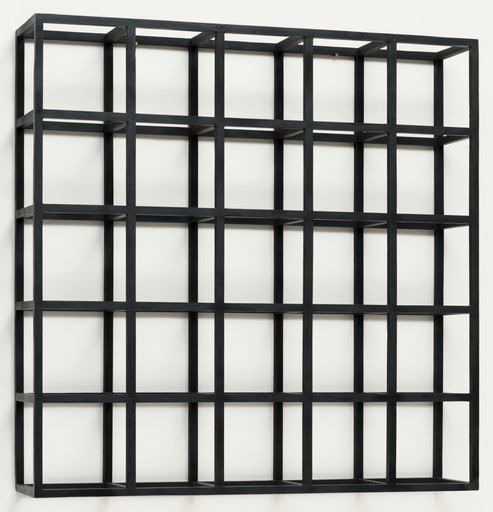
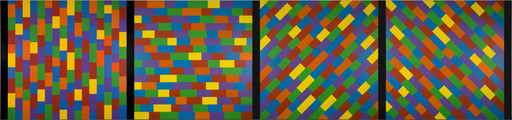
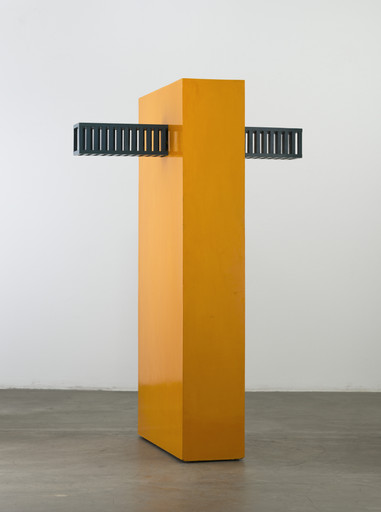
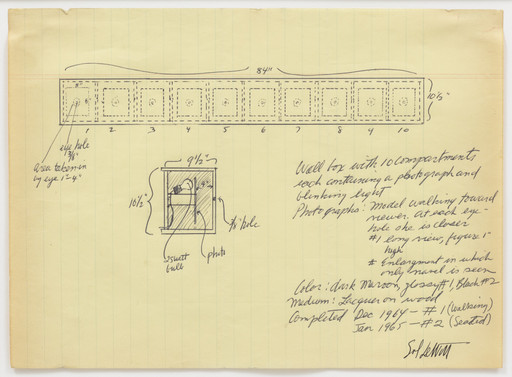
Minimalism
A primarily American artistic movement of the 1960s, characterized by simple geometric forms devoid of representational content. Relying on industrial technologies and rational processes, Minimalist artists challenged traditional notions of craftsmanship, using commercial materials such as fiberglass and aluminum, and often employing mathematical systems to determine the composition of their works.
Learn more →


Audio
Audio from the playlist Kids
From MoMA Design Store


Installation views
We have identified this work in the following photos from our exhibition history.
Licensing
Artwork or archival images
If you would like to reproduce an image of a work of art in MoMA's collection, or an image of a MoMA publication or archival material (including installation views, checklists, and press releases), please contact Art Resource (publication in North America) or Scala Archives (publication in all other geographic locations).
Audio and film clips
MoMA licenses archival audio and select out of copyright film clips from our film collection. At this time, MoMA produced video cannot be licensed by MoMA/Scala. All requests to license archival audio or out of copyright film clips should be addressed to Scala Archives at [email protected]. Motion picture film stills cannot be licensed by MoMA/Scala. For access to motion picture film stills for research purposes, please contact the Film Study Center at [email protected]. For more information about film loans and our Circulating Film and Video Library, please visit Circulating Film and Video Library.
Text from a publication or the archives
If you would like to reproduce text from a MoMA publication, please email [email protected]. If you would like to publish text from MoMA's archival materials, please fill out this permission form and send to [email protected].
Feedback
This record is a work in progress. If you have additional information or spotted an error, please fill out this feedback form.