Although it is hung on a wall like a painting, Untitled (Stack) projects nearly three feet from the wall and climbs like rungs on a ladder from floor to ceiling. It is made of galvanized iron boxes, all identical and of equal importance. The space around the boxes is also important. The sides are covered with commercially available green lacquer paint typically used to customize Harley-Davidson motorcycles. The tops and bottoms are bare metal. Each of the 12 boxes is nine inches high, and they are spaced nine inches apart. Depending on the height of the ceiling where Untitled (Stack) is displayed, the number of units may be reduced to maintain proper spacing between them. This flexibility reflects the importance of the whole work of art over its individual parts.
Donald Judd ignored traditional craft skills in favor of an overriding system or idea. He wanted his work to suggest an industrial production line. In fact, Judd had his works made in a factory in order to obtain a perfect finish without having to rework the material. The box was one of Judd’s favorite forms, because he felt it was neutral and had no symbolic meaning.
Gallery label from Collection: 1940s—1970s, 2019
Judd once wrote, “The main virtue of geometric shapes is that they aren't organic, as all art otherwise is.” Untitled is made of rectangular metal boxes: a simple geometric form the artist favored because he felt it carried no symbolic meaning. The spaces between the units are equal to each unit’s height. Depending on the height of the ceiling where the work is displayed, the number of units may be adjusted. By using a predetermined system, Judd circumvented the spontaneous decisions artists often face during the art-making process. Like many of his peers, he used new industrial materials and fabrication processes—in this case, galvanized iron and green lacquer paint typically used in auto body shops—and had the work welded at a sheet-metal shop.
Collection: 1940s—1970s, 2019
Publication excerpt from MoMA Highlights: 375 Works from The Museum of Modern Art, New York (New York: The Museum of Modern Art, 2019)
Starting out as a painter among the generation of artists that succeeded the Abstract Expressionists in New York, Judd quickly grew disillusioned with painting’s limitations. “The main thing wrong with painting is that it is a rectangular plane placed flat against the wall,” Judd wrote in his famous essay from 1965, “Specific Objects.” In response, he conceived of a lexicon of three-dimensional forms that would exist in “real space,” as he put it. Rather than portraying recognizable imagery, Judd’s blunt sculptures adhere to elemental geometric form and serial order. And yet, throughout his career, Judd retained a painter’s penchant for striking optical choices, often deploying color and reflective surfaces to stunning effect.
One of Judd’s favored forms was the “stack,” of which this untitled work is a signature example. Judd’s stacks consist of cantilevered boxes—typically ten but here twelve—hung vertically on the wall at equal intervals. The spaces between the units are equal to each unit’s height, thereby establishing a rhythmic alternation between open and closed volumes that extends from floor to ceiling. Created three years after Judd began inviting industrial fabricators to make his artworks, this sculpture was constructed from galvanized iron in a sheet-metal shop according to the artist’s specifications, and then coated in automobile paint. In authoring work that was ultimately built by commercial fabricators and composed of durable materials far removed from the realm of fine art, Judd presented a new direction for sculpture.
MoMA Highlights: 375 Works from The Museum of Modern Art, New York (New York: The Museum of Modern Art, 2019)
Explore more
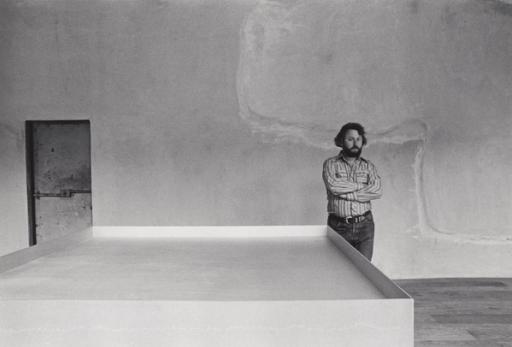
Donald Judd
American, 1928–1994 79 works onlineDonald Judd is a landmark figure in the history of postwar art. In the 1950s, he studied philosophy and art history and took classes at the Art Students League in New York.
Learn more →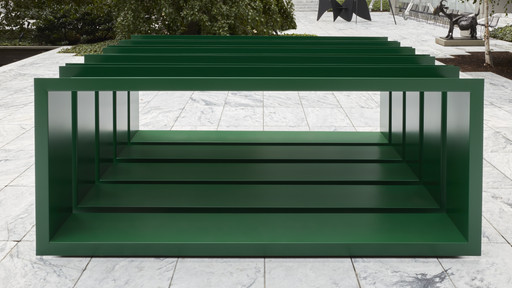
Minimalism
A primarily American artistic movement of the 1960s, characterized by simple geometric forms devoid of representational content. Relying on industrial technologies and rational processes, Minimalist artists challenged traditional notions of craftsmanship, using commercial materials such as fiberglass and aluminum, and often employing mathematical systems to determine the composition of their works.
Learn more →



Audio
Audio from the playlist Judd
From MoMA Design Store


Installation views
We have identified this work in the following photos from our exhibition history.
Licensing
Artwork or archival images
If you would like to reproduce an image of a work of art in MoMA's collection, or an image of a MoMA publication or archival material (including installation views, checklists, and press releases), please contact Art Resource (publication in North America) or Scala Archives (publication in all other geographic locations).
Audio and film clips
MoMA licenses archival audio and select out of copyright film clips from our film collection. At this time, MoMA produced video cannot be licensed by MoMA/Scala. All requests to license archival audio or out of copyright film clips should be addressed to Scala Archives at [email protected]. Motion picture film stills cannot be licensed by MoMA/Scala. For access to motion picture film stills for research purposes, please contact the Film Study Center at [email protected]. For more information about film loans and our Circulating Film and Video Library, please visit Circulating Film and Video Library.
Text from a publication or the archives
If you would like to reproduce text from a MoMA publication, please email [email protected]. If you would like to publish text from MoMA's archival materials, please fill out this permission form and send to [email protected].
Feedback
This record is a work in progress. If you have additional information or spotted an error, please fill out this feedback form.